
 Worksheets
Paper 1
Total questions: 25
Worksheet time: 13mins
Where is DNA stored in a cell?
Lysosomes
Golgi Complex
Ribosomes
Nucleus
When using the microscope, you should always start with this objective lens
low power
high power
Controls what enters and leaves the cell
Cell membrane
Ribosome
Chloroplast
Vacuole
Which is NOT an example of an organelle
Mitochondrion
Nucleus
Heart
Cell membrane
Which existed on earth first?
eukaryotes
prokaryotes
Active transport into a cell means the cell needs?
Water and a semipermeable membrane
Energy and a membrane with carrier proteins
Cell membranes with protein channels
Sodium and a protein channel
What is the process for making another DNA copy of a chromosome?
transcription
translation
replication
chromatin
The enzyme that unwinds the DNA to prepare for replication?
replicase
helicase
polymerase
What is the medium in which most processes of life occur?
Fire
Air
Soil
Water
Ideally, your cells should be in a(n) _______ solution
Hypertonic
Hypotonic
Isotonic
A student noticed that placing wilted lettuce in a bowl of cool water caused the lettuce to become more crisp and firm. What is the best explanation for his observation?
Water moved into the lettuce cells by active transport.
Water moved into the lettuce cells by osmosis.
Salt moved into the lettuce cells by diffusion.
Water moved out of the lettuce cells by osmosis.
You are in a lifeboat drifting in the ocean for 3 days and all the water is finished... You are thirsty and see an ocean full of water. Should you drink the sea water?
No. It's hypertonic to your cells
No. It's hypotonic to your cells
No. It's isotonic to your cells
No. It's paratonic to your cells
Yes. Go for it. Stay alive as long as you can

Which biomolecule is a main source of quick energy?
Nucleic Acid
Protein
Lipid
Carbohydrate
Which of the following is a phenotype?
BB
Bb
bb
Blue eyes
Genotype refers to the ...
physical expression of the genes
the possible combination of alleles in a gene
whether an allele is dominant or recessive
how an organism will appear
What are the basic building blocks of DNA and RNA?
ribose
purines
nucleotides
phosphorus
Transgenic organisms are produce by ______________
transformation
test cross breeding
genetic engineering
inbreeding
What carries food from the pharynx to the stomach?
larynx
trachea
esophagus
bronchioles
Where does the process of digestion begin?
mouth
esophagus
stomach
small intestine
What enzyme is found in saliva that starts digesting carbohydrates?
bile
amylase
pepsin
chyme
Where does the absorption of nutrients from food take place?
stomach
liver
small intestine
large intestine
What are the rhythmic muscular contractions of your esophagus called to help food move along?
swallowing
peristalsis
inertia contractions
paralysis
What is a population?
One individual member of a species
a group of individuals of the same species that live in the same area
a community of different species and their environment
An organism that helps to recycle nutrients within an ecosystem by eating dead or decaying organisms is a:
Predator
Autotroph
Producer
Decomposer
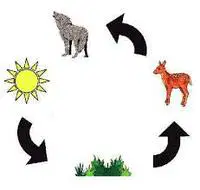
Where does the energy start in this food chain?
Plant
Sun
Deer
Wolf

