
NEW
Font size
 Worksheets
The Second and Third Law of Thermodynamics
Total questions: 17
Worksheet time: 12mins
In the process of trying to cool a substance to the lowest possible temperature, which law of thermodynamics is the reason why we cannot achieve absolute zero?
1st
2nd
3rd
Zeroth

Hot steel ball bearings are dropped into a large bucket of cool water. Which graph BEST represents the changes in temperature that will occur?


A solid object heated to 120°C is placed inside a container of water at 37°C. What is the BEST explanation of the resulting change in temperature?
The temperature of both the water and solid will decrease.
The temperature of the solid will decrease and the water will decrease.
The temperature of the water will remain constant; the temperature of the solid will decrease
The temperature of the water will increase; the temperature of the solid will decrease.
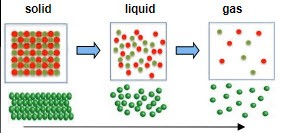
In the transition from ice to water and then to steam, why does entropy increase?
Molecular disorder increases
Molecular randomness decreases
Molecules are more energetic
Molecules are more reactive
In a melting ice cube, ___________ is the randomness or disorder of the system as it changes from solid to liquid.
Temperature
Heat
Entropy
Energy

In a closed room where a party is happening and everyone is dancing, the entropy of the room tends to ______________.
increase
decrease
stay constant
fluctuate wildly
The efficiency of an ideal machine is 100% but an actual machine's efficiency will always be less than 100%because of the second law of thermodynamics which states that
energy is neither created or destroyed, it changes form
energy is released into the environment as light energy.
energy is released into the environment as thermal energy
energy is released into the environment as sound energy.
Entropy is the amount of disorder in a system. The third law of thermodynamics explains the conditions for attaining minimum entropy. Which fundamental process will get a system to this state?
James heats a metal rod to 75°C and drops it into a bucket of tap water. How does the motion of the water molecules change as a result?
When water at 0°C freezes, the entropy of the water
An ideal gas undergoes an isothermal expansion. During this process, its entropy
Which of the following is a false statement?
Entropy is a quantitative measure of disorder.
The entropy of an isolated system must be conserved (it remains constant)
Entropy can be measured in units of J/K
When ice melts into water spontaneously, the entropy of the universe decreases.
True
False
In a busy kitchen, what does entropy describe?
The transition of energy from the stove to the pot.
The level of mess and disorganization in the kitchen.
The process of heat transfer from the hot stove to a pot through direct contact.
The emission and absorption of light from the kitchen lights.
Which picture shows the correct transfer of heat if you drop ice cold metal rods into a pot of boiling water?


The second law of thermodynamics leads us to conclude that
the total energy of the universe is constant
disorder in the universe is increasing with the passage of time.
it is theoretically possible to convert heat into work with 100% efficiency
the average temperature of the universe is increasing with the passage of time
During a phase change from liquid to gas, what happens to the entropy of the substance?
The entropy significantly decreases.
The entropy slightly decreases.
The entropy remains constant.
The entropy significantly increases.

