
 Worksheets
Biogeochemical Cycles
Total questions: 40
Worksheet time: 26mins


Which cycle are fossil fuels (oil, coal, natural gas) part of?
carbon
water
nitrogen
phosphorus
Which cycle DOESN'T have an atmosphere component (part)?
carbon
nitrogen
phosphorus
water

Which one of these does not add CO2 to the atmosphere?
cooking with gas
planting trees
burning wood
riding in a bus


Identify the cycle pictured.
The Water cycle
The Carbon cycle
The Nitrogen cycle
The Phosphorus cycle.

Identify the cycle pictured.
The Water cycle
The Carbon cycle
The Nitrogen cycle
The Phosphorus cycle.
Too much phosphorus in waterways (rivers, lakes) can lead to___________.
eutrophication
Nothing
Death
diseases

The burning of fossil fuels is known as...
Decomposition
Photosynthesis
Combustion
Respiration
The burning of fossil fuels is known as...
Decomposition
Photosynthesis
Combustion
Respiration
___________ is the process by which dead matter is broken down into simpler substances by detritivores.
Respiration
Decomposition
Combustion
Photosynthesis
Animals inhale oxygen and exhale....
CH4
CO2
NH3
N2O
Legumes provide starches for nitrogen fixing bacteria and nitrogen fixing bacteria add nitrogen to the soil for legumes to use. This relationship is best described as...
Commensalism
Parasitism
Predation
Mutualism
Eutrophication occurs when a body of water has too many nutrients leading to an increased population of....
Fish
Algae
Legumes
Bacteria
Which type of organisms are responsible for turning nitrogen gas into a form useable by other organisms?
Animals
Plantae
Fungi
Bacteria
Excess fertilizers might enter into an aquatic ecosystem through...
Precipitation
Evaporation
Transpiration
Runoff

Can animals consume Nitrogen directly from the air?
No
Yes
What is it called when water changes from liquid to gas
freezeing
evaporation
condensation
How is water returned to earth?
evaporation
transpiration
precipitation
percolation
When warm, evaporated air rises, it cools and begins to turn into liquid again. This part of the water cycle is called:
a: transpiration
b: precipitation
c: runoff
d: condensation
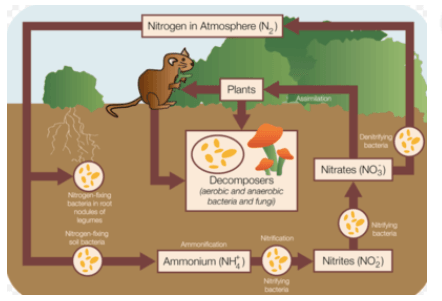
A correct path that nitrogen could take would be
air -> animals -> plants -> bacteria
animals -> air -> bacteria -> plants
bacteria -> air -> plants -> animals
air -> bacteria -> plants -> animals
Most of the phosphorus in the biosphere is stored in ____
rocks
atmosphere
clouds
ocean
How would phosphorus cycle from grass to a deer?
decay
grazing
sediment
erosion
Which one of these is not considered a biological process?
Nitrogen Fixation by bacteria
Consumption by animals
Elimination of Waste by animals
Erosion
How does a non-human living organism affect the water cycle? (short answer/fill in the blank)
Trees allow transpiration
Animals drink it
All of the above
Hills can cause runoff
How do non-human living things affect the carbon cycle (fill in the blank/short answer)
animals do cellular respiration
plants do photosynthesis
Fires release carbon into the atmosphere
All of the above
How do non-human living things participate in the nitrogen cycle? (fill in the blank/short answer)
Bacteria decompose organic matter (decomposition)
animals move nitrogen during consumption
Bacteria convert waste into ammonia (ammonification)
All of the above

