
 Worksheets
Ch 6: States of Matter Quiz
Total questions: 69
Worksheet time: 35mins
Which term refers to the resistance of a fluid to flow?
Solid
Surface tension
Viscosity
Vapor
What is the term for the elastic-like force existing at the surface of a liquid?
Gas
Viscosity
Vapor
Surface tension
Which of the following is not a state of matter?
Solid
Liquid
Vapor
Viscosity
What is matter?
Anything that takes up space and has volume
Only liquids and gases
Only solids and liquids
Only objects we can see
What are the most common states of matter?
Solid, Liquid, Gas
Solid, Liquid, Plasma
Liquid, Gas, Plasma
Solid, Gas, Bose-Einstein Condensate
What is plasma?
A state of matter with very low energy
A state of matter that is only found on Earth
A high energy matter with positive and negative charged particles
The most common state of matter on Earth
Where is plasma most commonly found?
In the ocean
On Earth's surface
In space because it's found in stars
Inside solid objects
Where can plasma be found on Earth?
In rivers and lakes
In lightning and created in fluorescent and neon lights
In the Earth's core
In the atmosphere as air
How can matter be described according to the text?
Only by its state
By its state, color, texture, and odor
By its state and mass only
By its color and density only
What is mass?
The amount of space matter takes up
The color of an object
The amount of matter in an object
The texture of an object
What units are used to measure mass?
Liters or milliliters
Cubic centimeters or cubic meters
Grams or kilograms
Cubic centimeters or grams per milliliter
What is volume?
Mass per unit volume
The amount of matter in an object
The amount of space matter takes up
The density of an object
Which units are used to measure the volume of liquids?
Grams or kilograms
Cubic centimeters or cubic meters
Liters or milliliters
Grams per cubic centimeter or grams per milliliter
What is density?
The color of an object
The amount of space matter takes up
Mass per unit volume
The texture of an object
Does density change with the size of the matter?
Yes, it increases as the size increases
Yes, it decreases as the size increases
No, it remains constant no matter the size of the matter
Density is not related to the size of the matter
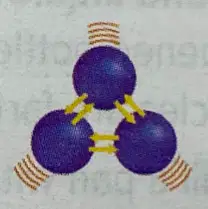
What do the yellow arrows represent?
The direction of particle movement
The attractive forces between particles
The repulsive forces between particles
The speed of particle movement
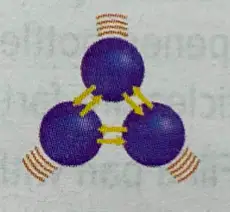
What do the red lines represent?
The movement of particles
The distance between particles
The energy of particles
The heat within the particles

Why are there more red lines in the second diagram than the first?
Because the particles are moving slower
Because the particles are moving faster and the distance between them increases
Because the particles are more energetic
Because the temperature is lower
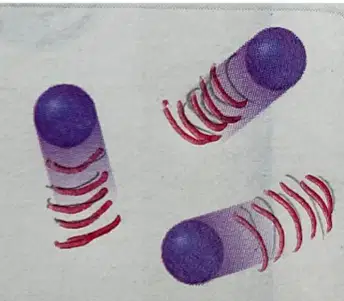
Why are yellow arrows absent from the third diagram?
Because the particles are not moving
Because the particles are moving too fast to have attractive forces
Because the attractive forces between particles are very weak
Because the distance between particles is very small
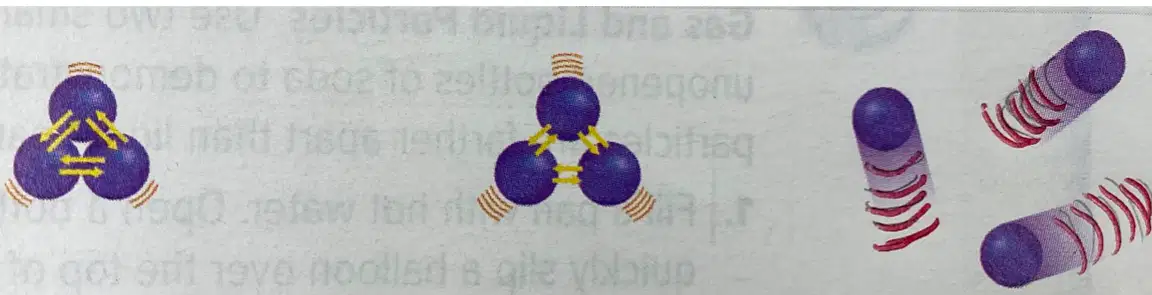
Which state of matter does each picture represent?
Solid, liquid, gas
Liquid, solid, gas
Gas, liquid, solid
Solid, gas, liquid
Which state of matter has particles that are closely packed in a fixed position?
Solid
Liquid
Gas
Plasma
Which state of matter has particles that are free to move around but still touch each other?
Solid
Liquid
Gas
Bose-Einstein Condensate
Which state of matter has particles that are well separated and move freely?
Solid
Liquid
Gas
Superfluid
Do solids have a definite shape and volume?
Yes, both
No, neither
Only a definite shape
Only a definite volume
How are the particles in a liquid arranged?
Tightly packed
Randomly and freely moving
Far apart and more freely moving than liquid
Vibrate in place
What kind of particle movement do gases exhibit?
Vibrate in place
Slide past each other
Move in straight lines with much space between
No movement at all
Which state of matter has the weakest attractive forces between particles?
Solid
Liquid
Gas
Both solid and liquid
What is viscosity a measurement of in a liquid?
The liquid's ability to conduct electricity
The liquid's resistance to flow
The liquid's transparency
The liquid's color intensity
Which factors can affect the viscosity of a liquid?
Particle mass, shape, and strength of particle attraction
The amount of liquid
The container shape
The altitude at which the liquid is measured
What happens to the viscosity of a liquid when it is heated?
It increases
It does not change
It decreases
It becomes solid
What is surface tension a result of?
Gravity acting on the surface of a liquid
Attraction between different molecules
Attraction between similar molecules
Repulsion between similar molecules
What is vapor?
A liquid state of a substance at room temperature
A solid state of a substance at high temperature
A gaseous state of a substance that is normally a solid or liquid at room temperature
A plasma state of a substance under extreme pressure
What type of solid has a regular, repeating pattern?
Amorphous
Liquid
Crystalline
Gas
Which of the following is an example of an amorphous solid?
Diamond
Water
Charcoal
Oxygen
What property is demonstrated by honey's high resistance to flow?
Density
Viscosity
Opacity
Elasticity
Which substance is likely to have low viscosity?
Honey
Syrup
Water
Tar
What determines the state of matter?
Particle motion only
Particle forces only
Particle motion and particle forces
Temperature and color
How do particles in matter behave according to the text?
They move in a zigzag pattern.
They move in a straight line until they collide with something.
They are always stationary.
They move in circular paths.
What happens when atoms in matter move slowly and stay close together?
The matter becomes a gas.
The matter becomes a liquid.
The attraction between atoms is broken.
The attraction between atoms is strong and the matter is a solid.
What state of matter is formed when atoms speed up and move apart?
Solid
Liquid
Gas
Plasma
What occurs when atoms move very far apart?
The matter becomes a solid.
The matter becomes a liquid.
The attraction between atoms can be broken and the matter becomes a gas.
The atoms form a plasma.
What is the definition of surface tension?
The force that acts on the particles at the bottom of a material
The force that acts on the particles at the surface of a material
The force that acts between liquid molecules that are far apart
The force that acts only on solid materials
Which of the following is an example of surface tension?
A rock sinking in water
Water striders walking on water
A sponge absorbing water
Water evaporating from a surface
What is a common experience that demonstrates surface tension?
Swimming smoothly in water
Doing a painful belly flop
Drinking through a straw
Freezing water into ice
Which term refers to the resistance of a fluid to flow?
Solid
Vapor
Viscosity
Surface tension
What is the process called when a gas turns into a liquid?
Sublimation
Deposition
Vaporization
Condensation
What does Boyle's law relate to?
Temperature and volume
Pressure and volume
Volume and gas
Pressure and temperature
What does Charles' law relate to?
Temperature and volume
Pressure and volume
Volume and gas
Pressure and temperature
What does the kinetic molecular theory describe?
The behavior of gases
The process of evaporation
The change of state from solid to gas
The increase in pressure due to temperature
What are the factors that determine whether matter will be solid, liquid, or gas?
Temperature and pressure
Color and texture
Size and shape
Mass and volume
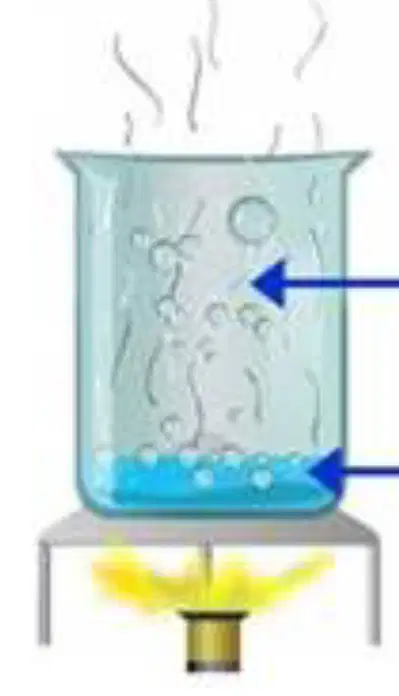
What is the process shown in the diagram where water changes from liquid to gas called?
Condensation
Evaporation
Sublimation
Freezing
What is the process called when a liquid turns into a gas?
Freezing
Melting
Evaporation
Sublimation
What is the process called when a gas turns into a liquid?
Condensation
Deposition
Sublimation
Evaporation
What is the process called when a gas turns directly into a solid?
Melting
Freezing
Deposition
Condensation
What is the process called when a gas turns directly into a solid?
Condensation
Deposition
Sublimation
Evaporation
What is the process called when a solid turns into a liquid?
Condensation
Melting
Evaporation
Sublimation
What is the process called when a liquid turns into a solid?
Sublimation
Deposition
Evaporation
Freezing
What is kinetic energy?
Energy stored in an object due to its position
Energy of an object due to its motion
Energy related to the temperature of an object
Energy released during a chemical reaction
What is potential energy?
Energy stored in an object due to its position
Energy of an object due to its motion
Energy related to the temperature of an object
Energy released during a chemical reaction
What is thermal energy?
Energy of an object due to its motion
Energy stored in an object due to its position
Energy related to the temperature of an object
Energy released during a chemical reaction
Which state of matter has the most kinetic energy (K.E.)?
Solid
Liquid
Gas
Plasma
Which state of matter has the least kinetic energy (K.E.)?
Solid
Liquid
Gas
Plasma
How are temperature and kinetic energy (K.E.) related?
As temperature decreases, K.E. decreases
As temperature increases, K.E. decreases
Temperature and K.E. are not related
As temperature increases, K.E. increases
How are chemical potential energy (P.E.) and particle distance related?
Greater distance between particles means less chemical P.E.
Greater distance between particles means greater chemical P.E.
Particle distance does not affect chemical P.E.
Chemical P.E. only depends on temperature
How do thermal energy and temperature differ?
Thermal energy is the sum of kinetic and potential energy, while temperature is the average kinetic energy
Thermal energy is the average kinetic energy, while temperature is the sum of kinetic and potential energy
Thermal energy and temperature are the same
Thermal energy is only potential energy, while temperature is only kinetic energy
What is the process called when a substance changes from a solid to a gas?
Condensation
Deposition
Sublimation
Evaporation
What is the term for the change from gas to solid?
Melting
Freezing
Deposition
Evaporation
During melting, which factor remains constant?
Temperature
Volume
Mass
Time
What must be added to matter to change it from a solid to a liquid?
Cold
Heat
Pressure
Mass

