wayground logo

Free Printable Worksheets

Font size

S
M
L
XL
Worksheets

SCIENCE 7 AARON 3RD MONTLHY EXAM

Total questions: 62

Worksheet time: 1hrs 3mins

Name
Class
Date
1.

It is the network of organs and tissues that help you breathe.

a)

digestive system

b)

nervous system

c)

circulatory system

d)

respiratory system

2.

What is the purpose of the respiratory system?

a)

takes in oxygen and releases nitrogen

b)

takes in carbon dioxide and releases oxygen

c)

takes in oxygen and releases carbon dioxide

d)

takes in nitrogen and releases oxygen

3.

Openings that pull air from outside your body into your respiratory system.

a)

sinuses

b)

mouth and nose

c)

bronchial tubes

d)

lungs

4.

Passage connecting your throat and lungs.

a)

pharynx

b)

bronchial tubes

c)

diaphragm

d)

trachea

5.

Bones that surround and protect your lungs and heart.

a)

ribs

b)

diaphragm

c)

pleura

d)

larynx

6.

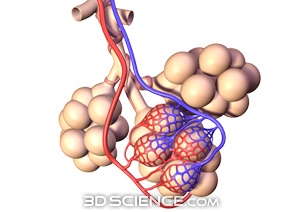
Tiny air sacs in the lungs where the exchange of oxygen and carbon dioxide takes place.

a)

bronchioles

b)

lung lobes

c)

alveoli

d)

capillaries

7.

Hollow organ that allows you to talk and make sounds when air moves in and out.

a)

pharynx

b)

larynx

c)

trachea

d)

cilia

8.

Our respiratory system helps us...

a)

absorb oxygen into our body.

b)

absorb nutrients from the food that we eat.

c)

protect our body from bacteria

d)

circulate oxygen

9.

Muscle that helps your lungs pull in air and push it out.

a)

diaphragm

b)

alveoli

c)

heart

d)

trachea

10.

This area warms, moisturizes, and filters air before going to the lungs.

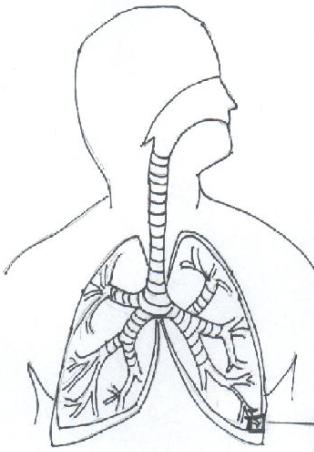
Which system does this image represent?oes this image represen

a)

trachea

b)

nose

c)

mouth

d)

nasal cavity

11.

What are the smaller branches of the bronchi called?

a)

bronchioles

b)

alveoli

c)

larynx

d)

lungs

12.

This condition occurs when the airway is narrowed due to inflammation of the bronchi.

a)

lung cancer

b)

asthma

c)

emphysema

d)

cystic fibrosis

13.

What do humans need to breathe in from the air?

a)

hydrogen

b)

carbon monoxide

c)

carbon dioxide

d)

oxygen

14.

What gas do plants take in that animal/humans breathe out?

a)

carbon monoxide

b)

carbon dioxide

c)

nitrogen oxide

d)

oxygen

15.

This sudden infection of your airways is usually caused by a virus.

a)

cystic fibrosis

b)

acute bronchitis

c)

emphysema

d)

tuberculosis

16.
the process by which the body obtains and uses oxygen and removes carbon dioxide and water.
a)
breathing
b)
respiration
c)
digestion
d)
circulation
17.
Number 6 is pointing to which organ of the Respiratory System
a)
Nose
b)
Lung
c)
Diaphragm
d)
Bronchi Tube
18.
Which 2 substances are exchanged in the Respiratory System?
a)
oxygen and nitrogen
b)
carbon dioxide and oxygen
c)
oxygen and glucose
d)
glucose and carbon dioxide
19.
The windpipe is also known as which organ?
a)
Lung
b)
Trachea
c)
Alveoli
d)
Nose
20.
The place in the lungs where oxygen and carbon dioxide are exchanged 
a)
Diaphragm
b)
Alveolus
c)
Bronchi Tube
d)
Trachea
21.
Number 11 is pointing to which organ of the Respiratory System?
a)
Alveoli
b)
Lungs
c)
Bronchi Tubes
d)
Bronchioles
22.
Letter D is pointing to which Respiratory organ?
a)
Alveoli
b)
Diaphragm
c)
Lung
d)
Bronchi
23.
Letter B is pointing to which organ of the Respiratory System?
a)
Nose
b)
Trachea
c)
Lungs
d)
Diaphragm
24.
When the diaphragm contracts and moves down, the lungs are...
a)
expanding with air
b)
shrinking - pushing air out
25.
When the diapragm relaxes and moves back up, the lungs are...
a)
expanding with air
b)
shrinking - pushing air out
26.
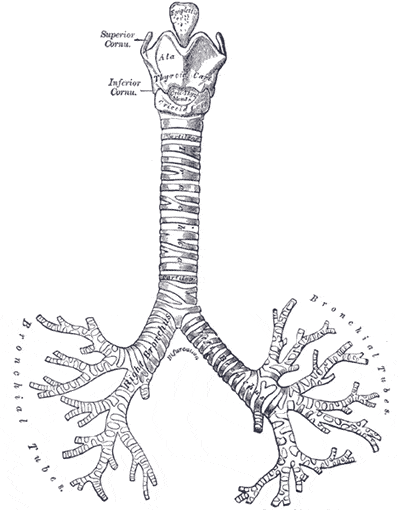
What is the function of the bronchi?
a)
Transport air from nose to lungs
b)
Transport air from trachea to lungs
c)
Transport air from lungs to alveoli
d)
Transport air from alveoli to blood
27.
The two main branches from the trachea (one to each lung)
a)
bronchi
b)
alveoli
c)
capillaries
d)
bronchioles
28.
Flap of skin that covers the opening to the windpipe during swallowing
a)
Stomach
b)
Trachea
c)
Pancreas
d)
Epiglottis
29.
The larynx is also known as the...
a)
Voice box
b)
Passage to the lungs
c)
Long vein
d)
Airway
30.
We receive oxygen and take out what from our bodies ? 
a)
Our need to live 
b)
Carbon Dioxide 
c)
Molecules unneeded to the body. 
d)
Chemicals needed to the body . 
31.
Why is the diaphragm important to the respiratory system ?  
a)
It contracts or expands air from the lungs.
b)
It helps the system to digest. 
c)
It helps the system to do its main functions. 
d)
It helps decrease the carbon dioxide in the system. 
32.
The air sacs that are covered with capillaries where gas exchange takes place
a)
bronchi
b)
lungs
c)
oxygen
d)
alveoli
33.
Air enters the respiratory system through the:
a)
Trachea
b)
Nose and mouth
c)
Bronchi
d)
Diaphragm
34.
The role of the mucus and and cilia in the respiratory system is to....
a)
warm the air. 
b)
clean the air.
c)
humidify the air. 
d)
All of the choices are true. 
35.
What does the cilia do in the respiratory syestem ?
a)
The cilia carries food and air through the respiratory system. 
b)
The cilia is known to be part of a cell. 
c)
Cilia filters particles that enter the nose. 
d)
Cilia contains the vocal chords. 
36.
spasm of the diaphragm
a)
cough
b)
sneeze
c)
hiccup
d)
yawn
37.
Which of the following is NOT part of a neuron?
a)
dendrite
b)
axon
c)
myelin sheath
d)
medulla oblongata
38.
Which are the main divisions of the nervous system?
a)
afferent and efferent
b)
peripheral and central
c)
somatic and autonomic
d)
sympathetic and parasympathetic
39.
What is the central nervous system made up of?
a)
brain and spinal cord
b)
cranial and spinal nerves
c)
sensory and motor systems
d)
sympathetic and parasympathetic systems
40.
What is the main function of the cerebellum?
a)
Consciousness
b)
sensory reception
c)
homeostatsis
d)
muscle coordination
41.
What is the largest part of the brain?
a)
Cerebellum
b)
Cerebrum
c)
brain stem
d)
medulla oblongata
42.
What is responsible for heartbeat, breathing, and blood pressure?
a)
midbrain
b)
pons
c)
medulla oblongata
d)
cerebrum
43.
What part of the brain is responsible for thought and planning?
a)
frontal
b)
parietal
c)
temporal
d)
occipital
44.
What part is responsible for visual processing?
a)
frontal
b)
parietal
c)
temporal
d)
occipital
45.
Which neurons carry messages from the brain to the body?
a)
sensory neuron
b)
motor neuron
c)
interneuron
d)
afferent
46.
Which system controls involuntary responses?
a)
somatic
b)
autonomic
c)
sympathetic
d)
parasympthetic
47.
What is number 1?
a)
dendrite 
b)
axon
c)
cell body
d)
myelin sheath
48.
What is number 4?
a)
dendrite
b)
axon 
c)
cell body
d)
myelin sheath
49.
What is number 5?
a)
cell body
b)
nucleus
c)
axon terminal
d)
synapes
50.
What is number 2?
a)
Cerebrum
b)
Cerebellum
c)
brain stem
d)
spinal cord
51.
What is number 6?
a)
Cerebrum
b)
Cerebellum
c)
brain stem
d)
spinal cord
52.

What part of your brain controls your voluntary muscle movements as well as interprets senses?

a)

Cerebellum

b)

Cerebrum

c)

Spinal Cord

d)

Nerves

53.

What are the three major parts of your brain?

a)

Cerebrum

b)

Nerves

c)

Cerebellum

d)

Spinal Cord

e)

Brain Stem

54.

What part of your brain controls involuntary muscle movements?

a)

olfactory

b)

Cerebrum

c)

Brain Stem

d)

cerebellum

55.

What part of your brain is responsible for coordinating muscle movements between the voluntary and involuntary muscles?

a)

Cerebellum

b)

Cerebrum

c)

Brain Stem

d)

Nerves

56.

If your voluntary and involuntary muscles both work, but they do not work together, what part of your brain might be damaged?

a)

Nerves

b)

Cerebrum

c)

Brain Stem

d)

Cerebellum

57.

What is the number 2 pointing to?

a)

brain stem

b)

cerebrum

c)

cerebellum

d)

spinal cord

58.

What is the number 1 pointing to?

a)

Spinal Cord

b)

Brain Stem

c)

Cerebellum

d)

Cerebrum

59.

How do your nerves work?

a)

They carry messages back and forth from the brain to the rest of the body

b)

The send messages only to the spinal cord

c)

They only receive messages from the spinal cord

d)

They really don't work. They are lazy and want everything done for them.

60.

Why is your spinal cord important?

a)

Because it holds our spine together

b)

Because all communication needs to travel through the spinal cord, towards and away from the brain.

c)

Because it controls our senses

d)

It's not

61.

What other systems does your nervous system work with?

a)

Circulatory

b)

Respiratory

c)

Skeletal

d)

Muscular

e)

Immune

62.

Which of the following is one of Mr. Gantt's favorite words?

a)

Lobe

b)

Medulla Oblongata

c)

Spinal Cord

d)

Cerebellum