
 Worksheets
Intro to Probability Practice
Total questions: 20
Worksheet time: 40mins

A regular 6-sided die is to be rolled once. What is the probability that a number less than 3 is rolled?
1/3
1/6
1/2
2/3

A spinner has 8 equal regions. Each region is marked with one of the following numbers: 10, 20, 30, 40, 50, 60, 70, 80. What is the probability of an even number being spun on the first roll?
1/8
1/2
1
3/8

There are 3 red marbles, 4 blue marbles, 2 green marbles, and 6 clear marbles in a burlap bag. One marble is randomly pulled from the bag. What is the probability the marble was green?
1/2
1/7
2/15
2/17

If you select a marble without looking, how likely is it that you will pick a black one?
certain
probable
unlikely
impossible
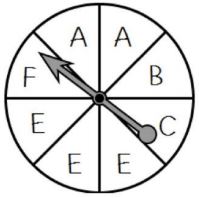
Which of the following statements is true?
A valid probability will always be between -1 and +1
An event that is impossible to occur has a probability of 1.00
An event that must happen has a probability of 1.00
In a valid probability model, all probabilities add to 100
Which of the following statements is false?
A complement for event A will always be found by 1−P(A)
Mutually exclusive events have no outcomes in common
The Law of Large Numbers applies to a situation after many, many trials
Theoretical probability will always equal empirical probability

How many outcomes are there for spinning the wheel?
4
8
16
32
Calculate P(Right Hand)
0.16
0.25
0.75
0.93
Calculate P(YellowC)
0.16
0.25
0.75
0.93
Calculate P(Foot)
0.16
0.25
0.50
0.75
Are the events "Landing on Green" and "Landing on Right Foot" mutually exclusive? Explain.
No; there are outcomes of the events in common
No; the probability of this to occur is 0
Yes; there are outcomes of the events in common
Yes; the probability of this to occur is 0
Even though commercial airlines have excellent safety records, in the weeks following a crash, airlines often report a drop in the number of passengers, probably because people are afraid to risk flying. A travel agent suggests that since the Law of Averages makes it highly unlikely to have two plane crashes within a few weeks of each other, flying soon after a crash is the safest time. What do you think?
The "Law of Averages" states that outcomes must even out in the short run. This means that the overall probability of an airplane crash is lower due to recent crashes.
The "Law of Averages" does not apply to this situation. The overall probability of an airplane crash does not change due to recent crashes.
The "Law of Averages" states that outcomes must even out in the short run. This means that the overall probability of an airplane crash is higher due to recent crashes.
There is no such thing as the "Law of Averages." The overall probability of an airplane crash does not change due to recent crashes
List the sample space and determine if the events are equally likely.
Roll two dice; record the sum of the numbers
S={1,2,3,4,5,6} ; the outcomes are equally likely
S={1,2,3,4,5,6} ; the outcomes are not equally likely
S={2,3,4,5,6,7,8,9,10,11,12} the outcomes are equally likely
S={2,3,4,5,6,7,8,9,10,11,12} the outcomes are not equally likely
List the sample space and determine if the events are equally likely.
Toss 2 coins; record the order of heads and tails.
S={HH,HT,TT} ; the outcomes are equally likely
S={HH,HT,TT} ; the outcomes are not equally likely
S={HH,HT,TH,TT} the outcomes are equally likely
S={HH,HT,TH,TT} the outcomes are not equally likely

A sports analyst is studying the number of goals scored during the first half of a particular soccer tournament. Is the probability distribution shown to the right valid? Explain.
No; the individual probabilities do not sum to 1
No; there is at least 1 probability below 1, which creates an invalid distribution
Yes; all probabilities add to 1, and each individual probability is between 0 and 1
Yes; there are no more than 5 probabilities expressed in the distribution, following the Law of Large Numbers

