
 Worksheets
Intro to Psych Quiz 2 Revision
Total questions: 46
Worksheet time: 3575secs


If a dog hears a whistle that a person cannot hear, this suggests that dogs and humans have different
kinesthesis systems.
Gestalt ratios.
absolute thresholds
vestibular systems.
A psychologist studying signal detection theory would be most interested in
subliminal advertising
messages.
the ability of a person to gain information without using the five senses
the minimum amount of light a person can see.
how a radio operator distinguishes between blips on a radar screen.
If we did not have cones in our eyes, we would not see
colors
shapes
sizes
distant objects
Damage to the olfactory nerve might prevent a person from
seeing a traffic light change.
hearing birds chirp.
smelling freshly baked bread.
feeling the texture of
a curtain.
Sensation
opening in the iris that regulates the amount of light entering the eye
the tendency to perceive certain objects the same way despite changing conditions
what occurs when a stimulus activates a receptor
contains light-sensitive receptor cells
Absolute Threshold
the weakest amount of a stimulus that a person can detect half the time
filling in the gaps in what our senses tell us
what occurs when a stimulus activates a receptor
organization of sensory information
Texting and driving is a major cause of car accidents in the modern day. Which academic term that we discussed defines this inability to focus on texting and driving at simultaneously?
Perceptual Set
Selective Attention
Absolute Threshold
Change Blindness
Gregory argued that to perceive the world we have to intepret it
true
false

The "floating finger sausage" represents which concept?
sensory adaptation
difference threshold
retinal disparity
hallucinations
Our sense of the position and movement of individual body parts is called
kinethesis
perception
sensation
retinal disparity
Juan's bag of marbles is twice as heavy as Beth's. If it takes 5 extra marbles to make Beth's bag feel heavier, it will take 10 extra marbles to make Juan's bag feel heavier. This best illustrates
absolute threshold
difference threshold
sensory adaptation
closure
Problems with the vestibular system would likely cause a person to
not recognize shapes or colors
stumble or fall
fail to identify sound locations
not be bothered by touching hot objects
A woman without sensory adaptation would
not see different colors
be continuously bothered by street noises outside her house
find it impossible to distinguish light and sound waves
not be able to distinguish between hot and cold sensations
The sense of smell.
sensation
olfaction
gustation
smell neurons
The process that occurs when special neuron receptor sites in the sense organs are activated, allowing various forms of outside stimuli to become neural signals in the brain.
sensory adaptation
transduction
sensation
trichromatic theory
The process of converting outside stimuli, such as light, into neural activity.
transduction
sensation
absolute threshold
sensory adaptation
The lowest level of stimulation that a person can consciously detect 50 percent of the time the stimulation is present.
pinna
rods
visual accommodation
absolute threshold
Visual sensory receptors found at the back of the retina, responsible for non-color sensitivity to low levels of light.
rods
cones
sensation
trichromatic theory
Visual sensory receptors found at the back of the retina responsible for color vision and sharpness of vision.
rods
cones
trichromatic theory
sensation

The place where the optic nerve leaves the retina, where there are no light-sensitive cells is the ________________.
lens
cornea
blind spot
sclera
An impression of a vivid image retained by the eye after the stimulus has ceased.
Afterimage
Blind spot
Retina
Cornea
If you stare at a green bird for a while, once you move your eyes to a while background, you see the bird in
green
orange
blue
red
Which sensory process are the hammer, anvil, and stirrup involved in?
detecting intense colors
processing sense of balance
transmitting light energy to ganglion cells
transmitting sound waves to the cochlea
smelling foul odors in the locker room
Which of the following might result from a disruption of your vestibular sense?
Inability to detect the position of your arm without looking
Loss of the ability to detect bitter tastes
Dizziness and a loss of balance
An inability to detect pain
Loss of color vision
Because of repeated exposure to loud noise they experience during their daily jobs, airport ground workers are most susceptible to damage of which of the following?
Olfactory nerve
Cochlea
Ganglion cells
Bipolar cells
Hammer, anvil, stirrup
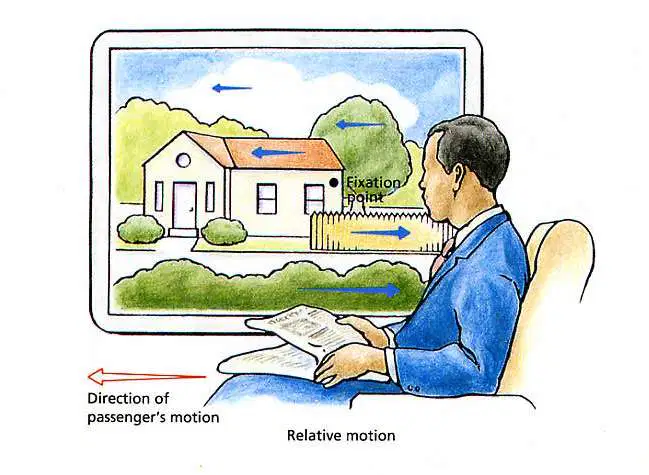
To a person in a moving vehicle, the closer objects appear to move in the opposite direction due to a phenomenon called
Selective attention
Sensory adaptation
Motion parallax
Kinesthesis

