wayground logo

Free Printable Worksheets

Font size

S
M
L
XL
Worksheets

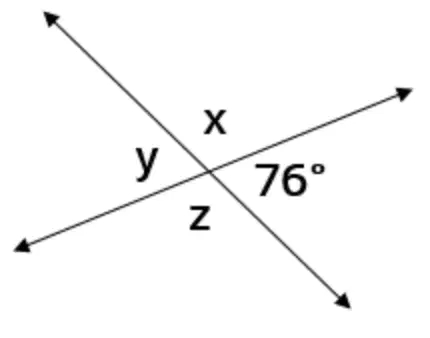
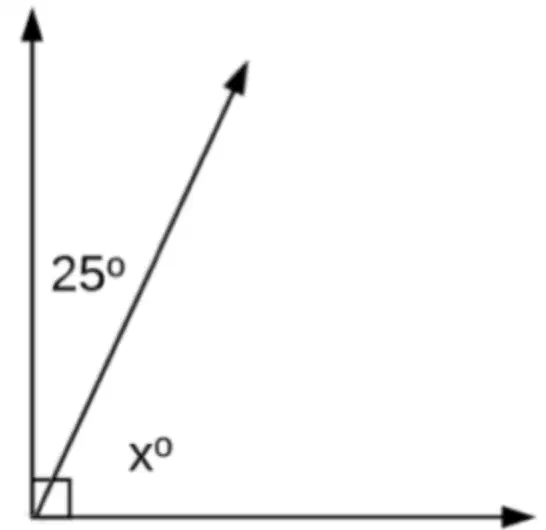
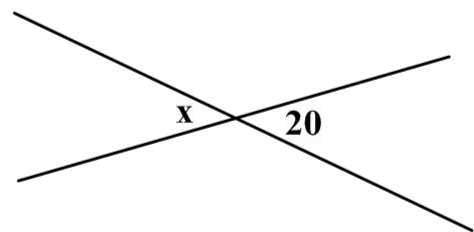
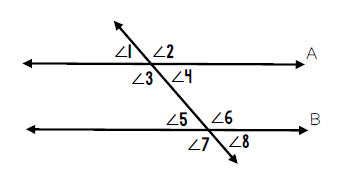
Finding Missing Angles

Total questions: 130

Worksheet time: 10hrs 10mins

Name
Class
Date
1.

True or False. These angles are complementary.

a)

True

b)

False

2.

Find x.

(a)  

3.

Find m.

(a)  

4.

True or False.

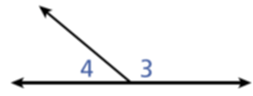
These angles are supplementary.

a)

True

b)

False

5.

Find x.

(a)  

6.

Find M.

(a)  

7.

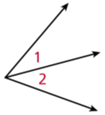
True or False. ∠1 and ∠2 are vertical angles.

a)

True

b)

False

8.

What is the measure of angle 2 ?

What is the measure of ∠2 ?

(a)  

9.

Which of the following definitions apply to ∠1 and ∠2?

a)

Complementary Angle

b)

Supplementary Angle

c)

Vertical Angle

d)

None

10.

Which of the following definitions apply to ∠1 and ∠2?

a)

Complementary Angle

b)

Supplementary Angle

c)

Vertical Angle

d)

None

11.

Which of the following definitions apply to ∠P and ∠Q?

a)

Vertical angles

b)

Complementary angles

c)

Adjacent angles

d)

Supplementary angles

12.

Which of the following definitions apply to ∠1 and ∠3?

a)

Vertical angles

b)

Complementary angles

c)

Adjacent angles

d)

Supplementary angles

13.

Which of the following definitions apply to ∠1 and ∠2?

a)

Complementary Angle

b)

Supplementary Angle

c)

Vertical Angle

d)

None

14.

What type of angles are these?

a)

Adjacent Angles

b)

Linear Pair

c)

Complementary Angles

d)

Supplementary Angles

e)

Vertical Angles

15.

What type of angles are these? (select 2)

a)

Adjacent Angles

b)

Linear Pair

c)

Complementary Angles

d)

Supplementary Angles

e)

Vertical Angles

16.

Supplementary angles always add up to

(a)  

17.

Complementary angles always add up to

(a)  
18.

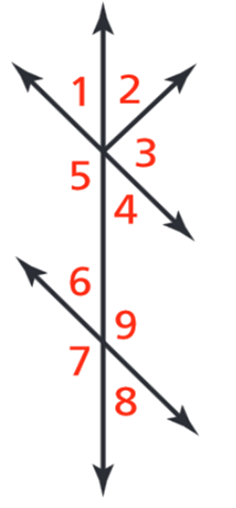
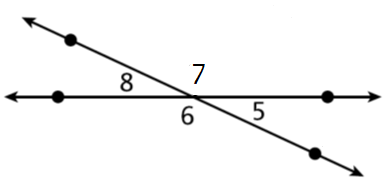
Which angles are vertical angles?

a)

8 & 7\angle8\ \&\ \angle7

b)

8 & 6\angle8\ \&\ \angle6

c)

8 & 5\angle8\ \&\ \angle5

19.

Complementary angles always add up to

(a)  
20.

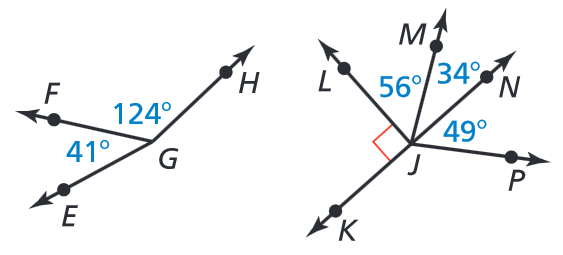
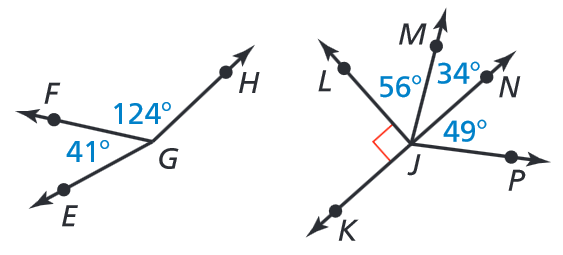
Which angle is complementary to LJM\angle LJM  

a)

MJN\angle MJN  

b)

NJP\angle NJP  

c)

FGE\angle FGE  

d)

LJK\angle LJK  

21.

Which of the following angles is  90°90\degree  ?

a)

FGH\angle FGH  

b)

KJL\angle KJL  

c)

PJK\angle PJK  

d)

EGH\angle EGH  

22.

Which angle is a linear pair with 1\angle1  ?

a)

2\angle2  

b)

3\angle3  

c)

4\angle4  

d)

5\angle5  

e)

6\angle6  

23.

Which angles are non-adjacent with 8\angle8  ?
 (mark all that apply)

a)

2\angle2  

b)

3\angle3  

c)

4\angle4  

d)

5\angle5  

e)

1\angle1  

24.

Which angle is a vertical angle to with 7\angle7  ?

a)

1\angle1  

b)

5\angle5  

c)

3\angle3  

d)

6\angle6  

e)

9\angle9  

25.

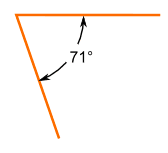
This is what kind of angle?

a)

obtuse

b)

right

c)

straight

d)

acute

26.

Which angle is a vertical angle to with 7\angle7  ?

a)

1\angle1  

b)

5\angle5  

c)

3\angle3  

d)

6\angle6  

e)

9\angle9  

27.
a)

x = 118

b)

x = 108

c)

x = 28

d)

x = 58

e)

x = 62

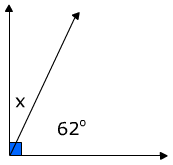
28.

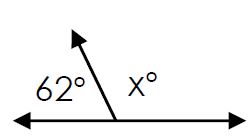
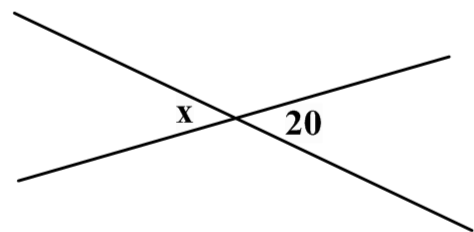
Find the missing angle.  Find x.

a)

20o

b)

70o

c)

160o

d)

180o

29.

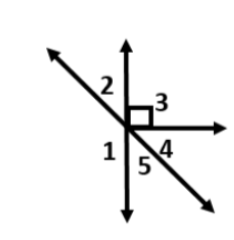
What angle is vertical to angle 2?

a)

∠4

b)

∠1

c)

∠2

d)

∠5

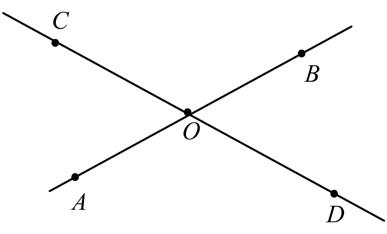
30.

Which are pairs of adjacent angles?

a)

∠COB and ∠DOA

b)

∠AOD and ∠AOC

c)

∠COB and ∠AOD

d)

∠BOD and ∠AOC

31.

Which angles are vertical angles?

a)

8  and 7\angle8\ \ and\ \angle7

b)

8 and 6\angle8\ and\ \angle6

c)

8 and 5\angle8\ and\ \angle5

32.

Which angle is a linear pair with 1\angle1  ?

a)

2\angle2  

b)

3\angle3  

c)

4\angle4  

d)

5\angle5  

e)

6\angle6  

33.

Which angle is a vertical angle to with 7\angle7  ?

a)

1\angle1  

b)

5\angle5  

c)

3\angle3  

d)

6\angle6  

e)

9\angle9  

34.
a)

x = 118

b)

x = 108

c)

x = 28

d)

x = 58

e)

x = 62

35.

Find the missing angle.  Find x.

a)

20o

b)

70o

c)

160o

d)

180o

36.

This is what kind of angle?

a)

obtuse

b)

right

c)

straight

d)

acute

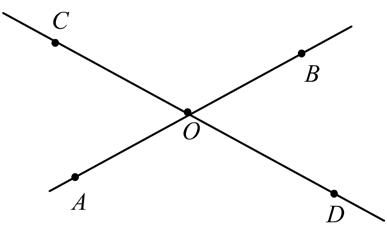
37.

Which are pairs of vertical angles?

a)

∠COB and ∠COA

b)

∠AOD and ∠AOC

c)

∠COB and ∠AOD

d)

∠BOD and ∠AOD

38.

Which are pairs of adjacent angles?

a)

∠COB and ∠DOA

b)

∠AOD and ∠AOC

c)

∠COB and ∠AOD

d)

∠BOD and ∠AOC

39.

Vertical angles are always

a)

acute

b)

total 180 degrees

c)

congruent (equal measures)

d)

adjacent angles

40.

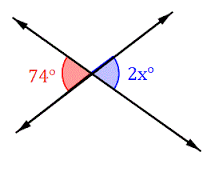
What is the value of x?

a)

37

b)

72

c)

108

d)

18

41.

Angles that are exactly 90 degrees are called _____ ______.

a)

tight angles

b)

acute angles

c)

obtuse angles

d)

right angles

42.

What is a Supplementary Angle?

a)

2 Angles that equal 360

b)

2 Angles that equal 180

c)

2 Angles that equal less than 90

43.

What is a Complementary Angle?

a)

2 Angles that sum is 0 to 90

b)

2 angles with a sum of 360

c)

2 Angles with a sum of 125

44.
What are vertical angles?
a)
Angles that are adjacent to each other
b)
Angles that add up to 180°
c)
Angles that are opposite of each other when lines intersect
d)
Angles that add up to 90°
45.
What are vertical angles?
a)
Angles that are adjacent to each other
b)
Angles that add up to 180°
c)
Angles that are opposite of each other when lines intersect
d)
Angles that add up to 90°
46.
If ∠BPD and ∠DPC have a sum of 72°. What is ∠APC?
a)
18°
b)
90°
c)
108°
d)
180°
47.
CHALLENGE: Find the values of x and y.
a)
x=7 ; y=25
b)
x=5 ; y=25
c)
x=7 ; y=5
d)
x=5; y=5
48.
What are supplementary angles?
a)
Angles that add up to 180°
b)
Angles that add up to 90°
c)
Angles that are equal to each other
d)
Angles that are opposite of each other when lines intersect
49.
What are complementary angles?
a)
Angles that add up to 180°
b)
Angles that add up to 90°
c)
Angles that are equal to each other
d)
Angles that are opposite of each other when lines intersect.
50.
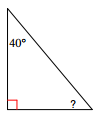
Find the value of x.
a)
38°
b)
52°
c)
142°
d)
152°
51.
Find the value of x.
a)
18°
b)
28°
c)
38°
d)
118°
52.
If m∠1 = 30°, then m∠3 = 
a)
30°
b)
60°
c)
150°
d)
undetermined
53.
The angle relationship shown is - 
a)
complementary angles
b)
supplementary angles
c)
vertical angles
d)
adjacent angles
54.
∠1 and ∠3 can best be described as -
a)
complementary angles
b)
supplementary angles
c)
vertical angles
d)
adjacent angles
55.
The angle relationship shown is -
a)
complementary angles
b)
supplementary angles
c)
vertical angles
d)
angle bisector
56.
What type of angle is shown?
a)
acute
b)
obtuse
c)
right
d)
straight
57.
Solve for x
a)
20
b)
25
c)
120
d)
180
58.
What is the relationship between angle 1 and 2?
a)
Supplementary
b)
Complementary
c)
Vertical
d)
Obtuse
59.
Solve for angle 2
a)
65
b)
60
c)
110
d)
115
60.
Solve for angle 5
a)
50
b)
55
c)
45
d)
60
61.
What is the value of x?
a)
37
b)
72
c)
108
d)
18
62.
Tell whether the angles are complementary or supplementary. Then find the value of x.
a)
Complementary, 15
b)
Supplementary, 16
c)
Complementary, 18
d)
Supplementary, 19
63.
Tell whether the angles are complementary or supplementary. Then find the value of x.
a)
Complementary; x=25
b)
Complementary; x=5
c)
Supplementary; x=25
d)
Supplementary; x=5
64.
Solve for x
a)
5
b)
90
c)
25
d)
10
65.
Solve for x
a)
5
b)
90
c)
25
d)
10
66.
Tell whether the angles are complementary or supplementary. Then find the value of x.
a)
Complementary, 15
b)
Supplementary, 16
c)
Complementary, 18
d)
Supplementary, 19
67.
What is the value of x?
a)
37
b)
72
c)
108
d)
18
68.
If m∠1 = 30°, then m∠3 = 
a)
30°
b)
60°
c)
150°
d)
undetermined
69.
CHALLENGE: Find the values of x and y.
a)
x=7 ; y=25
b)
x=5 ; y=25
c)
x=7 ; y=5
d)
x=5; y=5
70.
Solve for x
a)
20
b)
25
c)
120
d)
180
71.

What are complementary angles?

a)

Angles that add up to 180°

b)

Angles that add up to 90°

c)

Angles that are equal to each other

d)

Angles that are opposite of each other when lines intersect.

72.

What are supplementary angles?

a)

Angles that add up to 180°

b)

Angles that add up to 90°

c)

Angles that are equal to each other

d)

Angles that are opposite of each other when lines intersect

73.

What type of angles are these?

a)

Adjacent Angles

b)

Linear Pair

c)

Complementary Angles

d)

Supplementary Angles

e)

Vertical Angles

74.

Find b

a)

100°

b)

90°

c)

80°

d)

75°

75.

Find b

a)

80°

b)

75°

c)

85°

d)

90°

76.

Find a

a)

58

b)

37

c)

55

d)


60

77.
3. Find X
a)
59
b)
31
c)
177
78.
If m∠1 = 30°, then m∠3 = 
a)
30°
b)
60°
c)
150°
d)
undetermined
79.
2. Find X
a)
9
b)
27
c)
45
80.
If ∠A and ∠B are supplementary, and the measure of ∠A is 120°, what is the measure of ∠B?
a)
180
b)
50
c)
60
d)
80
81.
Find the missing angle.
a)
60
b)
70
c)
50
d)
140
82.

Choose all answers that apply: Find the angle measurements that are complementary to each other.

a)

75 and 105

b)

75 and 15

c)

25 and 65

d)

34 and 146

e)

38 and 52

83.
a)
x = 56
b)
x = 66
c)
x = 156
d)
x = 166
84.
Are these angles complementary, supplementary or neither?
a)
complementary
b)
supplementary
c)
neither
85.
What is the measure of the missing angle?
a)
76
b)
86
c)
166
d)
156
86.
a)
x = 118
b)
x = 108
c)
x = 28
d)
x = 58
87.
What is an example of a pair of complementary angles?
a)
13° and 45°
b)
10° and 170°
c)
81° and 9°
d)
90° and 3°
88.

What are complementary angles?

a)

Angles that add up to 180°

b)

Angles that add up to 90°

c)

Angles that are equal to each other

d)

Angles that are opposite of each other when lines intersect.

89.
Find the measure of the missing angle.
a)
90o
b)
100
c)
130o
d)
50o
90.
Find the measure of the indicated angle. (remember that the sum of interior angles is equal to 180 degrees)
a)
95
b)
85
c)
35
d)
45
91.
a)
61
b)
153
c)
27
d)
146
92.
What is the value of the missing angle?
a)
61
b)
50
c)
60
d)
69
93.

Find the measure of angle B

(a)  

94.

What is the measurement of angle A?

(a)  

95.

What is the measure of angle B?

(a)  

96.

Find the measure of angle A

(a)  

97.

Find the measure of angle B

(a)  

98.

Find the measure of angle B

(a)  

99.

What is the measure of angle A?

(a)  

100.

What is the measure of angle B?

(a)  

101.

What are complementary angles?

a)

Angles that add up to 180°

b)

Angles that add up to 90°

c)

Angles that are equal to each other

d)

Angles that are opposite of each other when lines intersect.

102.

What are supplementary angles?

a)

Angles that add up to 180°

b)

Angles that add up to 90°

c)

Angles that are equal to each other

d)

Angles that are opposite of each other when lines intersect

103.

What type of angles are these?

a)

Adjacent Angles

b)

Linear Pair

c)

Complementary Angles

d)

Supplementary Angles

e)

Vertical Angles

104.
Solve for x
a)
20
b)
25
c)
120
d)
180
105.
CHALLENGE: Find the values of x and y.
a)
x=7 ; y=25
b)
x=5 ; y=25
c)
x=7 ; y=5
d)
x=5; y=5
106.
If m∠1 = 30°, then m∠3 = 
a)
30°
b)
60°
c)
150°
d)
undetermined
107.

Find b

a)

80°

b)

75°

c)

85°

d)

90°

108.

Find a

a)

58

b)

37

c)

55

d)


60

109.
Solve for angle 2
a)
65
b)
60
c)
110
d)
115
110.
What is the relationship between angle 1 and 2?
a)
Supplementary
b)
Complementary
c)
Vertical
d)
Obtuse
111.

What is the measurement of a\angle a  if  b=105°\angle b=105\degree  ?

a)

105°105\degree

b)

75°75\degree

c)

90°90\degree

d)

180°180\degree

112.

What is the measurement of x\angle x ?

a)

25°25\degree

b)

155°155\degree

c)

15°15\degree

d)

180°180\degree

113.

What is the measurement of x\angle x ?

a)

13°13\degree

b)

117°117\degree

c)

23°23\degree

d)

94°94\degree

114.

What is the measurement of b\angle b ?

a)

45°45\degree

b)

90°90\degree

c)

180°180\degree

115.

What is the measurement of x\angle x ?

a)

13°13\degree

b)

17°17\degree

c)

73°73\degree

d)

90°90\degree

116.
a)

40

b)

16

c)

45

d)

7

117.
a)

11

b)

24

c)

8

d)

6

118.
a)

200

b)

36

c)

11

d)

49

119.
a)

22

b)

11

c)

68

d)

34

120.
a)

10

b)

20

c)

2

d)

80

121.

Which angles are vertical angles?

a)

8  and 7\angle8\ \ and\ \angle7

b)

8 and 6\angle8\ and\ \angle6

c)

8 and 5\angle8\ and\ \angle5

122.
a)

x = 118

b)

x = 108

c)

x = 28

d)

x = 58

e)

x = 62

123.

What is the measurement of angle y?

a)

38 degrees

b)

104 degrees

c)

76 degrees

d)

50 degrees

124.

What is the measurement of angle u?

a)

52 degrees

b)

130 degrees

c)

70 degrees

d)

26 degrees

125.

What is the measurement of angle x?

a)

65 degrees

b)

45 degrees

c)

155 degrees

d)

105 degrees

126.

What are vertical angles?

a)

A pair of non-adjacent angles formed by the intersection of two lines.

b)

A pair of adjacent angles formed by the intersection of two lines.

c)

A pair of angles formed by the intersection of two parallel lines.

d)

A pair of angles formed by the intersection of two perpendicular lines.

127.

Which angle is a vertical angle to with 7\angle7  ?

a)

1\angle1  

b)

5\angle5  

c)

3\angle3  

d)

6\angle6  

e)

9\angle9  

128.
Find the missing angle.  Find x.
a)
20o
b)
70o
c)
160o
d)
180o
129.

Angle 6 and Angle 7 are examples of which type of angle pair?

a)

Alternate exterior angles

b)

Alternate interior angles

c)

Vertical angles

d)

Corresponding angles

130.

Which equation can be used to solve for x?

a)

60 + 3(5 + x) = 180

b)

60 + 3(5 + x) = 90

c)

60 = 3 (5 + x)