
 Worksheets
Unit 11 CFA PRactice
Total questions: 18
Worksheet time: 10mins
Read the excerpt from one of the Enforcement Acts enacted during Reconstruction. Then answer the question that follows.
Two or more persons . . . conspir[ing] together . . . with intent to deny to any citizen of the United States the due and equal protection of the laws, or by force, intimidation, or threat to prevent any citizen of the United States lawfully entitled to vote from [voting] . . . shall be deemed guilty of a high crime.
Which group's actions led to the creation of these laws?
the Populists
the Ku Klux Klan
the Freedmen's Bureau
the Radical Republicans
What was the goal of Abraham Lincoln's plan for Reconstruction?
to punish the South for its role in the Civil War
to prevent future secession by restricting states' rights
to readmit former Confederate states to the Union as quickly as possible
to allow the federal government to take control of Southern agricultural land
In Georgia, the ratification of the Fourteenth and Fifteenth amendments resulted in
the founding of African American state universities and colleges.
the reduction of funding for the Freedmen's Bureau from the state budget.
the election of African Americans to serve in public office throughout the state.
the collapse of the Georgia Republican Party and the ousting of its elected officials.
The Fourteenth Amendment was the federal government's response to
popular opposition to the draft.
Black Codes (laws oppressing African Americans) enacted in the South.
Republican control of Southern state governments.
the Supreme Court decision in Dred Scott v. Sandford.
Which of the following were goals of the Freedmen's Bureau? Pick 3.
restoring the pre–Civil War social order in the South
ensuring Democratic control of Southern politics
expanding educational opportunities in the South
providing food and shelter to displaced Southerners
assisting African Americans in voting and practicing their rights
Which of the following were goals of the Ku Klux Klan? Pick 3.
restoring the pre–Civil War social order in the South
ensuring Democratic control of Southern politics
expanding educational opportunities in the South
preventing African Americans from exercising their rights
providing food and shelter to displaced Southerners
How did white legislators justify their removal of duly-elected African American legislators from the Georgia General Assembly during Reconstruction?
They claimed that recent election results were caused by voter fraud.
They claimed that African Americans had the right to vote but not to hold office.
They claimed that African Americans were US citizens but not citizens of Georgia.
They claimed that recent election results were caused by unconstitutional redistricting.
What was the goal of expelling African American legislators from the Georgia General Assembly during Reconstruction?
to gain the support of Radical Republicans
to convince the federal government to give Georgia aid
to maintain white supremacy in state politics
to bring an end to Georgia's county-unit electoral system
The use of sharecropping during Reconstruction allowed landowners in Georgia to
become leading producers of gold.
resume the mass production of cotton.
consolidate land into larger plantations
transition to the production of finished goods.
Which of the following are characteristics of sharecropping? Pick 3.
Laborers worked for landowners in exchange for land to farm.
Laborers usually owned the equipment they used.
Laborers provided a share of their crop to the landowner.
Laborers had no say in what crops they raised.
Which of the following are characteristics of tenant farming? Pick 2.
Laborers worked for landowners in exchange for land to farm.
Laborers usually owned the equipment they used.
Laborers provided a share of their crop to the landowner.
Laborers had no say in what crops they raised.
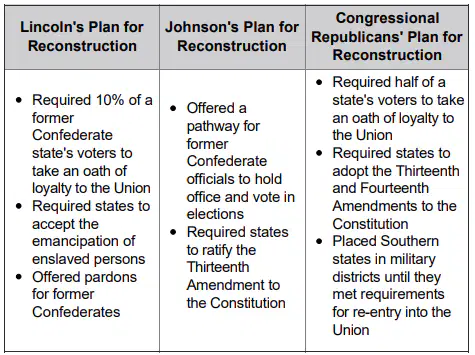
How did these proposals for managing Reconstruction after the Civil War compare?
Lincoln and Johnson prioritized the harsh punishment of former Confederates, while Congress prioritized diplomacy and negotiation.
Lincoln and Johnson prioritized restoring the Union, while Congress prioritized protecting the rights of formerly enslaved people.
Lincoln and Johnson prioritized rebuilding the South, while Congress prioritized the fair treatment of former Confederates.
Lincoln and Johnson prioritized ensuring citizens' loyalty, while Congress prioritized preventing Confederate states from rejoining the Union.
What is the name of the federal agency created to provide assistance and support to newly freed African Americans and other displaced persons in the South?
The KKK
The Southern Democrats
The Freedmen's Bureau
The Republican Party
What group used terrorism in their attempts to oppress African Americans after the Civil War?
The KKK
The Southern Democrats
The Freedmen's Bureau
The Republican Party
What did the 13th Amendment do?
Allowed everyone the right to vote
Turned all territories into states
Allowed women to vote
Officially ended slavery
What did the 14th Amendment do?
Allowed women to vote
Gave African Americans citizenship
Provided aid to former Confederate soldiers
Prohibited discrimination based on gender
What did the 15th Amendment do?
Allowed black men to vote
Allowed women to vote
Forced former Confederate soldiers swear oaths of loyalty to the U.S.
Outlawed sharecropping
What were the dominant agricultural systems in Georgia after the Civil War? Pick 2.
tenant farming
greenhouse growing
sharecropping
rental farming
crop rotating

