
 Worksheets
Big Ideas Geometry 7.1-7.4 Test Review
Total questions: 64
Worksheet time: 4hrs 37mins
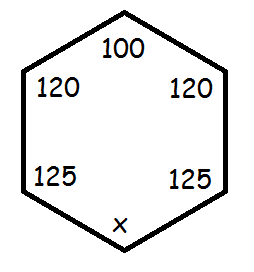

Which formula represents how to find the interior angle sum of any polygon?
(number of sides - 2) x 180
(number of sides + 2) x 180
number of sides x 180
number of sides x 360
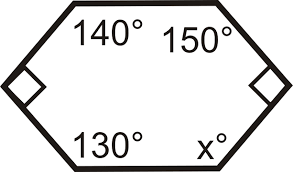
Find the value of x.
110
90
130
120
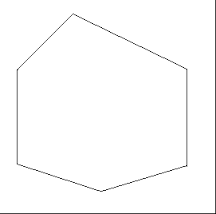
What is a regular polygon?
all side lengths are the same length
all angles are the same (equal in measure)
only some side lengths are the same
all side lengths are different
only some angles are the same
Match the Name with the Number of Sides

Triangle

Quadrilateral

Pentagon

Hexagon

Octagon

Cutting from vertex to vertex, how many triangles make up this hexagon (6-sided polygon)?
4
5
6
7
3

Cutting from vertex to vertex, how many triangles make up this Octagon (8-sided polygon)?
3
4
5
6
7


What is the measure of x?
14
156
95
109
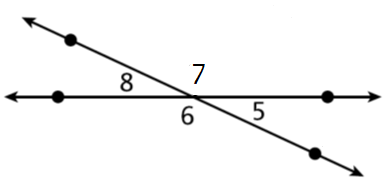
Which angles are vertical angles?
∠8 & ∠7
∠8 & ∠6
∠8 & ∠5

Use these SUPPLEMENTARY angles to find the value of x.
70
10
3
103

In parallelgram ABRK, ΔARB≅ΔRAK for what reason?
ASA
SAS
AAS
SSS
Given this information, which quadrilateral is proven?
"A quadrilateral with one pair of opposite sides both congruent and parallel"
Parallelogram
Rectangle
Rhombus
Square

Given this information, which quadrilateral is proven?
Parallelogram
Rectangle
Rhombus
Square


If you think this shape is a parallelogram, which of the following could prove it?
Opposite Sides are congruent
Opposite sides are parallel
Diagonals are congruent
Diagonals bisect each other
Diagonals are perpendicular

If you think this shape is specifically a rhombus, which of the following could prove it?
All sides are congruent
Opposite sides are parallel
Diagonals are congruent
Diagonals bisect each other
Diagonals are perpendicular

Which could tell you that this is a parallelogram?
Opposite angles are supplementary
Consecutive angles are supplementary
Opposite sides are parallel
Diagonals bisect each other
This is not a parallelogram
You can use the slope formula to calculate the lengths of opposite sides of a parallelogram.
True
False
You can prove both pairs of opposite sides are congruent in a parallelogram using the distance formula.
True
False
You can prove both pairs of opposite sides are parallel by using the slope formula.
True
False
Which of the following has the slope formula written correctly?
(x2−x1)(y2−y1)
(y2−y1)(x2−x1)
(x2−x1)(y1−y2)
(x2−y2)(x1−y1)
What formula would you use to show lengths are equal?
Slope Formula
Distance Formula
Midpoint Formula
What formula would you use to find the length of each side of a parallelogram?


If you are using the distance formula to prove a parallelogram in the coordinate plane, how many times do you have to do it?
1
2
3
4
If I have a parallelogram labeled ABCD and I am going to prove it using the slope formula, what sides need to be congruent?
AB∥CD and AD∥BC
AB∥BC and BC∥AB
AB ∥CD and CD∥BC
AB∥AD and AB∥AC
If I have a parallelogram labeled ABCD and I am going to prove it using the distance formula, what sides need to be congruent?
AB≅CD and AD≅BC
AB≅BC and BC≅AB
AB ≅CD and CD≅BC
AB≅AD and AB≅AC
How many pairs of sides are congruent in a parallelogram?
1
2
3
4

Is the quadrilateral a parallelogram?
Yes; one pair of opposite sides are parallel
Yes; one pair of opposite sides are congruent
Yes; opposite sides are parallel and congruent
No; only one pair of sides are parallel
No; only one pair of sides are congruent

Which theorem can be used to prove the quadrilateral is a parallelogram?
Parallelogram Opposite Sides Converse Theorem
Parallelogram Opposite Angles Converse Theorem
Opposite Sides Parallel and Congruent Theorem
Parallelogram Diagonals Converse Theorem

Which theorem can be used to prove the quadrilateral is a parallelogram?
Parallelogram Opposite Sides Converse Theorem
Parallelogram Opposite Angles Converse Theorem
Opposite Sides Parallel and Congruent Theorem
Parallelogram Diagonals Converse Theorem

Which theorem can be used to prove the quadrilateral is a parallelogram?
Parallelogram Opposite Sides Converse Theorem
Parallelogram Opposite Angles Converse Theorem
Opposite Sides Parallel and Congruent Theorem
Parallelogram Diagonals Converse Theorem

Which theorem can be used to prove the quadrilateral is a parallelogram?
Parallelogram Opposite Sides Converse Theorem
Parallelogram Opposite Angles Converse Theorem
Opposite Sides Parallel and Congruent Theorem
Parallelogram Diagonals Converse Theorem

Find the value of x that makes the quadrilateral a parallelogram.
41
12
14
This quadrilateral cannot be a parallelogram.

Find the value of x that makes the quadrilateral a parallelogram.
29
42
78
11


A square is a rhombus.
always true
sometimes true
never true
Two properties of a quadrilateral are listed below.
· The quadrilateral always has 4 congruent angles
· The quadrilateral does not always have 4 congruent sides
Which of the following quadrilaterals has both properties?
Parallelogram
Rectangle
Rhombus
Square
Which quadrilateral(s) have congruent diagonals? Select all that apply.
Parallelogram
Rectangle
Rhombus
Square

Consider Rectangle HGFE. What is the length of HG?
x = 4
x = 8
x = 21.5
x = 20


