
Font size
 Worksheets
Category 1 Reteach
Total questions: 32
Worksheet time: 26mins
Which characteristic of an atom is NOT used to determine the number of neutrons in an atom?
Protons
Atomic number
Atomic mass
Electric charge
How many hydrogen atoms are in one molecule of camphor? C10H16O
16
10
26
27
Which model has properties most similar to chlorine?


Two students complete a lab using two unknown substances in a chemical reaction. Which sign is NOT an indication of a chemical reaction?
Shape change
Bubbles
Temperature change
Odor change
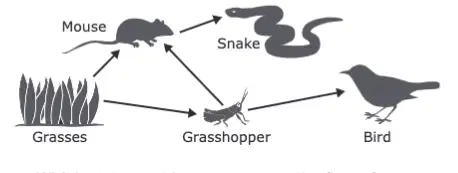
After researching the local community, a student diagrams a simple food web.
A grasshopper is prey for the mouse, snake and bird
A snake feeds on a mouse and grasses
A mouse eats both grasshopper and grasses
A mouse and grasshopper sometimes provide food for the bird

The pictures show several objects made of copper. Copper can be shaped into various forms due to a physical property called —
luster
malleability
reactivity
conductivity
Which example describes a chemical change that occurs during the digestion of food?
Saliva breaking down the starch in potatoes into simpler sugars
Teeth grinding cookie into smaller pieces
Esophagus moving food particles from the mouth to the stomach
Large intestine absorbing water from waste to be removed from the body
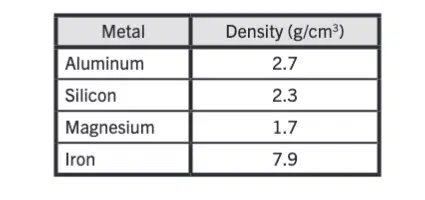
A student finds that the mass of an unknown metal is 11.9 grams and the volume is 7 cm³. What is the density of the unknown metal AND what is the identity of the unknown metal the student is measuring?

Potassium hydroxide, KOH, reacts with hydrochloric acid, HCl, to form a salt and water. What mass of hydrochloric acid, to the nearest hundredth of a gram, is required for this chemical reaction?
(a)

What is the best description of a molecule of glucose?
Six atoms of carbon, twelve elements of hydrogen and six atoms of oxygen
Six molecules of carbon, twelve molecules of hydrogen, and six molecules of oxygen
Six atoms of carbon, twelve atoms of hydrogen, and six atoms of oxygen
One atom of carbon, one atom of hydrogen, and one atom of oxygen
Based on information provided in the periodic table, which statement correctly describes the reactivity of elements?
Silicon is more reactive than aluminum and has properties similar to phosphorus
Calcium is more reactive than arsenic and has properties similar to radium
Xenon is nonreactive and has properties similar to iodine
Cesium is nonreactive and has properties similar to francium

A group of students is asked to describe the chemical reactivity of Element B based on the information provided. What is the best prediction for the reactivity of Element B?
Slightly reactive
Nonreactive
Very reactive
Reactivity cannot be determined from the information provided.
Which table accurately displays the electrical charge for each subatomic particle in an atom?


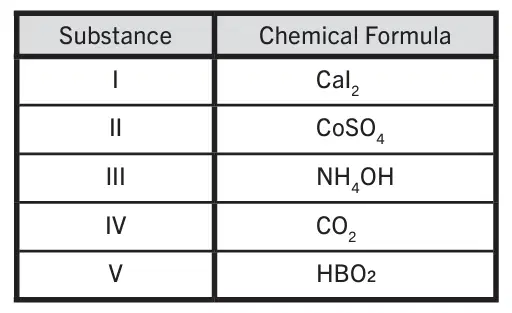
Based on the information provided in the table, which substances have the same number of atoms? Select TWO correct answers.
Substance I
Substance II
Substance III
Substance IV
Substance V

Students conduct an investigation to classify different substances as metals or nonmetals. They record observations in the table below. According to the table, which substances are NOT metals?
Sulfur, Carbon, Iron
Carbon, Aluminum, Graphite
Carbon, Sulfur, Graphite
Iron, Aluminum, Graphite
Dissolving sugar in water is an example of what type of change?
Digestive change
Physical change
Chemical change
Physical and chemical change

A student measures the mass and volume of four rocks. According to the data, which rock is most dense?
Rock 1
Rock 2
Rock 3
Rock 4
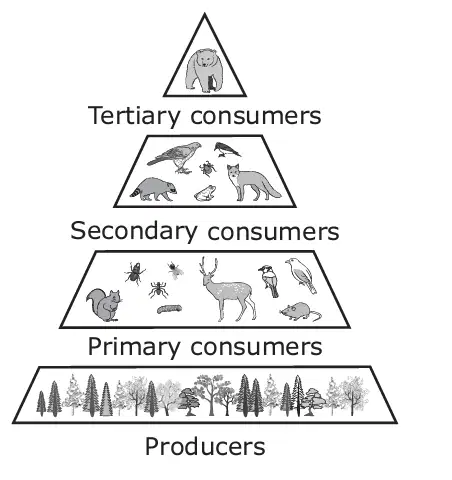
Students create an energy pyramid to describe the flow of energy between organisms in a forest ecosystem. Based on this model, which organisms receive most of their energy from small birds, rodents, insects, and deer in the forest?
Tertiary consumers
Secondary consumers
Primary consumers
Producers
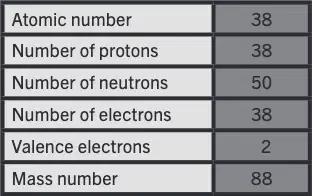
The following information is provided about an element in the periodic table. Which element is best described by the information in the table?
Helium (He)
Strontium (Sr)
Tin (Sn)
Radium (Ra)
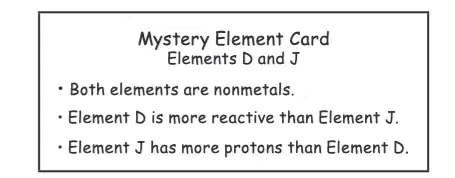
Students are given mystery element cards that describe characteristics of two elements from the periodic table, Elements D and J. Which periodic table places Elements D and J in locations that correspond to the characteristics on the mystery element cards?


Two students combine unknown substances during a chemical reactions investigation. How will the product MOST LIKELY present itself?
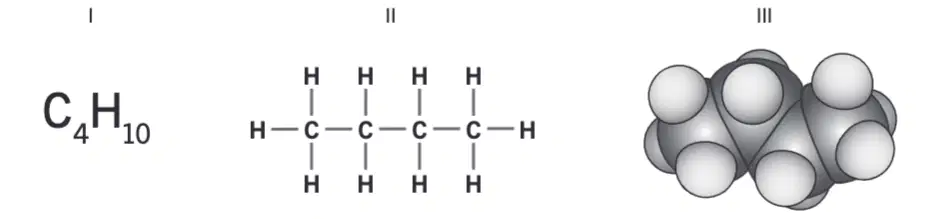
A teacher shows the class diagrams of three different substances. Which statement is a valid conclusion about these substances?
All three substances contain a different number of atoms.
Substances I and II contain the same number of atoms, but substance III contains a different number of atoms.
Substances I and III contain the same number of atoms, but substance II contains a different number of atoms.
All three substances contain the same number of atoms.
A scientist determines an unknown metallic sample to have 77 protons and 77 electrons with a mass number of 192. How many neutrons does one metal atom contain?
(a)
Which statement correctly places elements in order of least to greatest reactivity?
Arsenic, gallium, potassium, krypton
Potassium, gallium, arsenic, krpton
Krypton, arsenic, gallium, potassium
Krypton, potassium, gallium, arsenic

Plants use a chemical process called photosynthesis to generate the energy they need to live. The chemical equation shows the reaction by which they use sunlight to combine carbon dioxide and water, producing sugar and oxygen.
What is the total number of atoms of each element represented in the products of this reaction?
Carbon atoms: (a)
Hydrogen atoms: (b)
Oxygen atoms: (c)
Phosphorus, platinum, selenium, and zinc are elements. Tests of these four elements at normal room temperature would show that-
phosphorous is malleable and platinum conducts electricity
zinc is malleable and platinum conducts electricity
zinc is malleable and selenium conducts electricity
phosphorus is malleable and selenium conducts electricity
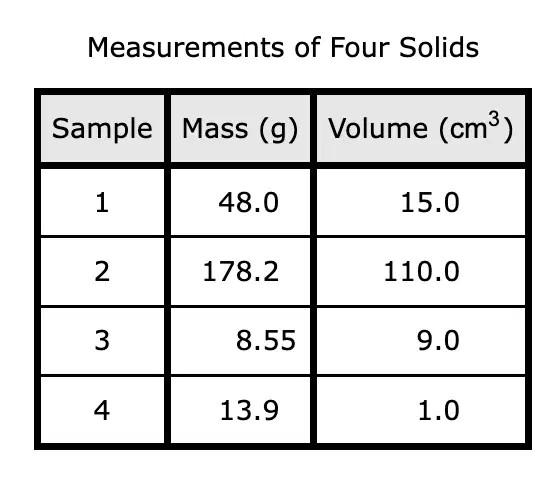
A student measured the mass and volume of four solids in order to calculate their densities. The table shows the student's data. The density of water is 1 g/cm³. Materials that are denser than water will sink in water, while materials that are less dense will float. Which of the samples would float in water?
Sample 1
Sample 2
Sample 3
Sample 4
A neutral atom of sodium, Na, has a mass number of 23. Which lists shows the number of protons, neutrons and electrons in the atom?
11 protons, 12 neutrons, 11 electrons
12 protons, 11 neutrons, 12 electrons
11 protons, 12 neutrons, 12 electrons
23 protons, 11 neutrons, 23 electrons
This question has two parts. A chemist made this table to record some atomic properties of four elements.

Part A
Based on the information in the table, which element is the most reactive?
Aluminum
Chlorine
Germanium
Indium
Part B
Which statement best supports the answer to Part A?
The element has an even number of electrons
The element has the smallest number of neutrons
The element has close to a full outer shell of electrons
The element has the greates number of protons

The characteristics of a certain element are listed. Which element has all of these characteristics?
Tellurium, Te
Bismuth, Bi
Molybdenum, Mo
Niobium, Nb
Which pair of processes includes only physical changes to matter?
Juice freezing to make ice pops and juice becoming sour as it spoils
A nail bending and a nail rusting
A sheet of pater crumpling and a sheet of paper burning
Water evaporating from a puddle and condensation forming on the outside of a cold glass of juice

The illustration shows what happened when a science teacher poured one clear liquid into another clear liquid. Soon afterward, a powdery solid settled to the bottom of the beaker.
Which is the best explanation for what happened in the beaker?
A difference in pressure caused a change in state
A chemical reaction between the liquids caused a solid to form
A difference in temperature caused one of the liquids to change to a solid
The two liquids separated because they have different densities

