
Font size
 Worksheets
Mock STAAR: how to answer these types of questions...
Total questions: 47
Worksheet time: 4hrs 51mins
What does scale factor do to a graphed image?
The graphed picture moves to the left/right and/or up/down
The graphed picture flips to another quadrant
The graphed picture turns in a circle around the origin
The graphed picture gets enlarged or reduced
What is the first step in solving a multi-step equation
Adding/Subtracting everything on each side of the equal sign
Getting your variables on one side of the equation by either adding or subtracting
Combining your variables across the equal sign
What do I look for with a scatterplot: check all that apply
Are all of my points in a straight line and are grouped together
What is the graph in increments (how far apart) of
I look at just the answers and see which one is close
If there is a positive or negative association
If you have a monthly fee or a fee that is charged or added in increments of time (time), how do you show that with a variable (x)?
time(x)
time - x
time / x
time + x
When looking at a graph, what are the most important things to look for?
labels of the graph
increments of the graph
the way the line is going
just pick c
If your answer has a pi symbol in it, you should not:
multiply your numbers by pi
pay attention to the pi symbol
read the question
multiply by pi two times
If I know the volume and I am searching for the height, what is a strategy I can use?
put the volume in place of height
divide all other numbers from the volume
look to see if I have multiple choice and fill in my height to see if I get my volume
Divide out each number using volume/number
If I am filling something, which formula do I use?
Volume
Surface Area
If I am covering something, which formula do I use?
Volume
Surface Area
What does lateral surface area mean?
The total prism is covered
The sides of the prism are covered
What does total surface area mean?
The whole prism is covered
Only the sides of the prism are covered
A function passes
vertical line test (that means only one point per vertical section)
no repeating x's
no repeating y's
horizontal line test (that means only point per horizontal section)
What does big B stand for?
base of the shape
area of the base that the prism is named for
perimeter of the base
area of the rectangle (even if it is a triangular prism)
If I get a scholarship/grant/help from family, what do I do with that amount?
Subtract it from the total you are going to have to pay for college.
Add it to the total you are going to have to pay for college
Do nothing with this amount
How do I determine if something is proportional?
y divided by x
y times x
see if there is a beginning balance if so, it is proportional
see if there is a beginning balance and if not, it is proportional
What do you do with a dilation problem?
multiply it by both x and y coordinate values
divide it by both x and y coordinate values
Only multiply/divide by one coordinate value
add the x and y coordinate values.
What preserves orientation?
Rotation of any kind
Translations
Dilations
Reflections
What preserves congruence?
Rotations of any kind
Reflections
Translations
Dilations
What causes only the x or the y coordinate to change its sign?
Rotations of any kind
Translations
Reflections
Dilations
True or False: A solution to a system of equation is the point when the two graphs cross/intersect
True
False
What only slides the shape around by adding or subtracting to the x and y coordinates?
Translations
Rotations of any kind
Dilations
Reflections
What makes a figure bigger/smaller by multiplying?
Translations
Dilations
Reflections
Rotations of any kind
True or False: turning a number into a decimal is the easiest way to order it
True
False
What does the big P mean in the surface area formula?
add all sides of the base shape
add all sides of the prism
find the area of the base
um, remind me again?
How do I determine if three sides create a right triangle?
a + b = c
leg squared + leg squared = hypotenuse squared
Just add two smallest sides to see if it is larger than the longest
leg + leg = hypotenuse
How do I find the total account balance for simple interest?
I = Prt
A = I + P
A = P - I
None of the these
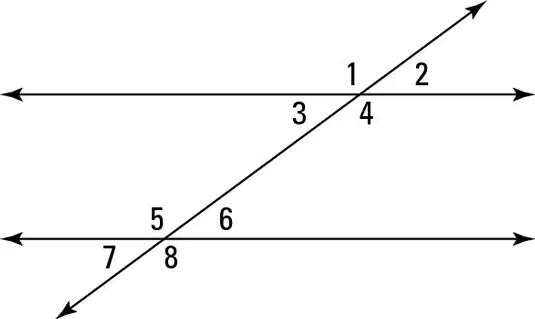
If I know the answer to one, how do I find 2 or 3?
Add all of the other numbers
Subtract 1 from 180
Number 2 and number 3 are the same angle
Subtract 1 from 90
True or False: If I am looking at a scatterplot, I need to see if I am looking for a specific x amount for a specific y amount.
True
False
Pick what you know about scientific notation.
If the standard form is larger than one, the exponent is positive
If the standard from is larger than one, the exponent is positive
If the standard form is smaller than one, the exponent is negative
If the standard form is smaller than one, the exponent is negative
True or false when dealing with scientific notation your number has to be greater than zero and less than 10
True
False
What type of rotation is this? (y, -x)
90 clockwise/270 counterclockwise
180 clockwise/180 counterclockwise
270 clockwise/90 counterclockwise
What type of rotation is this: (-x,-y)
90 clockwise/270 counterclockwise
180 clockwise/180 counterclockwise
270 clockwise/90 counterclockwise
How do I find slope from a graph?
Count from two points on a graph how many up over how many over
Subtract two y coordinates and subtract two x coordinates that are from the same points put change in y over change in x
run/rise
rise/run
What type of rotation is this: (-y, x)
90 clockwise/270 counterclockwise
180 clockwise/180 counterclockwise
270 clockwise/90 counterclockwise
What does the b represent in the equation y = mx + b, check all that apply
starting point on a graph
where it crosses the y-axis
the initial or starting amount
where it crosses the x-axis
What do I count to determine scientific notation's exponent?
The zeros
The number of places the decimal moved
If I rotate a figure, what does it maintain?
Orientation
Congruence
Place on the graph
None of the above
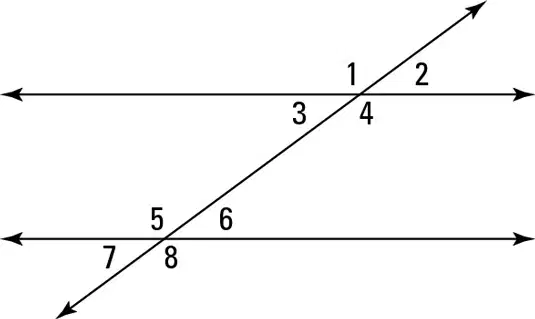
Which angles are congruent to number 1
4, 5, 8
4
3, 2, 6, 7
6
The Pythagorean Theorem ONLY works on which triangle?
obtuse
scalene
isosceles
right
What side(s) will always be the longest on a right triangle?
The Hypotenuse
Leg A
Leg B
The Right Angle
What side(s) will always be the shortest on a right triangle?
Select all that apply
The Hypotenuse
Leg A
Leg B
The Right Angle

What is the relationship between the sides in the Pythagorean Theorem shown?
Hint: Think about when the hypotenuse is missing!
a + b = c
a2 + b2 = c2
a2 – b2 = c2
a – b = c
If I need to find the missing side of a figure: what steps do I take?
I make sure that the orientation of both figures is the same
I set up the side over the same side as the other figure
If it is prime (new), I put it on top and the other on the bottom
I just always use one side over another
I multiply until I see an answer choice
Side c on a right triangle is ALWAYS the longest.
true
false
c2 = a2 - b2
How do I order negative numbers?
Draw out a number line and place numbers there
Order them the same way I would order a positive set
Turn all numbers into decimals and then order
I order them?
True or False: MEAN ABSOLUTE DEVIATION (MAD) when in doubt: do I choose the smallest one?
True
False

