wayground logo

Free Printable Worksheets

NEW

Font size

S
M
L
XL
Worksheets

Graphic Design CTE Practice

Total questions: 75

Worksheet time: 38mins

Name
Class
Date
1.
Color Theory and Print Production What "special" kind of dot enables commercial printers to reproduce over 16,000 colors out of 4 inks (CMYK - Cyan, Magenta, Yellow, and blacK)?
a)
polka dot
b)
halftone dot
c)
dot array
d)
elliptical dot
2.
Color Theory and Print Production CMYK (Cyan, Magenta, Yellow, and blacK) is a pigment based ink system, where the pigments absorb some wavelengths of light. This is known as _____________ color space.
a)
an additive
b)
a beautiful
c)
a subtractive
d)
a monotone
3.
Color Theory and Print Production RGB (Red, Green, Blue) is a light based system, where the wavelengths of light added together produce white. This is known as _____________ color space.
a)
a beautiful
b)
a subtractive
c)
a monotone
d)
an additive
4.
Color Theory and Print Production A designer is using a scanner to capture original artwork and wants to reduce an 8x10 image to a 4x5 image. To do so, the designer should set the scanner to reduce to
a)
25 percent
b)
50 percent
c)
75 percent
d)
100 percent
5.
Color Theory and Print Production When the "device" (monitor, phone, TV, digital camera, projector, etc.) uses light to produce images with pixels or filters, graphic designers produce artwork in the Color Space known as:
a)
C M Y K
b)
R A B
c)
R G B
d)
C M Y B
6.
What Element of Design does this image represent?
a)
saturation
b)
space
c)
line
d)
distortion
7.
What Element of Design does this image represent?
a)
texture
b)
space
c)
line
d)
distortion
8.
What Element of Design does this image represent?
a)
saturation
b)
shape
c)
line
d)
distortion
9.
Of the following colors, which will create the impression of warmth?
a)
blue
b)
green
c)
silver
d)
orange
10.

Quick, numerous, spontaneous sketches of ideas are called:

a)
specifications
b)
thumbnails
c)
roughs
d)
comprehensives
11.
The ____________________ is the person who lays out a magazine ad.
a)
graphic designer
b)
photographer
c)
illustrator
d)
printer
12.
A candidate should bring his/her _________________ when going to an Art College interview.
a)
birth certificate
b)
credit card
c)
portfolio
d)
driver's license
13.
A well­ designed vacation resort brochure should contain:
a)
all text
b)
more text and fewer photos
c)
less text and more photos
d)
all photos
14.
Which of the following extensions indicates a graphics file?
a)
.wav
b)
.xls
c)
.jpg
d)
.mov
15.
Web graphics (pixel based) are commonly created at:
a)
72 ppi
b)
200 ppi
c)
350 ppi
d)
900 ppi
16.
Print graphics (pixel based) are commonly created at ______________, at actual production size:
a)
172 ppi
b)
200 ppi
c)
300 ppi
d)
650 ppi
17.

What design software is primarily used for editing pixel-based art (also known as raster or bitmap)?

The qualities of this kind of digital art are usually photographic, or emulate traditional art mediums, and lose image quality when scaling up larger than 200%.

a)

Adobe Illustrator (file format .ai) (export as .svg .eps .pdf)

b)

Adobe Photoshop (file format .psd) (export as .jpg .png .gif)

c)

Adobe Acrobat (file format .pdf) (for digital distrubution or print production)

d)

Adobe InDesign (file format .indd) (export as .pdf)

18.

What design software is primarily used for editing vector-based art? 

The qualities of this kind of digital art are often clean lines suitable for logos, can have a cartoony style, and it is infinitely scalable when printing.

a)

Adobe Illustrator (file format .ai) (export as .svg .eps .pdf)

b)

Adobe Photoshop (file format .psd) (export as .jpg .png .gif)

c)

Adobe Acrobat (file format .pdf) (for digital distrubution or print production)

d)

Adobe InDesign (file format .indd) (export as .pdf)

19.

What design software is primarily used for assembling projects with multiple pages (like like books, magazines and newsletters) by importing and arranging photos, illustrations and text?

a)

Adobe Illustrator (file format .ai) (export as .svg .eps .pdf)

b)

Adobe Photoshop (file format .psd) (export as .jpg .png .gif)

c)

Adobe Acrobat (file format .pdf) (for digital distrubution or print production)

d)

Adobe InDesign (file format .indd) (export as .pdf)

20.
What internet browser is required to be the default for Adobe's software license verification?
a)
Firefox
b)
Chrome
c)
Microsoft Edge
d)
Safari
21.
When printing a conference research paper, which of the following font styles would be a better choice:
a)
Times New Roman
b)
Comic Sans MS
c)
Script
d)
Olde English
22.
The aspect that has the most effect on readability is:
a)
letter spacing
b)
font thickness
c)
message
d)
proportion
23.
What Element of Design does this image represent?
a)
saturation
b)
space
c)
line
d)
color
24.
What Element of Design does this image represent?
a)
hue
b)
value
c)
line
d)
saturation
25.
What Element of Design does this image represent?
a)
hue
b)
size
c)
line
d)
saturation
26.

What Element of Design is the lightness or darkness of a color.

a)
line
b)
shape
c)
value
d)
harmony
27.

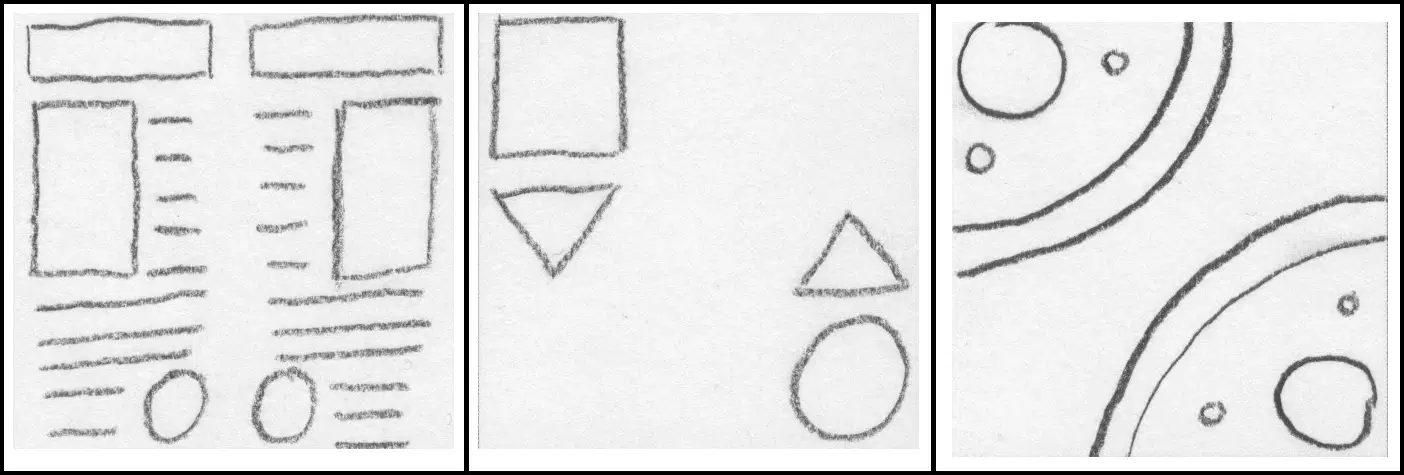
What Element of Design is how big or small something is?

This element can create hierarchy, especially with exaggerated scale.
a)
line
b)
shape
c)
value
d)
size
28.
What Element of Design is? An interwoven pattern that imparts a physical quality to a surface (rough, smooth, etc.).
a)
line
b)
shape
c)
texture
d)
rhythm
29.
What Element of Design is? A closed line. Can be geometric or organic. 2 dimensional.
a)
line
b)
value
c)
harmony
d)
shape
30.
What Element of Design is? A mark that is longer than it is wide. Linked points. “... a dot going for a walk.” – Paul Klee
a)
line
b)
shape
c)
dot array
d)
texture
31.
What Element of Design is? An element of art and design that has 3 properties: Hue, Value and Intensity.
a)
line
b)
color
c)
dot array
d)
saturation
32.
What Principle of Design does this image represent?
a)
contrast
b)
size
c)
alignment
d)
balance
33.
What Principle of Design does this image represent?
a)
movement
b)
unity
c)
emphasis
d)
balance
34.
What Principle of Design does this image represent?
a)
size
b)
alignment
c)
contrast
d)
balance
35.
What Principle of Design does this image represent?
a)
harmony
b)
repetition
c)
alignment
d)
balance
36.
What Principle of Design does this image represent?
a)
movement
b)
unity
c)
emphasis
d)
balance
37.
What Principle of Design does this image represent?
a)
contrast
b)
alignment
c)
rhythm
d)
unity
38.
What Principle of Design does this image represent?
a)
harmony
b)
rhythm
c)
alignment
d)
balance
39.
What Principle of Design does this image represent?
a)
harmony
b)
balance
c)
alignment
d)
contrast
40.
What Principle of Design does this image represent?
a)
contrast
b)
alignment
c)
harmony
d)
balance
41.
What Principle of Design? Can be symmetrical or asymmetrical, Elements convey a feeling of equal weight.
a)
repetition
b)
balance
c)
unity
d)
rhythm
42.

What Principle of Design? Uses other Elements/Principles (Size, Contrast, etc.) to make a particular part of the design stand out.

a)
movement
b)
balance
c)
emphasis
d)
rhythm
43.
What Principle of Design? Elements organized relative to each other (left, right, center, top, bottom, mid-line).
a)
repetition
b)
balance
c)
unity
d)
alignment
44.
What Principle of Design? A single Element used over and over. Can become a Pattern, which is a group of Elements used over and over.
a)
emphasis
b)
repetition
c)
contrast
d)
rhythm
45.
What Principle of Design? Elements are arranged to lead the eye through the design creating a sense of motion.
a)
repetition
b)
balance
c)
movement
d)
rhythm
46.
What Principle of Design? A measure of how well the Elements/Principles of the design work together to achieve the goal of the work. They fit together nicely, nothing feels out of place.
a)
unity
b)
value
c)
balance
d)
harmony
47.
What Principle of Design? Elements used repeatedly, creating a feeling of organized movement.
a)
rhythm
b)
repetition
c)
balance
d)
emphasis
48.
What Principle of Design? Opposite values (light/dark), textures (soft/spiky), scale (big/tiny), etc.
a)
repetition
b)
contrast
c)
unity
d)
rhythm
49.
What Principle of Design? Elements with similar traits that look pleasing when used together.
a)
rhythm
b)
harmony
c)
repetition
d)
unity
50.
What Design Process is used in brainstorming?
a)
kerning
b)
texture
c)
pre-press
d)
thumbnail sketches
51.
Graphic Design helps us to?
a)
all of these, and so much more
b)
navigate a city
c)
read a book
d)
choose a shampoo at the store
e)
vote
52.
Color Theory and Print Production When digital photographs are taken, the resolution is determined by
a)
dpi - dots per inch
b)
lpi - lines per inch
c)
pmt - photo mechanical transfer
d)
ppi - pixels per inch
53.
Graphic Design touches ____________________ our lives. What is the best choice to fill in the blank?
a)
the games we play in
b)
very little in
c)
almost every aspect of
d)
the products we buy in
54.

The primary goal of brainstorming is to

a)
refine ideas
b)
eliminate bad ideas
c)
generate A LOT of ideas
d)
choose the appropriate idea
55.
Typography The ability to easily read the text.
a)
kerning
b)
leading
c)
comprehension
d)
legibility
56.
Typography The ability to easily understand the text.
a)
leading
b)
comprehension
c)
legibility
d)
kerning
57.
Typography Especially important with large headlines and signage. The space between two letters.
a)
comprehension
b)
legibility
c)
kerning
d)
leading
58.
Typography The space between lines of type. Also known as line spacing.
a)
leading
b)
comprehension
c)
legibility
d)
kerning
59.
Typography Forced Line Breaks are when we send words to the next line by entering the "enter" key. We do this because we want to:
a)
make extra space.
b)
we actually don't want to do this.
c)
go into production.
d)

improve reading comprehension by "keeping thoughts together."

60.
Typography The overall spacing between the letters of a whole word (or line).
a)
x-height
b)
serif
c)
descender
d)
tracking
61.
Typography Very useful when organizing longer passages of text. Can be used for bullet points as well.
a)
paragraph spacing
b)
tracking
c)
ascender
d)
sans serif
62.
Typography Font category where the characters of a font have little "feet."
a)
sans serif
b)
eye
c)
serif
d)
tail
63.
Typography Font category where the characters of a font do NOT have little "feet."
a)
sans serif
b)
serif
c)
blackletter
d)
slab serif
64.
Typography Font category with heavily stylized fonts that are not suitable for body text.
a)
serif
b)
sans serif
c)
slab serif
d)
display
65.

Design Process Graphic Designers are most effective at solving their client's design challenges, and produce their best work, when they sit right down and crank out just one very finished design to present to their client.

a)
true
b)
false
66.
Design Process Making a collection of fonts, colors. styles, photos and designs that you find appealing and can serve as inspiration for the work you are about to create is known as a:
a)
mood board
b)
surf board
c)
charcuterie board
d)
font board
67.
Design Process Making a collection of the competing brands' marketing campaigns will NOT help you ensure your designs are unique.
a)
true
b)
false
68.
Intellectual Property ________________, protects the author. You need the author's permission to use their work.
a)
Public domain
b)
Copyright
c)
Fair use
d)
Creative commons
69.
Intellectual Property Use without permission under specific conditions (ex. limited, tranformative, educational) is known as ________________.
a)
Public domain
b)
Copyright
c)
Fair use
d)
Creative commons
70.
Intellectual Property ________________, is free for everyone, no one can own it.
a)
Public domain
b)
Copyright
c)
Fair use
d)
Creative commons
71.
Intellectual Property In a __________________ license, the author releases specific usage rights directly in the copyright (specific permissions in advance).
a)
Public domain
b)
Copyright
c)
Fair use
d)
Creative commons
72.
Intellectual Property With a __________________ license, the buyer pays a one-time fee, and can use the image over and over.
a)
software or font
b)
royalty-free
c)
rights-managed
d)
driver's
73.
Intellectual Property A _________________ license is for a specific use. If the buyer wants to use it again, they have to negotiate a fee for THAT use. Sometimes, exclusive rights can be negotiated.
a)
software or font
b)
royalty-free
c)
rights-managed
d)
driver's
74.
Intellectual Property _________________ licenses determine how/when the buyer can use them.
a)
software or font
b)
royalty-free
c)
rights-managed
d)
driver's
75.
Design Critique Gallery Walks are wonderful opportunities for students to experience the many ways that ideas can be interpreted and communicated. Whereas beauty is always in the eye of the belohder, Gallery Walks are a collaboration tool that can help the artist understand if the message they are looking to communicate is being received by the audience.
a)
true
b)
false