
 Worksheets
Forces and Motion
Total questions: 12
Worksheet time: 6mins
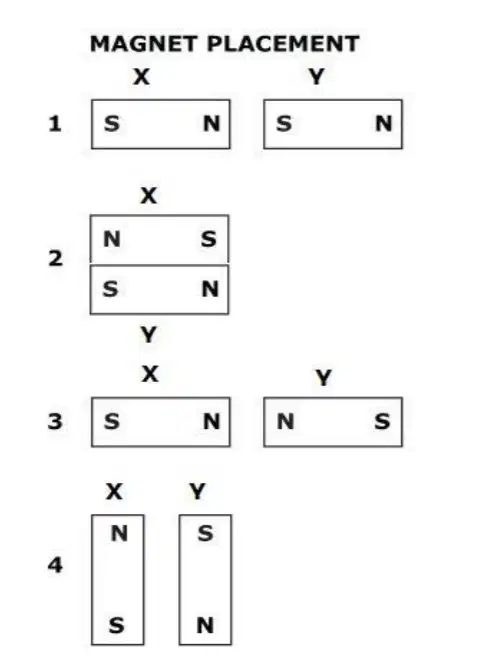
The diagram below shows pairs of magnets X and Y placed in different directions or together. Which placement will cause magnets X and Y to repel each other? SC.5.P.13.1
A person pushes a cart and the cart moves several meters. Which statement explains why the cart moved after the push, but the person remained in the same location? SC.5.P.13.2
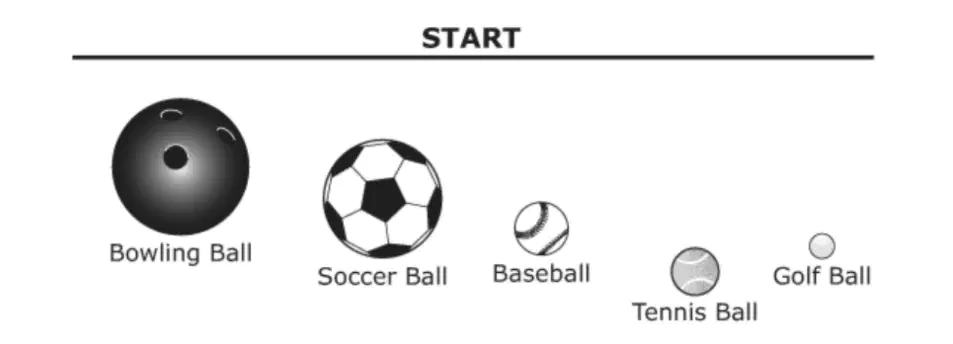
A group of students wanted to test how far five different balls would travel with a given force. They placed a golf ball, a tennis ball, a baseball, a soccer ball, and a bowling ball on the ground behind a start line. The students pushed each ball with the same amount of force. The distance each ball traveled from the start line is shown below. Which statement best explains why the bowling ball traveled the shortest distance? SC.5.P.13.2
Julie has several objects on a table. She moves a magnet towards the objects. Which object will likely NOT move when the magnet is near? SC.5.P.13.1
Heather tried to push a heavy desk across the floor but could not get it to move. Which sentence best explains why the desk did NOT move? SC.5.P.13.2
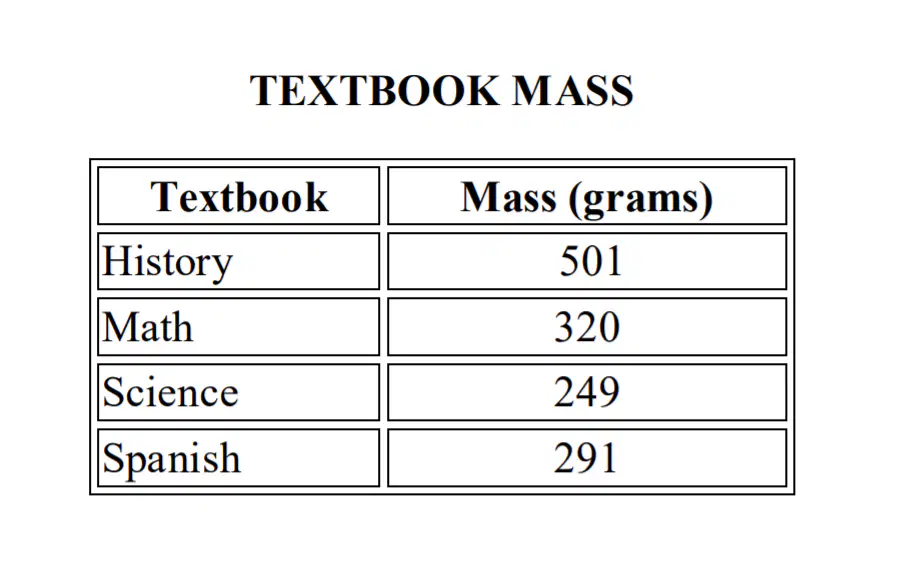
A student made the chart below to show the mass of several textbooks that she weighted using a triple bean balance. Each textbook is pulled separately across a table the same amount of distance. All of the textbooks have similar covers. Which statement is true about the amount of force it would take to move the textbooks across a able by pulling them? SC.5.P.13.2
When a toy car is released from the top of a ramp, it rolls down and then continues on the flat surface until it stops. Which statement best describes why the toy car eventually stops moving? SC.5.P.13.2
The force of gravity acting on the car increases, causing it to stop.
The car runs out of stored energy and comes to a stop.
Friction between the car's wheels and the surface eventually stops the car.
The car's motion is opposed by air resistance only.
Mark tries to push a heavy object across the floor, but it does not move. Erik helps Mark push the object, and it then moves. Which statement best describes why Mark was unable to move the object, and why Mark and Erik combined were able to move the object across the floor? SC.5.P.13.2
Josh is investigating magnets. He moves two long thing magnets toward each other. The magnets pull toward each other and stick together. Josh then turns one magnet around the opposite way. He repeats the investigation, keeping everything else the same. What will happen to the magnets? SC.5.P.13.1
An apple is on a teacher's desk. Why does the apple remain motionless and not fall to the ground? SC.5.P.13.1
Multiple forces, such as gravity and friction, act on a ball when it rolls down a smooth slope. Which statement describes how friction affects the motion of a ball traveling down a grassy slope? SC.5.P.13.2
A car accelerates down a hill, then continues on a flat road. Which statement best describes the forces acting on the car as it moves from the hill to the flat road?
Gravity is the only force acting on the car throughout its motion.
Friction increases as the car moves from the hill to the flat road, slowing it down.
The force of gravity decreases as the car moves to the flat road, causing it to slow down.
Air resistance and friction act against the car's motion, but gravity helps it move down the hill.

