
Font size
 Worksheets
Complex, Pedigrees, and Mutations
Total questions: 40
Worksheet time: 1hrs 11mins
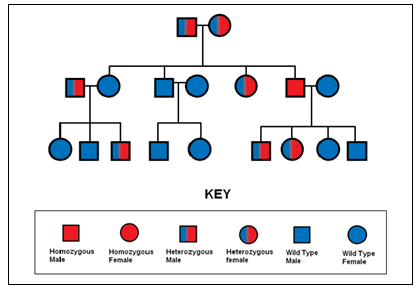
In a pedigree, which shape represents a male?
circle
square

On a pedigree, this symbol represents a ---
not affected female.
not affected male.
affected male.
affected female.

On a pedigree, this symbol represents a ----
not affected male.
not affected female.
affected male.
affected female.

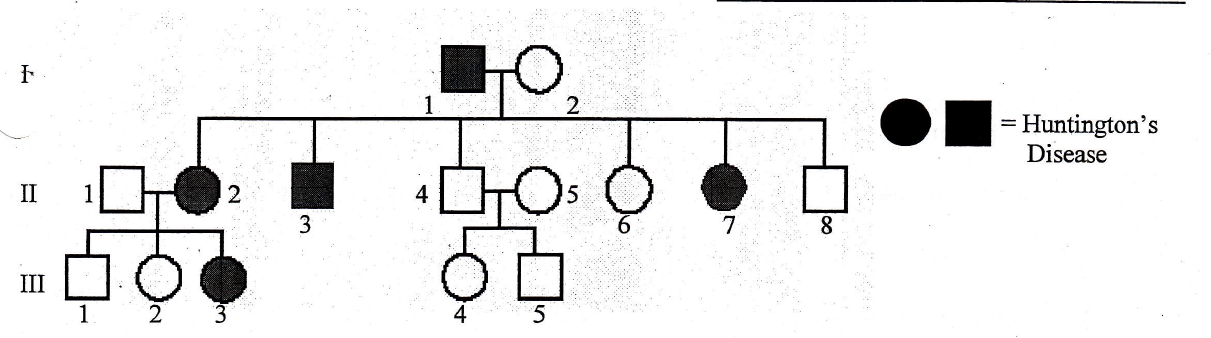
How many individuals are there in the 3rd generation?
1
2
4
6

How are individuals III-2 and II-4 related?
Brother and sister
Dad and daughter
Uncle and niece
Grandfather and granddaughter

The trait this pedigree traces is recessive because it skips a generation and individuals can be carriers. What is the most likely genotype for person III-3?
GG
Gg
gg


If this pedigree shows a recessive disorder, what MUST the genotype of individual 4 be?
HH
Hh
hh


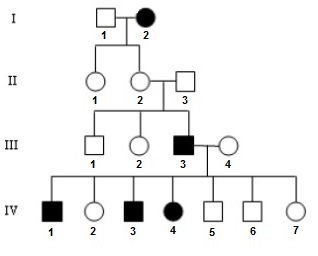

What is the correct genotype for individual I-2?


Generation 2 individuals 5 and 6 are
brother and sister.
cousins.
married.
not related.

In some chickens, feather color shows incomplete dominance. If a black chicken BB is mated with one that is blue (BW), what is the probability of having a chicken that is black?
1/4
1/2
3/4
100%
In snapdragons, flower color exhibits incomplete dominance. When crossed, red (RR) and white (WW) flowers make pink flowers (RW). Complete a cross between a pink flower and a red flower. Find the phenotype ratio.
1 red: 1 pink
4 red: 0 pink
4 pink: 0 white
1 pink: 1 white

In humans, there are three phenotypes for hair--curly, wavy, and straight. Hair texture shows incomplete dominance. Suppose two people with wavy hair have a child. What is the probability the child will have straight hair?
100%
0%
25%
50%

A purple-flowered plant (PP) is crossed with a white flowered plant (WW). The gene for petal color in these plants expresses incomplete dominance. What percentage of the offspring will have blue (PW) flowers?
0%
25%
50%
100%

Raccoons can exhibit three types of washing behaviors controlled by a gene that shows incomplete dominance. Some raccoons wash all of their food (WW) and some wash none of their food (NN). The heterozygotes wash some of their food. Two heterozygous raccoons mate. What percentage of their offspring are expected to wash some of their food?
0%
25%
50%
100%

Part of a chromosome
is deleted
Deletion Mutation-Gene
Translocation
Deletion Mutation -Chromosomal
Crossing Over

Part of a chromosome is repeated
Gene Mutation
Point Mutation
Deletion Mutation
Duplication Mutation

Part of a chromosome is reversed.
Inversion Mutation
Deletion Mutation
Translocation
Point Mutation

Part of one chromosome is transported and attached
to a non-homologous chromosome
Inversion Mutation
Translocation Mutation
Duplication Mutation
Point Mutation

Failure of homologous chromosomes
to separate during meiosis.
Results in gametes with either one extra or one missing chromosome.
Translocation
Nondisjunction
Replication
Transcription

This trait appears to be a (a) trait.
Label the correct parts
Click on the affected female in generation III.
Label the pedigree
Female without trait
Male with trait
Male without trait
Male carrier
Female with trait

Match the following shapes to what they would represent on a pedigree chart.

male that DOES express the trait.

female that DOES express the trait.

female that does NOT express the trait.

male that does NOT express the trait.
The pedigree shows the history of ADHD in a family.
Select the family member who is a son who does NOT have ADHD?
Label the parts of the following pedigree.

A tool that geneticists use to map out the inheritance of traits. (a)

This diagram is called a (a) .
Females are represented by (b) and males are represented by (c) .
This diagram shows (d) generations.
heredity chart
inheritance graph
Select person II-4

The following pedigree is for a dominant trait. Label the genotypes provided.
dd

