
 Worksheets
Year 9 Geography
Total questions: 70
Worksheet time: 43mins
What is the main cause of water evaporation from the ocean?
Heat energy from the Sun
Wind and wave action along the shore
Heat energy from the ocean floor
Currents in the ocean
(a) is the concentration of water vapour present in the air.
Relief rainfall occurs
on the windward side of a mountain
on the leeward side of a mountain
at the foot of a mountain
on the peak of a mountain

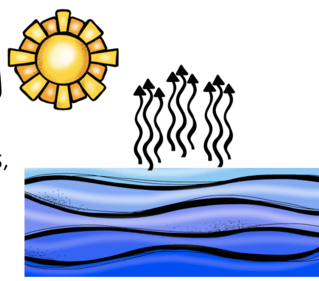
What step of the water cycle does this picture show?
Condensation
Runoff
Precipitation
Evaporation
The process when plants release water vapor from their leaves is called _____________.
precipitation
evaporation
transpiration
condensation
Condensation occurs when water vapor_____________.
heats up and becomes liquid water
cools off and becomes liquid water
freezes and becomes ice
rains on the land
What is precipitation?
Sweat from our bodies on hot days
Warm rain but not cold snow or sleet
Gas that we use in furnaces or ovens
Any form of water that falls from the sky

The image shows various stages in the water cycle. During which stage does water flow back towards the sea as runoff?
W
X
Y
Z
As a part of the water cycle, water from Earth's surface enters the clouds and finally falls back to the ground in the form of rain. What is the correct sequence of processes water undergoes?
Evaporation, Condensation, Precipitation
Precipitation, Condensation, Evaporation
Condensation, Evaporation, Precipitation
Evaporation, Precipitation, Condensation
What happens when warm air with water droplets meet cold air and become visible?
precipitation
evaporation
transpiration
condensation

These are examples of what?
precipitation
evaporation
transpiration
condensation
Puddles that disappear on a hot day is an example of......
transpiration
condensation
evaporation
precipitation

The stages of the water cycle are...
(think of the first stage)
evaporation
condensation
precipitation
condensation
water vapor
precipitation
wind
transpiration
sun
clouds
precipitation
evaporation
Constant movement of water is called________
water runoff
precipitation
condensation
the water cycle
Evaporation is when _________________________________________________________
water freezes
water changes
from a gas to a
liquid
water changes
from liquid to a
gas
plants use the
water from the rain
When is energy absorbed during the water cycle?
during evaporation
during transpiration
during condensation
during precipitation
What happens when water vapor loses thermal energy?
it expands into millions of droplets that form clouds
it condenses into millions of droplets that form clouds
it condenses into millions of droplets that form lakes and rivers
it expands on the surface of plants and goes into the air
Water vapor leaves a plant in the biosphere and goes into the atmosphere through
transpiration
respiration
precipitation
evaporation


What is another name or synonym for the water cycle?
Geologic cycle
Hydrologic cycle
Geosphere
Carbon cycle
Where does the energy needed for the water cycle to occur, come from?
The Moon
The Sun
Producers
Omnivores
(a) is one of the steps in the water cycle.
A river's ________________ is the starting point of the river.
source
triutaries
mouth
drainage basin
________________ are streams that flow together to make a river.
source
tributaries
mouth
drainage basin
The place where the river end in the sea or large lake is called the ___________.
source
tributaries
mouth
drainage basin
The area of land DRAINED by a river system is called the _____________
drainage basin
mouth
tributaries
source

What landform can you see in this picture?
Waterfall
V Shaped Valley
Meander
Ox-bow lake

What landform can you see in the picture?
Meanders
Rapids
Estuary
V shaped valleys


What helps create Waterfalls? (Choose 3)
Abrasion
Solution
Silting
Hydraulic Action


Which process involves large boulders and rocks being rolled along the river bed?
Saltation
Traction
Suspension
Solution
What is the edge of the river basin called?
waterside
waterway
watershed
water
What landform can you see in this picture?
Waterfall
V Shaped Valley
Meander
Ox-bow lake

In the upper course which process is dominant?
(a)
Which of these shows a river channel?


Which of these shows a diagram of a Drianage Basin?


_________ is where streams/rivers meet each other.
Confluence
Tributary
Mouth
Watershed
A _________ is a smaller stream/river that contributes to the main river a drainage basin.
Tributary
Mouth
Watershed
Source
The _________ is where the main river will eventually drain all its water into.
Mouth
Watershed
Source
Confluence

What is a river drainage basin?
The point in which 2 rivers meet.
A smaller river which enters a larger river.
The boundary between to drainage basins.
The start of a river.
The area of land drained by a river and its tributaries.
What is erosion?
The movement of sediment
The breaking of sediment
The dropping of sediment
Which of these is an example of erosion?
Light shinning onto a mountain
Rain breaking down rock
Wind blowing away sediment
All of the above
What type of changes does erosion cause?
Physical changes
Chemical changes
Electrical changes
Magnetic changes
How do sandy beaches form?
Waves pounding pebbles int smaller and smaller pieces
Wind eroding pebbles into smaller pieces
Water freezing and thawing the cracks of pebbles
Rain wearing away rocks into smaller and smaller pieces
Why is it hard to see glacial erosion in action?
Because glaciers are so big
Because light from glaciers refracts too much
Because glaciers move very, very slowly
Because glacial erosion is usually very subtle

The sand dune was formed by-
Water
Ice
Wind
Snow

What type of erosion create the structure in the picture?
wind erosion
water erosion
glacial erosion
mass wasting
The movement of people is...
Migration
Mobility
Immigration
Globalisation
Define Emigration.
to move from a country
to move to a country
the constant flow of migrannts from one country into another country
someone who seeks safety by going into another country
Define Refugee.
to move to a country
to move from a country
something taht encourages people to leave a country behind
someone who seeks safety by going to another country
What are the forces that encourage a migrant to actually move? (Check all that apply)
Social Forces
Environmental Forces
Economic Forces
Political Forces
All of the above
Select TWO push factors
persecution
better job opportunities
armed conflicts
political freedom
Which if the following is a push factor?
Natural Disasters
Better economic opportunities
to be with families and friends
to live in a better environment
the number of deaths each year per 1,000 people
population
birth rate
death rate
demography
the number of live births each year per 1,000 people
death rate
population
birth rate
population density

