
 Worksheets
BP Unit#4 Evolution
Total questions: 18
Worksheet time: 9mins
The beaks of finches found on various Galapagos Islands differed based on:
The available food supply
The size of their island
The length of their wings
The predators that hunted them
Species go extinct when:
They can't adapt to environmental changes quickly enough; think of the dinosaur.
They've survived for longer than ten million years.
Their genetic code changes.
They lose the ability to evolve.
What is evolution?
How organisms change over a long period of time.
When animals move to warmer climates in the winter.
When people breed organisms to get desirable traits.
Ancient rock layers and the fossils they contain.
What is a scientific theory?
An explanation for how a certain things happen, backed up by lots and lots of evidence.
An educated guess.
A conclusion based on only researching topics with which you agree.
The hypothesis in an experiment.
Which best describes the function of a vestigial structure?
It no longer has any function.
It has the same function it had in its ancestor.
It is a new structure that its ancestor did not have.
It's function has changed over time.
An adaptation is a trait that helps an organism do what?
Survive and reproduce
Run faster
Fight better
Become larger and stronger
In the phrase "survival of the fittest," to what does the term "fittest" refer?
The best-adapted organisms
The biggest organisms
The smartest organisms
The strongest organisms
What kind of mutation would be most beneficial to a population of giraffes living in an area with many tall trees?
Giraffes with longer necks have greater access to more food because they can reach leaves on higher tree branches.
Being able to run faster.
Having sharper horns
Living in a large herd.
What are the parts (or features) that lead to natural selection? Use page SJp.73
Overproduction, competition, variation, selection
Competition, selection, extinction
Selective breeding, evolution, competition
Observations, fossil record, competition, evolution
How did Darwin come up with the theory of evolution?
He compared thousands of species from his travels on the Beagle.
He learned about it in college and expanded the ideas.
He stole it from other scientists.
He and his friends developed it together.
What was Charles Darwin's main contribution to science?
He developed the theory of evolution by natural selection.
He was the first person to be captain of the British naval ship called the Beagle.
He disagreed with the modern theory of evolution.
He was the first person to see a finch.
When is a trait most likely to be passed on to the next generation? Choose the best answer.
When it becomes an advantage to the species' survival
When it serves no purpose to the species
When it prevents the species from finding a mate
When it gives the species an abundant supply of water
Which is most likely an evolutionary response of birds to a food supply of insects living in deep, narrow tunnels?
Birds' beaks get longer and thinner with each generation.
Birds begin eating bark and leaves instead.
Birds learn to plug up the tunnels, forcing the insects to the surface for air.
Birds get smaller with each generation, until they can fit inside the tunnels.
When nature "selects" a variation, that means that the trait:
Gets passed along from generation to generation
Causes the population to shrink
Has brought about a new species
Helps prey escape predators
All the various breeds of dogs are an example of which of these?
Selective breeding
A common ancestor
The natural pace of evolution
Extinction rates rising
How are the terms "evolution" and "natural selection" related?
Evolution is a process of change that we can observe, Natural Selection is the theory that explains how it happens.
Evolution is a guess about how life came to be, Natural Selection is a guess about why.
Evolution and Natural selection are synonyms and mean the same thing.
Evolution and natural selection are both different theories about the origin of life.
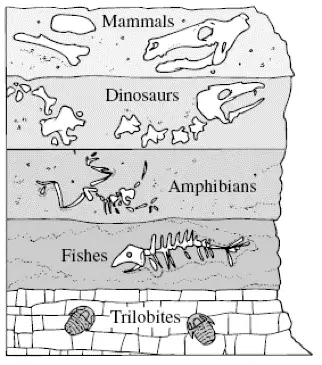
According to the fossil evidence provided in the image below, which type of organism evolved first? Remember this is sedimentary rock which means it laid down in layers over time, so the deepest layer is the oldest.
trilobites
mammals
dinosaurs
fishes
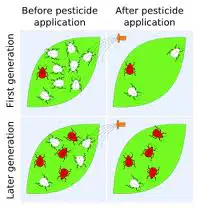
A population of insects is sprayed with a new insecticide. Most of the insects are killed but a few survive. In the next generation, many more of the insects are unaffected by the insecticide. Which of the following BEST explains these results?
A few insects in the first population were immune and passed this trait to their offspring.
The insects learned to fight off the insecticide.
The insects must have mutated to be more easily killed by the pesticide.
It means nothing. Spray them again; they will die this time.

