
NEW
Font size
 Worksheets
Magnetic Effects of Electric Current
Total questions: 25
Worksheet time: 13mins
Choose the incorrect statement from the following regarding magnetic lines of field
The direction of magnetic field at a point is taken to be the direction in which the north pole of a magnetic compass needle points
Magnetic field lines are closed curves
If magnetic field lines parallel and equidistant, they represent zero field strength
Relative strength of magnetic field is shown by the degree of closeness of the field lines
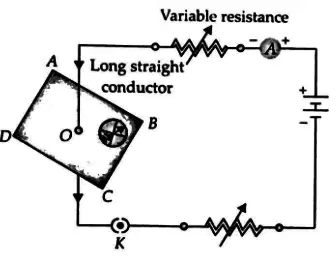
If the key in the arrangement (Fig.) is taken out (the circuit is made open) and magnetic field lines are drawn over the horizontal plane ABCD, the lines are
concentric circles
elliptical in shape
straight lines parallel to each other
concentric circles near the point O but of elliptical shapes as we go away from it

A constant current flows in a horizontal wire in the plane of the paper from east to west as shown in Fig. The direction of magnetic field at a point will be North to South.
directly above the wire
directly below the wire
at a point located in the plane of the paper, on the north side of the wire
at a point located in the plane of the paper, on the south side of the wire

A circular loop placed in a plane perpendicular to the plane of paper carries a current when the key is ON. The current as seen from points A and B (in the plane of paper and on the axis of the coil) is anti clockwise and clockwise respectively. The magnetic field lines point from B to A. The N-pole of the resultant magnet is on the face close to
A
B
A if the current is small, and B if the current is large
B if the current is small, and A if the current is large
The strength of magnetic field inside a long current carrying straight solenoid is
more at the ends than at the centre
minimum in the middle
same at all points
found to increase from one end to the other
For a current in a long straight solenoid N- and S-poles are created at the two ends. Among the following statements, the incorrect statement is:
The field lines inside the solenoid are in the form of straight lines which indicates that the magnetic field is the same at all points inside the solenoid
The strong magnetic field produced inside the solenoid can be used to magnetise a piece of magnetic material like soft iron, when placed inside the coil
The pattern of the magnetic field associated with the solenoid is different from the pattern of the magnetic field around a bar magnet
The N- and S-poles exchange position when the direction of current through the solenoid is reversed
Magnetic fields do not interact with
electric charges at rest
electric charges in motion
permanent magnets at rest
permanent magnets in motion.
A positive charge projected towards east is deflected towards north by a magnetic field. The magnetic field is directed
towards west
towards south
upward
downward
The force on a charged particle moving in a magnetic field is maximum when the angle between direction of motion and field is
zero
90⁰
180⁰
45⁰
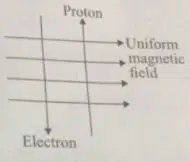
A uniform magnetic field exists in the plane of paper pointing from left to right as shown in Fig. In the field an electron and a proton move as shown. The electron and the proton experience
forces both pointing into the plane of paper
forces both pointing out of the plane of paper
forces pointing into the plane of paper and out of the plane of paper, respectively
force pointing opposite and along the direction of the uniform magnetic field respectively
Electromagnetic induction is involved in
charging a body with positive charge
production of current by relative motion between magnet and the coil
rotation of the coil of an electric motor
generation of magnetic field due to a current carrying solenoid.
Fleming's Right-hand rule gives:
magnitude of the induced current
magnitude of the magnetic field
direction of the induced current
both, direction and magnitude of the induced current.
The device based on the principle of electromagnetic induction is
electric generator
electric motor
voltmeter
ammeter.
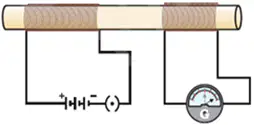
In the arrangement shown in Fig. there are two coils wound on a non-conducting cylindrical rod. Initially the key is not inserted. Then the key is inserted and later removed. Then
the deflection in the galvanometer remains zero throughout
there is a momentary deflection in the galvanometer but it dies out shortly and there is no effect when the key is removed
there are momentary galvanometer deflections that die out shortly, the deflections are in the same direction
there are momentary galvanometer deflections that die out shortly, the deflection are in opposite directions
Choose the incorrect statement
Fleming's right-hand rule is a simple rule to know the direction of induced current
The right-hand thumb rule is used to find the direction of magnetic fields due to current carrying conductors
The difference between the direct and alternating currents is that the direct current always flows in one direction, whereas the alternating current reverses its direction periodically
In India, the AC changes direction after every 1/50 second
To convert an AC generator into DC generator
split-ring type commutator must be used
slip rings and brushes must be used
a stronger magnetic field has to be used
a rectangular wire loop has to be used
The most important safety method used for protecting home appliances from short circuiting or overloading is
earthing
use of fuse
use of stabilizers
use of electric meter
The electric fuse and switches should be connected to
live wire
neutral wire
earth wire
none of these.
An alternating current is that current which changes regularly its
magnitude
direction
both magnitude and direction
none of these.
The frequency of A.C. mains used in India is
30 cps
50 cps
60 cps
120 cps.
A current is flowing in a circular loop of wire in clockwise direction. The magnetic field at the centre of the loop is
directed downward
zero
inversely proportional to the radius of the loop
both (a and c)
A bar magnet is moved along the axis of a copper ring placed far away from the magnet. Looking from the side of the magnet an anticlockwise current is found to be induced in the ring. In this situation
the S-pole faces the ring and the magnet moves towards it
the N-pole faces the ring and the magnet moves towards it
the N-pole faces the ring and the magnet moves away from it.
both (b and c)
Assertion (A): If an electron, while coming vertically from outer space, enters the earth's magnetic field, it is deflected towards west.
Reason (R): Electron has negative charge.
Both (A) and (R) are true and (R) is the correct explanation of the assertion (A).
Both (A) and (R) are true but (R) is not the correct explanation of the assertion (A).
(A) is true but (R) is false.
(A) is false but (R) is true.
Assertion (A): An induced emf is generated when magnet is withdrawn from the solenoid.
Reason (R): The relative motion between magnet and solenoid induces emf.
Both (A) and (R) are true and (R) is the correct explanation of the assertion (A).
Both (A) and (R) are true but (R) is not the correct explanation of the assertion (A).
(A) is true but (R) is false.
(A) is false but (R) is true.
Assertion (A): At high temperatures, metal wires have a greater chance of short circuiting.
Reason (R): Both resistance and resistivity of a material vary with temperature.
Both (A) and (R) are true and (R) is the correct explanation of the assertion (A).
Both (A) and (R) are true but (R) is not the correct explanation of the assertion (A).
(A) is true but (R) is false.
(A) is false but (R) is true

