
 Worksheets
9189PH2CWPPT1Q1
Total questions: 48
Worksheet time: 24mins
What is the term used to describe the formation of hard limescale that sticks to the inside of pipes and appliances due to the presence of salts and minerals in water?
Condensation
Precipitation
Evaporation
Filtration
Which of the following is NOT a method used to prevent the precipitation of limescale in water systems?
Water conditioners
Water softeners
Water filters
Water heaters
Scaling problems in water systems are more likely to occur in which type of water areas?
Soft water areas
Hard water areas
Saltwater areas
Freshwater areas
What is the consequence of precipitation in water systems on appliances?
Increases the appliance's efficiency
Changes the color of the appliance
Makes the appliance unusable in some cases and reduces efficiency
Has no effect on the appliance
What is the purpose of a magnetic water conditioner in a cold water service to the property?
It adds zinc to the water to suppress the formation of calcium crystals.
It uses dissolved hardness salts and minerals to cluster together on surfaces.
It prevents scale build-up by influencing the type of calcium crystals precipitated.
It washes away any crystals that are formed by the flow of water.
Which type of water conditioner is used for individual appliance protection, such as a combi boiler?
Electronic (electromagnetic) water conditioner
Electrolytic water conditioner
Magnetic water conditioner
None of the above
How do electrolytic water conditioners work?
By adding a minute amount of zinc to the water.
By using magnetic fields to change calcium crystal formation.
By clustering dissolved hardness salts and minerals together.
By heating the water to prevent scale build-up.
What is the function of an electronic (electromagnetic) water conditioner?
It adds zinc to the water to suppress the formation of calcium crystals.
It prevents scale build-up by influencing the type of calcium crystals precipitated.
Changes the shape of the limestone to stop it clumping together
It is used for individual appliance protection only.
What is the purpose of a water softener?
To heat water
To remove water hardness
To filter out contaminants
To store excess water
Where are water softeners usually installed in relation to the water's main entry into the building?
Far from the main entry
Outside the building
As close to the main entry as possible
In the bathroom only
Can modern water softeners be easily fitted under a kitchen sink?
No, they require a separate room
Yes, but they require special equipment
No, they are too large
Yes, they are very compact
What is the purpose of drinking water filters according to the text?
To increase water pressure
To alter the water composition to improve its taste, odour, and appearance
To cool the water
To add minerals to the water
Where are plumbed-in filters usually installed?
In the bathroom
Underneath the kitchen sink
Outside the house
In the refrigerator
What is the purpose of an activated carbon filter in drinking water systems?
To increase the mineral content in the water
To reduce taste and odour such as chlorine
To add beneficial bacteria to the water
To heat the water
What is the principle behind ion exchange filters?
They filter water using ultraviolet light
They increase the pH level of the water
They work by replacing minerals or contaminants with salt ions
They cool the water down
How do sediment filters work to clean drinking water?
By dissolving impurities in the water
By using chemical reactions to purify water
By trapping fine particles as water passes through a mesh
By introducing oxygen to oxidize contaminants
What is the purpose of reverse osmosis in drinking water filters?
To add essential minerals to the water
To remove most of the dissolved mineral content by passing the water through a very fine membrane
To change the pH level of the water
To infuse the water with carbon dioxide
How does distillation purify water?
By adding chlorine to the water
By exposing the water to ultraviolet light
By boiling the water and condensing the steam back to water vapour
By passing the water through a series of coarse filters
What method is used in disinfection to reduce the bacteria content in water?
By adding fluoride to the water
By using ultraviolet light or a very fine sediment filter
By increasing the water temperature to boiling point
By introducing beneficial bacteria to the water
What is a characteristic of direct cold water systems in modern domestic properties?
They require a separate storage tank.
They are not suitable for drinking.
They operate at high pressure
They operate at low pressure.
Why are direct cold water systems considered cost-effective?
They use complex piping systems.
They have little or no pipework or components in loft and can run off 15mm pipe
They require frequent maintenance.
They are only used in commercial properties.
What is the quality of water supplied by all cold water taps in a direct cold water system?
Non-potable
Potable
Filtered
Heated
What is typically used to supply cold water to the hot water cylinder in a direct cold water system?
A 100-litre cistern
A 150-litre cistern
A combi boiler
Mains water supply
Is a feed cistern necessary in a direct cold water system when the hot water is supplied by an instantaneous hot water heater or combi boiler?
Yes, it is always necessary
No, unless incoming pressure is unusually low
Yes, but only for combi boilers
No, it is never necessary
How are both hot and cold water supplies fed in modern direct cold water systems?
From a feed cistern
From separate storage tanks
Directly from the mains
Through a central heating system
What size should the rising main be for a 3–4 bedroom home to supply most cold water demands, including the bath?
15mm
22mm
28mm
150mm
If a hot water storage cylinder is installed, what size should the cold feed be from a 150-litre cold water storage cistern?
15mm
22mm
28mm
150mm
What size might larger installations require for the rising main, depending on the system requirements?
15mm
22mm
28mm
150mm
Where does the cold main connect first in an indirect system?
Directly to the outlets
To the cistern in the roof space
To the kitchen sink
To the WC cistern
According to the Water Regulations, what should all properties have for drinking water?
An indirect connection to the main
A direct connection to the cold water storage cistern
At least one outlet connected directly to the main
Multiple outlets connected directly to the main
Which outlet is directly fed for drinking water in an indirect system?
The WC cistern
The bath
The kitchen sink
The wash hand basin
What is the minimum capacity for a water cistern in an indirect plumbing system?
100 litres
230 litres
150 litres
300 litres
In an indirect plumbing system, which outlet is usually fed directly from the main?
Bathroom
Toilet
Kitchen
Wash Basin
What is the purpose of the vented hot water storage vessel in an indirect plumbing system?
To store cold water
To heat the water directly
To vent excess hot water
To store hot water
What size rising cold water main is generally sufficient for a 3-4 bedroom home in an indirect system?
10mm
15mm
20mm
25mm
How is the kitchen sink typically supplied in an indirect system?
Via a 22mm pipework
Directly via 15mm pipework
With a 28mm pipework
Through a 10mm pipework
What size distribution pipe is used from the cistern to washbasins, WC, and bath in an indirect system?
15mm
20mm
22mm
28mm
What size pipe is recommended from the cold water storage cistern to the hot water cylinder?
15mm
20mm
22mm
28mm
For what reason does the bath require a 22mm straight through pipe in an indirect system?
Due to the high pressure
Because of the small demand and high pressure
Due to the large demand and relatively low pressure
Because it is the standard size for all fixtures
Why are indirect systems particularly useful in certain properties?
They require less maintenance.
They are useful if the property is in a low-pressure area where mains supply pipework is not capable of supplying the full requirements of the system.
They are cheaper to install.
They use less water.
What is one of the purposes of storing a reserve of water in indirect systems?
To reduce water bills.
To provide better water quality.
To have a reserve in the event of mains water failure.
To increase water pressure.
Where is a water meter typically installed in new installations?
Inside the property's main bathroom
At the boundary to the property in the external stop-valve chamber
Directly underneath the kitchen sink
In the attic next to the water storage system
What is an alternative location for a water meter if it is not installed at the boundary to the property?
Inside an internal groundbreaker-type meter box on the side of the property
Attached to the external wall of the property without any cover
Buried in the garden without any protective box
Installed within the roof space for temperature regulation
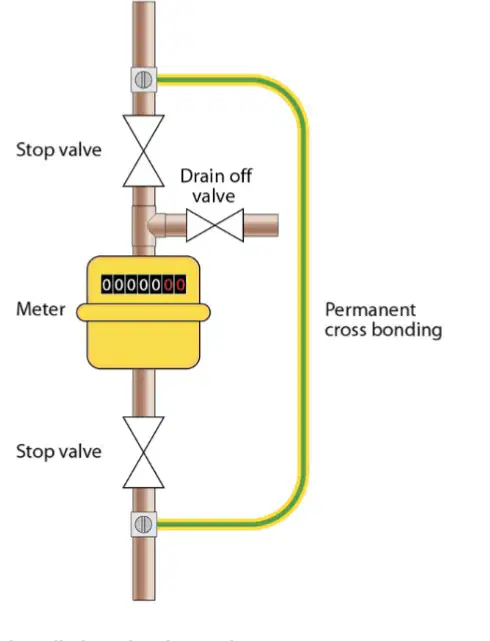
What is the purpose of the permanent cross bonding shown in the diagram of an internal water meter installation?
To measure the water pressure
To prevent water theft
To provide electrical safety
To regulate water temperature
What is one of the advantages of a direct water system?
Reserve of stored water
Greater wear on fittings
Good pressure
Risk of frost damage in loft space
Which of the following is a disadvantage of an indirect water system?
Drinking water at all outlets
Increased cost of installation
Smaller pipe sizes, generally
Better for unvented HW systems
What is a benefit of an indirect system over a direct system during high-demand periods?
No reserve of stored water
Pressure may fluctuate during high demand
Reduced demand on the main
Colder pipework may condensate
Which system is likely to have less structural support required in the loft?
Indirect system
Direct system
Both systems equally
Neither system

