
 Worksheets
AP Respiratory System Test
Total questions: 44
Worksheet time: 24mins
Name
Class
Date
1.
Another word for breathing is ventilation.
a)
True
b)
False
2.
The organs of the upper respiratory tract are located outside the thorax.
a)
True
b)
False
3.
The pharynx is an enlargement at the top of the trachea that houses the vocal cords.
a)
True
b)
False
4.
The left lung is larger than the right lung and is divided into three lobes.
a)
True
b)
False
5.
The pectoralis minor muscles and the sternocleidomastoid muscles are used in forced expiration.
a)
True
b)
False
6.
The greatest amount of carbon dioxide transported in the blood is in the form of dissolved carbon dioxide.
a)
True
b)
False
7.
Oxygen is carried in the blood in the form of bicarbonate ions and is bound to hemoglobin.
a)
True
b)
False
8.
The process called__________ involves gas exchange between the atmosphere and the cells of the body and the resulting chemical reactions that provide the cells with energy to function.
a)
breathing
b)
oxidation
c)
respiration
d)
metabolism
9.
Describe the process of ventilation.
a)
Delivery of oxygen to cells
b)
Forcible movement of oxygen molecules into the bloodstream
c)
Delivery of carbon dioxide to cells
d)
Movement of air into and out of lungs
10.
Which of the following does not contain a paranasal sinus?
a)
maxilla
b)
frontal bone
c)
sphenoid bone
d)
zygomatic bone
11.
Where are the vocal cords located?
a)
In the pharynx
b)
In the larynx
c)
In the trachea
d)
In the oral cavity
12.
Which of the following is not a function of the mucus-lined nasal passages?
a)
Warming inspired air
b)
Moistening inspired air
c)
Trapping small particles
d)
Cooling exhaled air
13.
What determines the intensity (volume) of a vocal sound?
a)
Force of air passing over the vocal cords
b)
Tension of the vocal cords
c)
Size of the laryngeal cartilages
d)
Shape of the laryngeal cartilages
14.
What is the correct order of structures, from superior to inferior?
a)
Nasopharynx → oropharynx → laryngopharynx
b)
Oropharynx → laryngopharynx → nasopharynx
c)
Oropharynx → nasopharynx → laryngopharynx
d)
Laryngopharynx → oropharynx → nasopharynx
15.
The pharynx functions as a passageway for__________, whereas the larynx functions as a passageway for__________.
a)
passageway for air and food; passageway for food only
b)
passageway for air only; passageway for air and food
c)
passageway for air and food; passageway for air only
d)
passageway for food only; passageway for air only
16.
What changes occur as the respiratory tract branches into smaller and smaller tubes?
a)
They have relatively more cartilage.
b)
They have relatively thicker epithelial lining.
c)
Their epithelial lining changes to connective tissue.
d)
Their epithelial lining becomes thinner.
17.
The right lung has__________ lobes; the left lung has__________ lobes.
a)
three; two
b)
two; two
c)
three; three
d)
two; three
18.
What causes air to move into the lungs during inspiration?
a)
Pressure gradient between atomosphere and alveoli
b)
Muscle contraction of upper airways
c)
Concentration gradients for oxygen and carbon dioxide
d)
Partial pressure gradients for oxygen and carbon dioxide
19.
What drives the air out of the lungs during quiet expiration?
a)
Contraction of the diaphragm
b)
Contraction of the external intercostal muscles
c)
Surface tension and the elastic recoil of lung tissues
d)
Contraction of smooth muscles in airways
20.
Following a normal inspiration, the volume of additional air that enters the lungs during forced maximal inspiration is called the__________.
a)
inspiratory reserve volume
b)
expiratory reserve volume
c)
vital capacity
d)
tidal volume
21.
Which of the following respiratory volumes is the largest?
a)
expiratory reserve volume
b)
inspiratory reserve volume
c)
residual volume
d)
tidal volume
22.
What would happen to partial pressures of gases in the blood if the breathing rate did not increase with physical exercise?
a)
They would remain unchanged.
b)
Partial pressure of CO2 in the blood would drop.
c)
Partial pressure of O2 in the blood would increase.
d)
Partial pressure of CO2 in the blood would increase.
23.
What normally holds the visceral and parietal pleural membranes together?
a)
loose connective tissue
b)
dense connective tissue
c)
thin film of serous fluid
d)
surfactant
24.
Name the volume of air that is moved in (or out) during a single quiet respiratory cycle.
a)
inspiratory reserve volume
b)
Vital capacity
c)
Tidal volume
d)
Expiratory reserve volume
25.
Which of the following occurs first, causing inspiration?
a)
The diaphragm moves downward and the external intercostal muscles contract.
b)
Atmospheric pressure forces air into the respiratory tract.
c)
Intra-alveolar pressure decreases.
d)
The lungs inflate.
26.
According to Boyle's law, as the volume of a container decreases,__________.
a)
the pressure increases
b)
the temperature decreases
c)
the pressure decreases
d)
the temperature increases
27.
A__________ is a sudden inspiration caused by a spasmodic contraction of the diaphragm while the glottis is closed.
a)
yawn
b)
laugh
c)
sneeze
d)
hiccup
28.
"I'm going to hold my breath until I die and it will be all your fault!" shrieked 6-year-old Riley at her father. Why would she be unable to carry out her threat?
a)
The diaphragm will begin to fatigue and will not be able to hold its contracted position for more than a short period of time.
b)
Increased CO2 and hydrogen ion concentrations and decreased oxygen concentration stimulate her chemoreceptors, triggering inspiration.
c)
Decreased CO2 and hydrogen ion concentrations and increased oxygen concentration stimulate her chemoreceptors, triggering inspiration.
d)
The inflation reflex would not her allow to keep her lungs full of air for a prolonged period. The reflex would trigger inspiration.
29.
Receptors called__________ are located in the ventral part of the medulla oblongata near the origin of the vagus nerve.
a)
baroreceptors
b)
mechanoreceptors
c)
central chemoreceptors
d)
peripheral chemoreceptors
30.
Why are the concentrations of CO2 and H+ more important to respiratory control than the concentration of O2?
a)
Both CO2 and H+ are much smaller than O2 molecules, allowing them easier access to the chemoreceptors.
b)
Since carbon dioxide and hydrogen ion are transported in the blood as CO2 and H+, and since O2 is bound to hemoglobin, the free CO2 and H+ are better able to stimulate chemoreceptors.
c)
The oxygen levels remain high in the blood even after O2 delivery to tissues, so during normal functioning, O2 levels do not typically drop low enough to put the cells in danger.
d)
Neither the peripheral or central chemoreceptors have receptor sites specific for O2.
31.
Which of the following has an effect on the pH of blood?
a)
Oxygen
b)
Phosphate
c)
Carbon Dioxide
d)
Nitrogen
32.
What is the result of hyperventilation?
a)
Decreased PCO2 and decreased pH
b)
Decreased PCO2 and increased pH
c)
Increased PCO2 and decreased pH
d)
Increased PCO2 and increased pH
33.
What protein can transport some of the carbon dioxide in the blood?
a)
hemoglobin
b)
carbonic anhydrase
c)
heme
d)
albumin
34.
The volume of air called__________ is the portion of inhaled air that does not reach the alveoli and, therefore, does not participate in gas exchange.
a)
alveolar dead space
b)
anatomic dead space
c)
minute ventilation
d)
alveolar ventilation
35.
What respiratory volumes, when added together, equal the vital capacity?
a)
VC = TV + IRV + ERV
b)
VC = TV + IRV
c)
VC = ERV + RV
d)
VC = IC + FRC
36.
How is oxygen transported in the blood?
a)
98% bound to hemoglobin; 2% dissolved in plasma
b)
95% bound to hemoglobin; 3% bound to albumin; 2% dissolved in plasma
c)
90% bound to hemoglobin; 10% dissolved in plasma
d)
100% bound to hemoglobin
37.
How is carbon dioxide transported in the blood?
a)
70% transported as HCO3-; 23% bound to hemoglobin; 7% dissolved in plasma
b)
98% bound to hemoglobin; 2% transported as HCO3-
c)
50% transported as HCO3-; 25% bound to hemoglobin; 25% dissolved in plasma
d)
95% transported as HCO3-; 3% bound to hemoglobin; 2% dissolved in plasma
38.
The large cartilage at the front of the larynx is called the (a) cartilage.
39.
The (a) is the cartilaginous structure at the base of the tongue that helps to prevent food and liquid from entering the trachea during swallowing.
40.
The layer of serous membrane that is firmly attached to the surface of a lung is called the (a) .
41.
In a mixture of gases, each gas creates a pressure called its (a) pressure.
42.
Carbon dioxide combines with (a) to form carbonic acid.
43.
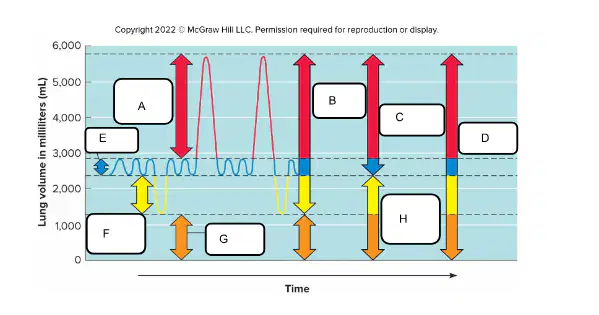
Match the following
a)
A
1.
Inspiratory reserve volume
b)
B
2.
Vital Capacity
c)
C
3.
Inspiratory Capacity
d)
D
4.
Total Lung Capacity
44.

Match the following
a)
E
1.
Tidal Volume
b)
F
2.
Expiratory reserve Volume
c)
G
3.
Residual Volume
d)
H
4.
Functional Residual Capacity
100 %

