
NEW
Font size
 Worksheets
9189PH2CWPPT6Q1
Total questions: 28
Worksheet time: 14mins
What is the range of outputs for the different types of electric showers available on the market?
5kW to 10kW
8.5kW to 11kW
7kW to 12kW
9kW to 13kW
What is the minimum water pressure most electric showers operate on?
0.5 bar
1 bar
1.5 bar
2 bar
Are there electric shower models available for cistern-fed cold water supplies?
Yes, but only for high-pressure systems
No, they are only for mains water supply
Yes, some models are available
No, electric showers do not support cistern-fed systems
What do shower mixing valves fed from a storage cistern require to maintain the correct mixing ratio of hot and cold water?
Different pressures on the hot and cold supplies
Equal pressures on both the hot and cold supplies
Higher pressure on the cold supply only
Higher pressure on the hot supply only
Which type of valve is considered the safest for maintaining a constant temperature irrespective of the temperature of the incoming hot and cold supplies?
Manual valve
Thermostatic valve
Ordinary mixing valve
Pressure-balanced valve
Are ordinary mixing valves used with cistern-fed supplies thermostatically controlled?
Yes, they are always thermostatically controlled.
No, ordinary mixing valves are not thermostatically controlled.
Yes, but only with additional equipment.
It depends on the brand of the valve.
What is the minimum head required to create enough pressure for a reasonable gravity fed shower?
0.5m
1m
1.5m
2m
Where should the connection of cold water feed to the cylinder be made in relation to the cold feed for the shower?
At the same level
Lower than the cold for the shower
Higher than the cold for the shower
Outside the building
At what angle should the connection to the cylinder be made?
90°
45°
30°
60°
What diameter should the pipe be taken as far as possible before reducing to 15mm for a gravity-fed shower installation?
15mm
22mm
25mm
30mm
What is the purpose of having the connection of cold water feed to the cylinder higher than the cold for the shower in a twin impeller pump system?
To ensure that cold water runs out first
To allow air from the cylinder to escape
To ensure the hot water from runs out first
To make the installation process easier
What is the recommended pipe size to be taken as far as possible before reducing to 15mm in a pump-assisted shower installation with a twin impeller?
15mm
22mm
30mm
10mm
What is the purpose of a pump in a shower system?
To decrease the pressure of the water
To increase the temperature of the water
To increase the pressure of the hot and cold water supplies independently
To mix the water to the correct temperature
What happens before the water flows to the showerhead?
The water is heated to the correct temperature
The water pressure is decreased
The water is mixed to the correct temperature in the valve
The flow switches are turned off
What is the purpose of a single impeller pump in a shower installation?
To decrease water pressure before it reaches the mixer valve
To boost the water after it has left the mixer valve
To mix hot and cold water before it reaches the shower head
To filter impurities from the water before it is heated
Where is the connection of cold water feed to the cylinder in relation to the cold feed for the shower in the diagram?
It is lower so that the cold water runs out first
It is at the same level for equal pressure
It is higher so that the hot water runs out first
There is no connection to the cylinder in the diagram
What is a negative head in the context of shower pump installations?
A) A situation where the water pressure is too high.
B) A condition where the cistern is higher than the pump.
C) A scenario where the cistern is lower than the shower head
D) A malfunction that occurs when the shower is turned off.
What purpose does a small accumulator or pressure vessel serve in negative head shower pumps?
A) It decreases the water pressure in the system.
B) It 'piggybacks' the pump to help start it.
C) It stores extra water for when the shower is in use.
D) It shuts off the flow of water when the shower is turned off.
What happens when the shower valve is opened in a negative head situation?
A) The pressure within the system increases.
B) The accumulator is deactivated.
C) The pressure within the system suddenly drops.
D) The flow switch is turned off.
How is the flow switch activated in a negative head shower pump system?
A) By turning off the shower valve.
B) By the accumulator forcing a small amount of water out through a small plastic tube.
C) By increasing the water pressure manually.
D) By the pump automatically shutting down.
What occurs once the flow switch is activated in a negative head shower pump system?
A) The shower pump stops running.
B) The shower pump runs at negative head.
C) The water pressure in the system is reduced permanently.
D) The accumulator refills with water.
What happens to the shower pump pressure after the shower is turned off in a negative head situation?
A) The pressure remains charged at the shower pump pressure until the valve is opened again.
B) The pressure immediately drops to zero.
C) The pressure gradually increases until the valve is opened again.
D) The pressure fluctuates until the system stabilizes.
What is the function of the Essex flange in the diagram?
A) To connect the shower pump to the mains water supply
B) To connect the shower pump to the hot water storage cylinder
C) To isolate the shower pump from the water system
D) To regulate the pressure of water going to the shower pump
What category of cross-contamination occurs when there is a cross-connection from hot (cat 2) to cold (cat 1)?
Cat 1
Cat 2
Cat 3
Cat 4
What category of cross-contamination is associated with a shower hose that may be partially or fully submerged in the shower base, basin, or bath?
Cat 1
Cat 2
Cat 3
Cat 4
How can cross-contamination from hot to cold be prevented in plumbing systems according to the learning material?
By using a double check valve
By using a single check valve, normally built into the mixer valve
By installing separate pipes for hot and cold water
By using a pressure relief valve
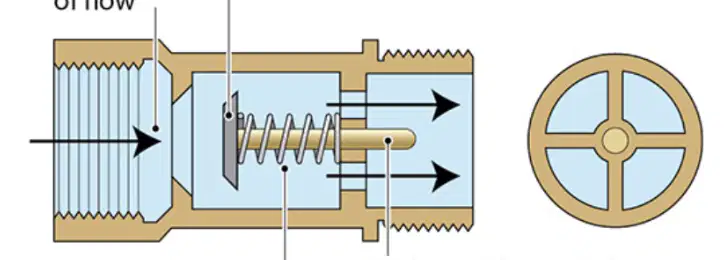
What type of check valve is depicted in the diagram for protecting the mains cold water supply when a shower mixer valve is fitted?
Type AB verifiable double check valve
Type EB non-verifiable single check valve
Type BC verifiable single check valve
Type DA non-verifiable double check valve
What is the purpose of the spring-loaded valve in the non-verifiable single check valve?
To regulate water temperature
To control water pressure
To prevent backflow
To filter water impurities

