
NEW
Font size
 Worksheets
NC 6E1
Total questions: 10
Worksheet time: 13mins
Which object has a gravitational force so strong that is forms the center of the solar system?
Earth
the Moon
the Sun
Mercury
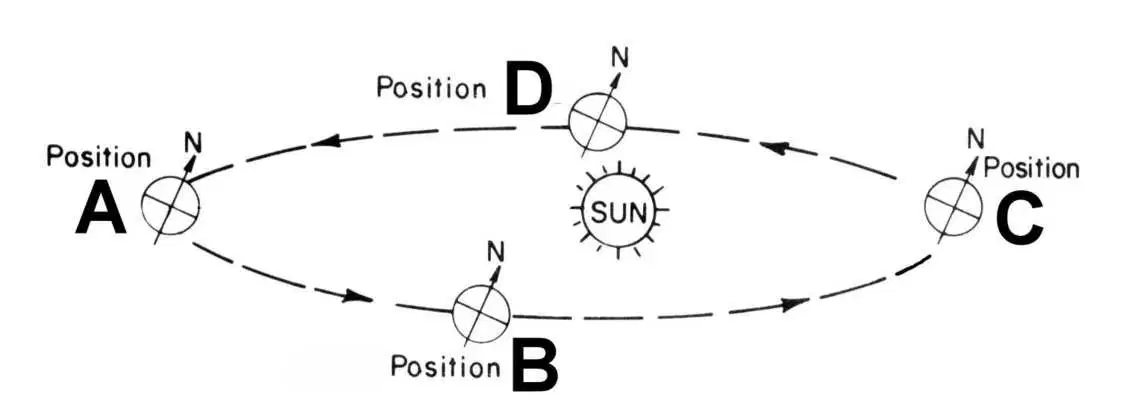
The diagram shows the Earth revolving around the Sun.
Which position of Earth shows summer in North America?
Position A
Position B
Position C
Position D

Why are Earth's high tides at their highest when the Sun, Moon, and Earth are lined up like in the picture?
The moon is blocking the gravity of the Sun.
The gravity on Earth is pulling the Moon.
The Sun's gravity increases as the moon is pulled away from Earth.
The Sun's gravity and the Moon's gravity are pulling in the same direction.
Which model correctly shows the position for the Sun, moon, and Earth during a solar eclipse?


All of these are examples of how the moon and Earth interact EXCEPT-
The phases of the moon.
The tides on Earth.
Seasons on Earth.
Lunar eclipses.
When the lighted half of the moon faces the Sun and the dark half faces the Earth -the phase of the moon as viewed from Earth is called;
Full moon
New moon
Waxing Gibbous
Waning crescent
Of the planets in the solar system - which characteristic is unique to planet Earth?
Orbited by a moon.
Has a gravitational field.
Revolves around the Sun.
Covered mostly by water.

What causes day and night?
The Earth orbiting the Sun.
The moon orbiting the sun.
The Earth rotating on its axis.
The moon orbiting the Earth.
To which planet does the National Aeronautics and Space Administration (NASA) scientists hope to send humans?
Venus
Jupiter
Mercury
Mars
Which properties are MOST important to sustaining life on Earth?
Time of rotation and revolution.
Distance from the sun and rocky/watery surface.
Elliptical shaped orbit and rocky/watery surface.
Orbit time and distance from the sun.

