
NEW
Font size
 Worksheets
HPLC test
Total questions: 20
Worksheet time: 20mins

What happens to the given substance under reverse phase conditions when the pH of the mobile phase is raised?
Retention time doesn't change
Retention time will increase
Retention time will decrease
Which of the following mobile phases would provide the strongest elution conditions in reversed phase chromatography?
50% water, 50% acetonitrile
50% water, 25% acetonitrile, 25% THF
100% acetonitrile
50% acetonitrile, 50% THF

What will happen with the retention time of the given molecule in reversed-phase HPLC if the water content of the mobile phase is increased?
Increase
Decrease
Stay the same
Rank the solvents in order of increasing strength under HILIC conditions. Place the weakest solvent first and the strongest last.
Water – Methanol – Acetonitrile – Isopropanol
Water – Acetonitrile – Isopropanol – Methanol
Water – Methanol – Acetonitrile – Isopropanol
Acetonitrile – Isopropanol – Methanol – Water
What is the most commonly used stationary phase in reversed phase chromatography?
C18
Silicagel
C8
Carbon
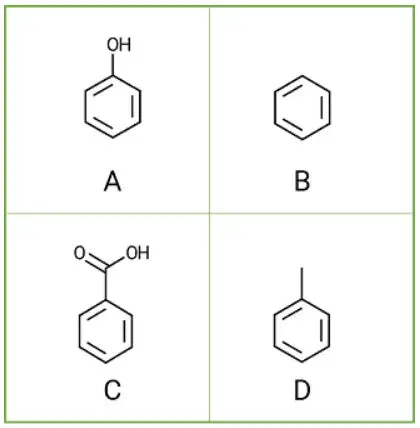
In what order will these substances elute from the column in reverse-phase chromatography? Start with the least retained substance.
C A D B
A C D B
B A C D
C A B D

In what order will these substances elute from the column in reverse phase chromatography? Start with the least retained substance.
C A B D
B A C D
C B A D
A B D C
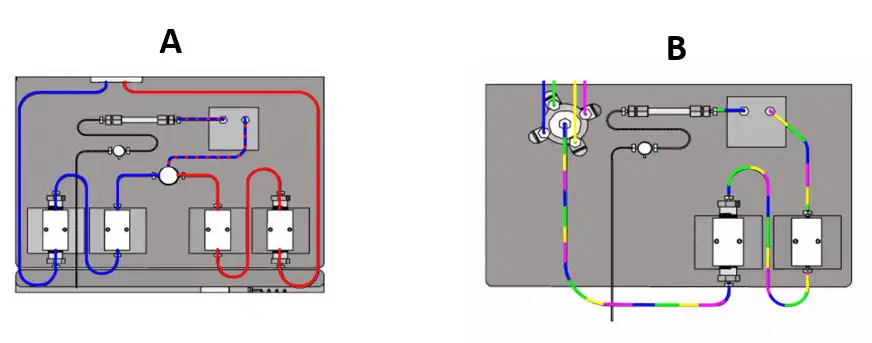
Which one is the binary pump?
A
B
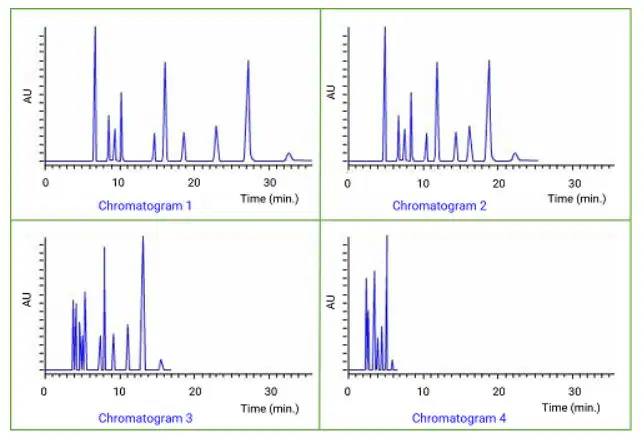
The chromatograms shown were obtained with four different mobile phase systems (same sample, reverse phase conditions): 30% THF, 30% acetonitrile, 30% methanol, and 40% methanol.
Which chromatogram was obtained with 30% methanol?
1
2
3
4
What is the purpose of gradient elution in HPLC?
To increase retention time
To reduce resolution
Improve the separation of complex mixtures
To reduce the pressure drop in the column
What is the main principle of high performance liquid chromatography (HPLC)?
Separation based on the interaction of compounds with the stationary phase
Separation based on solubility of compounds
Separation based on boiling points of compounds
Separation based on the molecular size of compounds
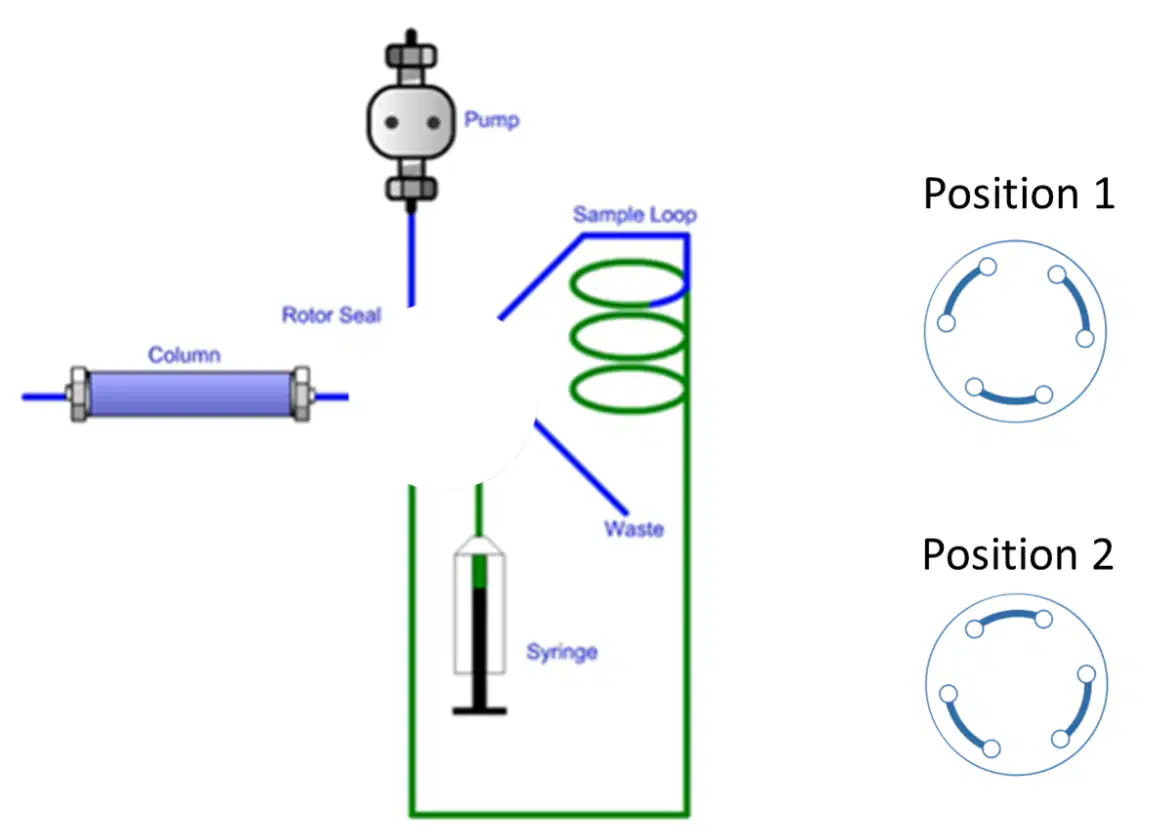
In what position should the sample inlet valve be in order to transfer the sample to the column?
1
2
What would be the most suitable mobile phase pH for the analysis of this substance mixture using liquid chromatography?
Cysteine (Cys): pKa1 = 1.92, pKa2 = 8.18
Arginine (Arg): pKa1 = 2.18, pKa2 = 9.04, pKa3 = 12.48
Tyrosine (Tyr): pKa1 = 2.20, pKa2 = 9.11
Methionine (Met): pKa1 = 2.28, pKa2 = 9.21
2
4
6
8
10
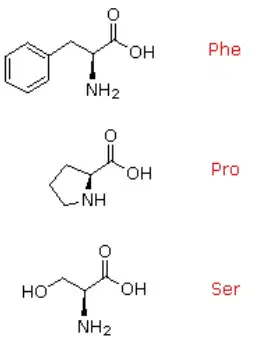
What will be the order of elution of the given substances in HILIC mode?
Phe-Pro-Ser
Phe-Ser-Pro
Pro-Phe-Ser
Pro-Ser-Phe
Ser-Phe-Pro

Under HILIC conditions analyte retention ________ mobile phase polarity
decreases with
increases with
is not affected by

In HILIC gradient applications the water composition is increased during the analysis
True
False

Which of the analyte isomers shown will have the longest retention time in normal phase HPLC using a silica stationary phase?
A
B
C

A variable wavelength detector can be used to achieve which of the following:
Record UV spectra during data acquisition
Measure absorbance at multiple wavelengths simultaneously
Measure absorbance at a single wavelength

What is the configuration of the autosampler shown in the schematic?
Pull to fill
Push to fill
Integral loop

The purpose of the injection system is to introduce a volume of sample solvent into the mobile phase flow without broadening the chromatographic band or introducing excessive amounts of
Sample
Air
Organic solvent
Mobile phase

