
 Worksheets
OLYMPHYSICS (SIMULATION 1)
Total questions: 18
Worksheet time: 18mins
If the mass of one object doubles, the mass of the other object is quadrupled and the distance between the two object is halved, how does the gravitational force change?
Increases 16 times
Increases 32 times
Increases 2 times
Increases 4 times
Two objects, A and B, have masses of 1500 g and 8750 g, respectively. The gravitational force between these two objects is 0.2189 nanoNewtons. Calculate the distance between these two objects.
1 m
2 m
1000 m
2000 m
A hydraulic lift is used to raise a heavy object weighing 2000 Newtons. The input piston has a diameter of 0.02 meters, while the output piston has a diameter of 0.2 meters. Calculate the force required to exert on the smaller piston to lift the object using Pascal's principle.
400,000 N
300,000 N
100,000 N
200,000 N
A cube has a density of 650 kg/m³ and a buoyant force of 15 N is fully submerged in water. Find the dimension of the cube.
0.0024 m
0.0015 m
0.12 m
0.11 m
Two balloons attract each other with a force of 4.05 µN at a separation distance of 5 meters. If one balloon has a charge of +2.5 nC, then find the charge of the second balloon.
- 4.5 nC
4.5 nC
4.5 µC
-4.5 µC
An object has a resistance of 25 kOhms at 25 degrees Celsius. What is the final temperature if the resistance of an object increased to 25.105 kohms. (use: resistivity = 5.6x10^-5 ohm-meter)
125 degrees C
0 degrees C
75 degrees C
100 degrees C

Find the total current of the circuit.
(Clue: 10 ohms and 20 ohms are in series)
0.6 A
0.29 A
0.33 A
0.21 A
A metal rod with an original length of 2 meters undergoes temperature changes. If the rod experiences a temperature increase from 25 degrees C to 38 degrees Celsius and a change in length of 5 mm, then determine the coefficient of area expansion.
1.92 x 10 ^ -4 per degree Celsius
3.85 x 10 ^ -4 per degree Celsius
5.77 x 10 ^ -4 per degree Celsius
A Carnot heat engine with an efficiency of 62% is operating a hot reservoir at 900 K. Determine the operation of the engine on a cold reservoir.
271 K
900 K
342 K
2369 J
A scientist is conducting an experiment involving water weighing 250 grams at 25°C. The goal is to raise the temperature of the water to 100°C, and then completely evaporate it into water vapor at 100°C. Given the specific heat of water is 4.18 J/g∘C and the latent heat of vaporization for water is 2265 J/g, calculate the total heat energy required for this entire process.
644,625 J
696,875 J
42,469,795 J
70,782,295 J
A car is traveling on a banked curve with a radius of 50 meters. The banking angle is 20 degrees. The coefficient of static friction between the tires and the road is 0.4. Determine the maximum speed at which the car can safely navigate the curve without skidding.
18 m/s
20 m/s
22 m/s
29 m/s
A car is traveling on a straight road with an initial velocity of 25 m/s. The car accelerates at a rate of 2 m/s² in 350 meters. Determine the total time duration during this acceleration period.
10 s
5 s
8 s
16 s
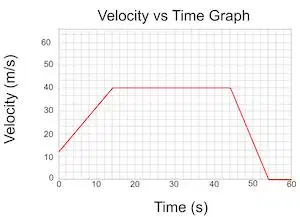
A, B, C, D, and F indicates the endpoints of each segment. Interpret the acceleration in segment CD.
Constant Acceleration
Zero Acceleration
Increasing Acceleration
Decreasing Acceleration
A man is moving 15 meters (25 degrees SE), 10 meters (N), and 8 meters (30 degrees W of N). Determine the resultant of the vector.
11 N
14 N
22 N
29 N
A particle moves in the xy-plane with its position given by the vector
x(t) = (3t^3 + 3t) i + (5t^2 - 2t) j, where t is the time in seconds. Determine the acceleration at t = 5s.
100
80
70
20
An ambulance is moving at 50 m/s towards an observer walking at 1 m/s towards the ambulance. The ambulance's horn emits a sound wave with a frequency of 1500 Hz. Determine the frequency of the sound wave observed by the walking observer as the ambulance moves away after passing.
1310 Hz
1760 Hz
1750 Hz
2000 Hz
A 60 kg runner is moving to the left with a velocity of 5 m/s. It collides and sticks with an 80 kg runner moving to the right with a velocity of 2 m/s. After the collision, the two person stick together until they fell to the ground. Determine the final velocity after the collision.
-1 m/s
1 m/s
2 m/s
2 m/s
A 750 kg roller coaster car starts from rest at a height of 50 meters on a frictionless track. The track consists of a steep drop followed by an uphill slope. The roller coaster descends the drop, reaching a speed of 20 m/s at the bottom. After that, it goes up the slope, coming to rest momentarily before descending another identical drop. The roller coaster continues this pattern indefinitely. Calculate the speed of the roller coaster at the top of the first hill.
10 m/s
25 m/s
31 m/s
35 m/s

