
 Worksheets
BSE unit 5 lesson 5 effective planning and procedures
Total questions: 52
Worksheet time: 26mins
What is the main objective of lean construction principles and tools?
To increase the complexity of planning and control
To facilitate planning and control, maximise value, and reduce waste throughout a project
To focus solely on individual tasks rather than the whole process
To prioritize competitive working over collaborative efforts
How can lean principles be applied fully and effectively in construction?
By focusing on individual tasks rather than the whole process
By ensuring that competitive working is the main value
By focusing on improving the whole process and ensuring collaborative working is a core value
By reducing the planning phase and starting construction immediately
What is one of the principles of lean construction mentioned in the learning material?
Focus on the competition.
Focus on the customer (client).
Ignore process management.
Increase waste and inefficiency.
According to the principles of lean construction, what should be standardized?
Customer feedback.
Approaches to construction activities.
Work environment aesthetics.
Variation in processes.
What is a key focus in lean construction to manage and improve processes?
Increasing complexity.
Reducing standardization.
Reducing variation.
Ignoring customer needs.
What is the goal of focusing on delivering in lean construction?
Delivering the minimum value.
Delivering the best aesthetics.
Delivering the best value.
Delivering the most expensive solution.
What does lean construction aim to improve regarding efficiency?
Improve efficiency and maximize waste.
Improve efficiency and minimize waste.
Worsen efficiency and minimize waste.
Ignore efficiency and focus on costs.
What should be ensured for the work environment in lean construction?
It should be artistic and visually appealing.
It should be clean and safe.
It should be expensive and high-tech.
It should be complex and challenging.
What is the focus related to review and improvement in lean construction?
Focus on intermittent review and improvement.
Focus on annual review and improvement.
Focus on continuous review and improvement.
No focus on review and improvement.
What is the focus of lean construction?
Minimizing costs at all stages
Striving for continuous improvement and ensuring value for stakeholders
Reducing the time required for project completion
Increasing the number of projects undertaken
What does creating a culture of feedback and collaborative working help to focus on?
Reducing employee turnover
Focusing on continuous improvement
Increasing profit margins
Expanding the business
Which of the following can be carried out to focus on continuous improvement?
Market research
Audits and formal reviews
Investment in new technology
Restructuring the organization
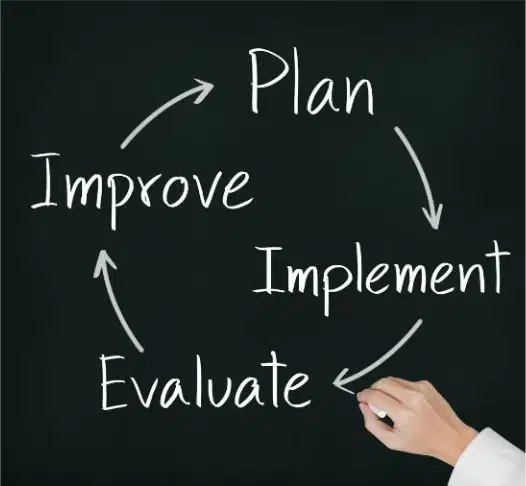
What does the cycle of continuous improvement include according to the diagram?
Design, Build, Test, Launch
Plan, Do, Check, Act
Plan, Implement, Evaluate, Improve
Analyze, Design, Develop, Implement
What is the main benefit of Just in Time (JIT) deliveries in construction?
It increases the need for storage space.
It reduces the risk of materials being damaged while stored on site.
It requires more manpower for handling materials.
It is only effective for small construction projects.
Why is supply chain integration important in Just in Time (JIT) deliveries?
To decrease the effectiveness of JIT.
To increase the cost of materials.
To maximise the effectiveness of JIT.
To prolong the delivery times of materials.
What is a prime example of Just in Time (JIT) delivery mentioned in the text?
Steel beams that are prefabricated off-site.
Concrete that is ordered and delivered exactly when the site is ready for it to be poured.
Electrical components that are delivered months in advance.
Tools that are rented on a daily basis.
What is a key principle of BIM and lean construction?
Competitive working
Independent initiatives
Collaborative working
Reducing costs only
What do BIM and lean construction share?
Different core values
The same core values
No commonalities
The same cost reduction techniques
What does BIM help to identify and focus on?
Increasing productivity only
Design clashes and reducing waste
Time management
Cost estimation
Which of the following is NOT represented as a core value in the diagram associated with BIM and lean construction?
Safety
Cost
Competition
Time
What do lean principles focus on in management?
Standardized activities only
Value over cost
Remedial works
Time delays
What is the main driver for continuously focusing on improvement according to the text?
Avoiding extra costs
The management team
The customer and their experience
Standardized activities
What can the management team focus on by fully understanding the processes involved in the delivery of a project?
Increasing time delays
Adding extra costs
Getting it right the first time to avoid the need for remedial works
Focusing on standardized activities
What is one of the key aspects of lean thinking during construction according to the T Level Technical Qualification in Building Services Engineering for Construction?
Cost reduction strategies
Clear communication
Increased inventory levels
Automation of manual tasks
Which practice linked to CDM 2015 is part of lean thinking during construction?
Individual working practices
Collaborative working practices
Competitive working practices
Independent working practices
What is emphasized for the workforce as part of lean thinking during construction?
Training and CPD
Overtime work
Self-learning
Freelancing
What is considered important for boosting productivity in the context of lean thinking during construction?
High morale in the workforce
Strict supervision
Financial incentives
Punitive measures
What type of meetings are encouraged to ensure that all workers are well informed?
Annual general meetings
Regular meetings and toolbox talks
Sporadic meetings
Online-only meetings
What does the use of AR and VR in construction ensure according to the text?
It ensures that construction is completed faster.
It ensures that client requirements are met aesthetically.
It ensures better communication between team members.
It ensures reduced material costs.
What is the focus of value management in construction?
Reducing the time required for construction.
Focusing on client values.
Increasing the profit margins.
Improving the safety on the construction site.
What does the use of integrated design involving BIM encourage?
It encourages independent work among contractors.
It encourages close cooperation between clients, designers, and contractors.
It encourages a reduction in design quality for faster completion.
It encourages the use of traditional construction methods.
What are the benefits of standardisation and prefabrication of processes and components in construction?
They increase the complexity of construction projects.
They lead to higher construction costs.
They improve quality, reduce costs, and prevent time delays.
They discourage innovation in construction methods.
Which of the following is NOT a benefit of advanced manufacturing techniques in lean construction as mentioned in the text?
Easier to design, plan, and execute projects
Reduction in waste materials
Increased digitisation of design and planning
Decreased precision in measurements
What is the main advantage of constructing modular architecture off site according to the text?
It allows for the construction process to become more expensive
It improves the efficiency of the construction
It requires more on-site storage
It decreases the standardisation of construction
How does the digitisation of the design and planning stages impact the construction process?
It makes the construction process less precise
It increases the time needed for construction
It ensures extremely precise measurements and plans
It has no impact on the efficiency of the construction
What is the purpose of conservation in the context of heritage buildings?
To change the structure of historic buildings completely
To maintain and manage change to a heritage building in a way that sustains and enhances its significance
To demolish old buildings to make way for new construction
To restrict any kind of changes to historic buildings
What is a benefit of preserving historic buildings mentioned in the text?
Increasing the cost of housing
Reducing the availability of housing
Helping to regenerate areas through tourism or other investment
Decreasing the cultural value of a region
What factors determine the restrictions on the types of work that can be carried out on heritage sites?
The age of the building
The color of the materials
The significance of the site
The personal preference of the owner
Which of the following is NOT listed as a category of heritage sites given protection?
World Heritage Sites
Listed Monuments
Registered Battlefields
Commercial Shopping Centers
Why has the city of Bath been designated a UNESCO World Heritage Site?
Because of its Victorian architecture
Because of its Georgian architecture
Because of its Roman origins and 18th century stone architecture
Because of its modern skyscrapers
What is Harrods Village?
A Grade I Listed castle
A Grade II Listed apartment block
A shopping mall
A university building
What was Harrods Village formerly known as?
A famous hotel
A royal residence
The London landmark shop's furniture warehouse
A historical museum
What is a feature of many UK towns and cities in terms of heritage conservation?
They have modernized all historical areas
They have conservation areas, such as bridges and ancient walls
They have no historical buildings left
They have replaced all old buildings with new constructions
What percentage of listed buildings in England are Grade I?
91.7%
5.8%
2.5%
50%
Which grade of listed buildings represents buildings of exceptional interest?
Grade II
Grade II*
Grade I
Grade III
Grade II* listed buildings are important because they are:
Buildings of no special interest
Buildings of exceptional interest
Buildings of more than special interest
Buildings of standard interest
What is the National Heritage list?
A list detailing modern buildings in England
A list containing the details of all listed buildings in England
A list of all buildings in need of repair in England
A list of newly constructed buildings in England
Which grade of listed buildings is the most common in England?
Grade I
Grade II*
Grade II
Grade III
What is required for demolition, alteration or extension works that affect the character of a listed building with special architectural or historic interest?
A) A special permit from the building owner
B) Listed building consent from the local planning authority
C) Approval from the national government
D) A petition signed by the local community
What must the materials used in works on listed buildings be in line with?
A) The most modern design standards
B) The original design to protect the building’s aesthetics
C) The cheapest available options
D) The personal preference of the building owner
What did The Planning Act (Listed Buildings and Conservation Areas) 1990 introduce?
A) Special controls for the alteration, extension, and demolition of structures of historic or architectural special interest
B) A new tax on listed buildings
C) A ban on all construction works on listed buildings
D) A grant scheme for the renovation of old buildings
Under The Planning Act (Listed Buildings and Conservation Areas) 1990, who has obligations to protect heritage buildings and their settings?
A) The national government
B) Local planning authorities
C) Building contractors
D) International heritage organizations

