
 Worksheets
Unit 4 - done
Total questions: 56
Worksheet time: 44mins
Export/ import financing in which a bank acts as an intermediary without accepting financial risk is called documentary collection.
True
False
A sight draft extends the period of time following delivery by which the importer must pay for the goods.
True
False
A revocable letter of credit allows the bank issuing the letter to modify the terms of the letter only after obtaining the approval of both exporter and importer
True
False
A confirmed letter of credit is guaranteed by both the exporter's bank in the country of export and the importer's bank in the country of import
True
False
The advance payment method reduces the risk of non-shipment that the importer faces under the open account method
True
False
Which of these financing methods comprises the highest risk for importers?
Documentary collection
Advance payment
Letter of credit
Open account
Which of these financing methods comprises the highest risk for exporters?
Documentary collection
Advance payment
Letter of credit
Open account
A document ordering the importer to pay the exporter a specified sum of money at a specified time is called a(n)
bill of lading
letter of credit
bill of exchange
airway bill
Which of these requires the importer to pay when goods are delivered?
A sight draft
A bill of lading
A time draft
An air way bill
A contract between the exporter and carrier that specifies destination and shipping costs of the merchandise is called a(n)
draft
bill of lading
letter of credit
bill of exchange
Export/import financing in which the importer's bank issues a document that the bank will pay the exporter when the exporter fulfills the terms of the document is called a (n)
draft
bill of lading
letter of credit
bill of exchange
Which of these allows the bank issuing the letter to modify the terms of the letter only after obtaining the approval of both exporter and importer
A revocable letter of credit
A confirmed letter of credit
A bill of lading
An irrevocable letter of credit
Which of these can be modified by the issuing bank without obtaining approval from either the exporter or the importer?
A revocable letter of credit
A confirmed letter of credit
A bill of lading
An irrevocable letter of credit.
. _______ is guaranteed by both the exporter's bank in the country of export and the importer's bank in the country of import.
A revocable letter of credit
A confirmed letter of credit
A bill of lading
An irrevocable letter of credit
Export/ import financing in which a bank acts as an intermediary without accepting financial risk is called (a) .
A document ordering an importer to pay an exporter a specified sum or money at a specified time is called a (an) (a) . (2 đáp án viết liền)
Export/ import financing in which the importer's bank issues a document stating that the bank will pay the exporter when the exporter fulfills the terms of the document is called a (an) (a)
A contract between the exporter and carrier that specifies destination and shipping costs of the merchandise is called a(n) (a) .
Export / import financing in which an exporter ships merchandise and later bills the importer for its value is called (a) .
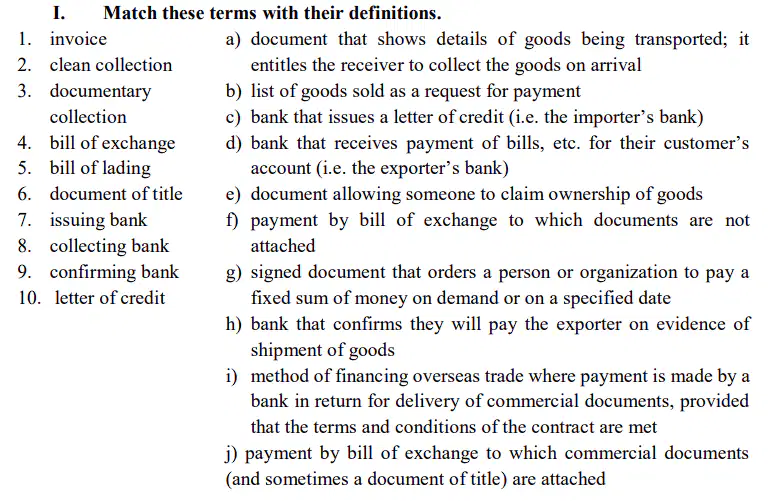
a) document that shows details of goods being transported; it entitles the receiver to collect the goods on arrival
(a)
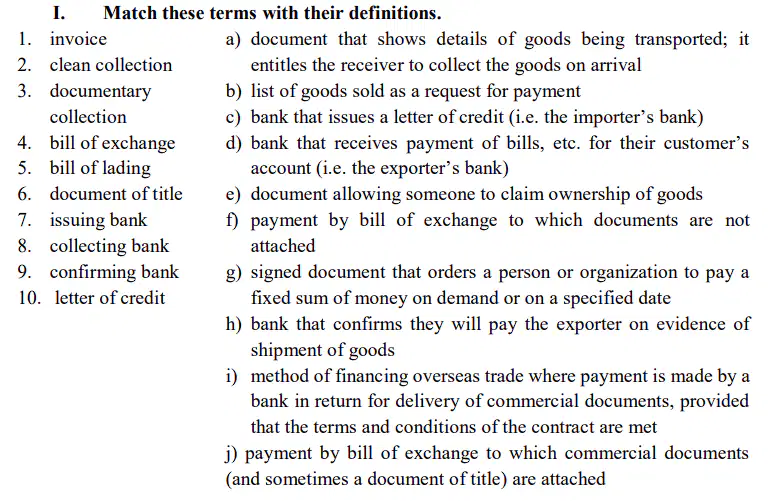
b) list of goods sold as a request for payment
(a)
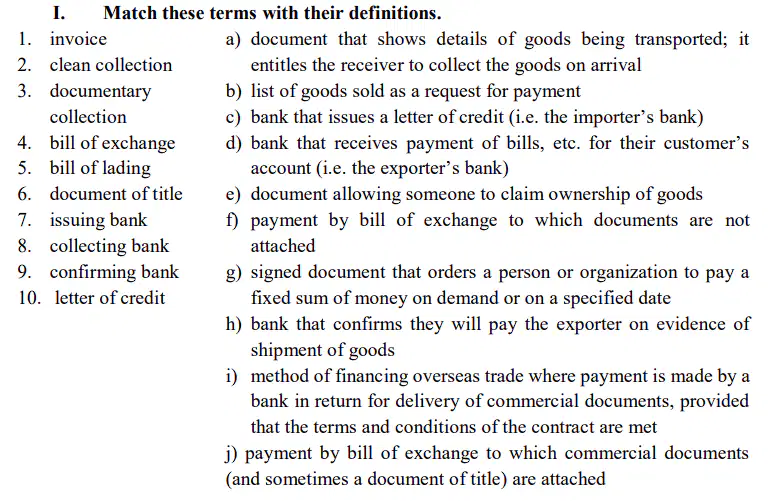
c) bank that issues a letter of credit (i.e. the importer’s bank)
(a)
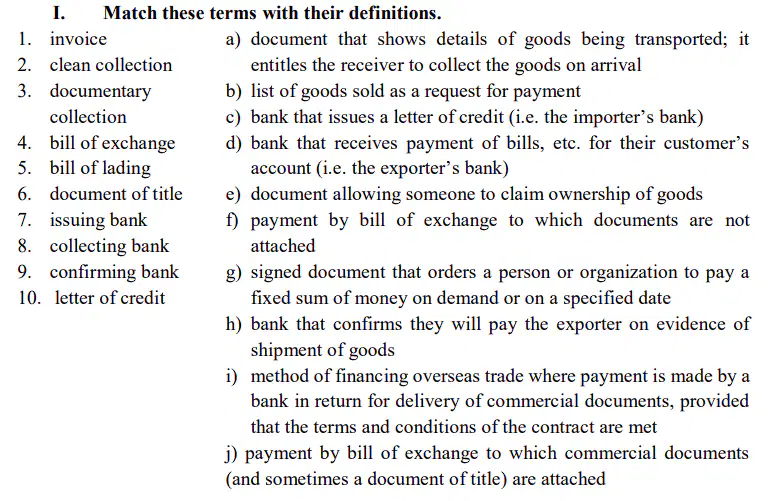
d) bank that receives payment of bills, etc. for their customer’s account (i.e. the exporter’s bank)
(a)
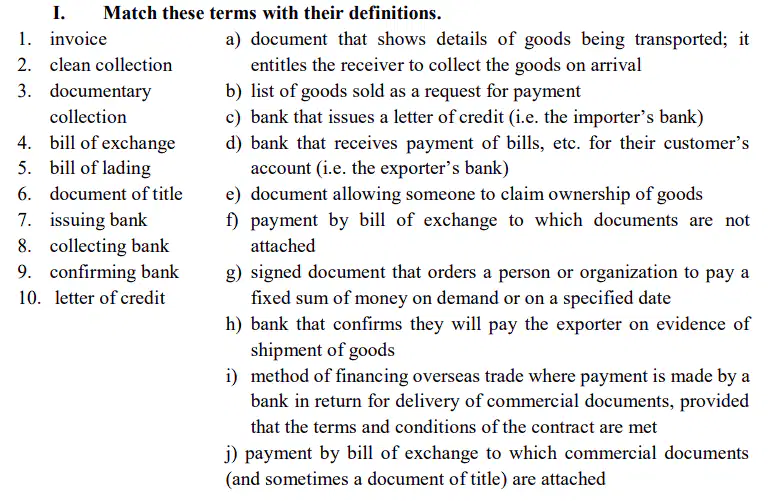
e) document allowing someone to claim ownership of goods
(a)
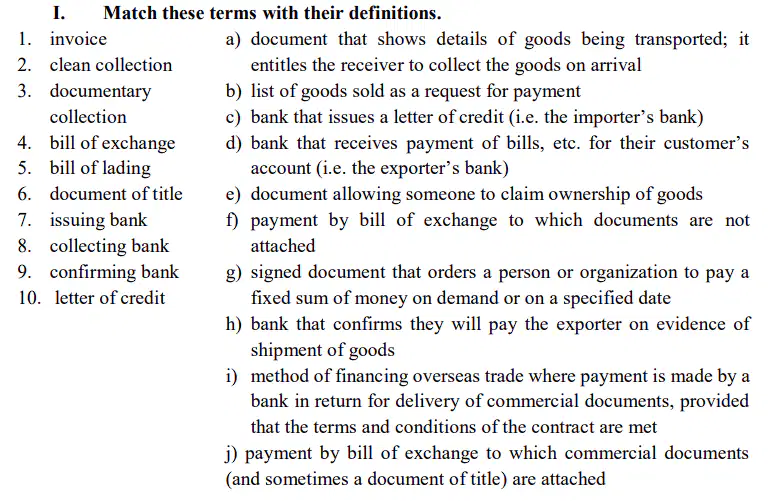
f) payment by bill of exchange to which documents are not attached
(a)
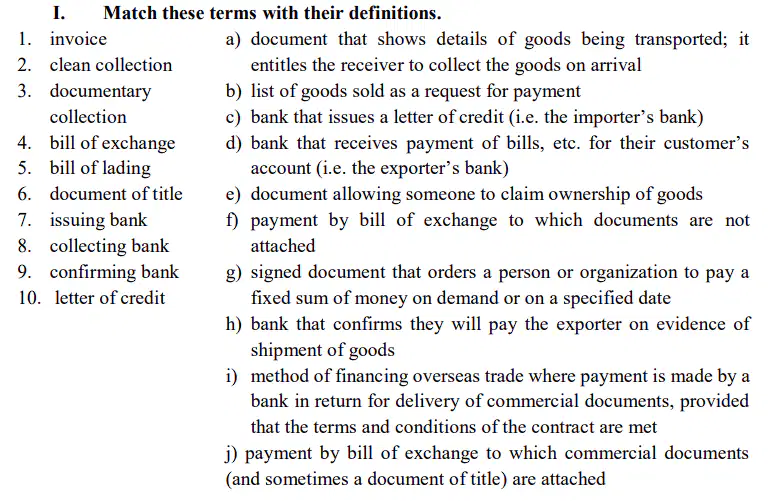
g) signed document that orders a person or organization to pay a fixed sum of money on demand or on a specified date
(a)
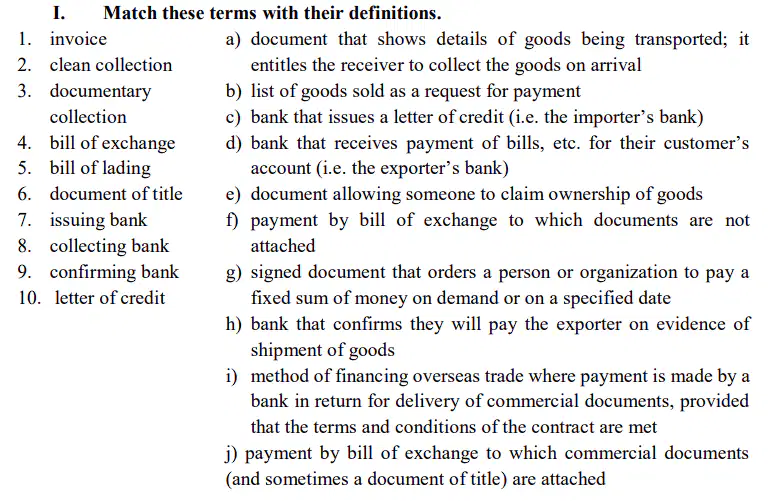
h) bank that confirms they will pay the exporter on evidence of shipment of goods
(a)
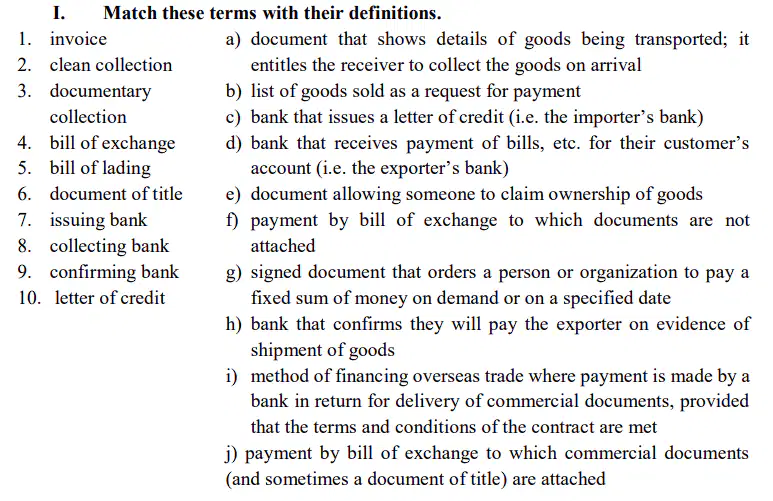
i) method of financing overseas trade where payment is made by a bank in return for delivery of commercial documents, provided that the terms and conditions of the contract are met
(a)
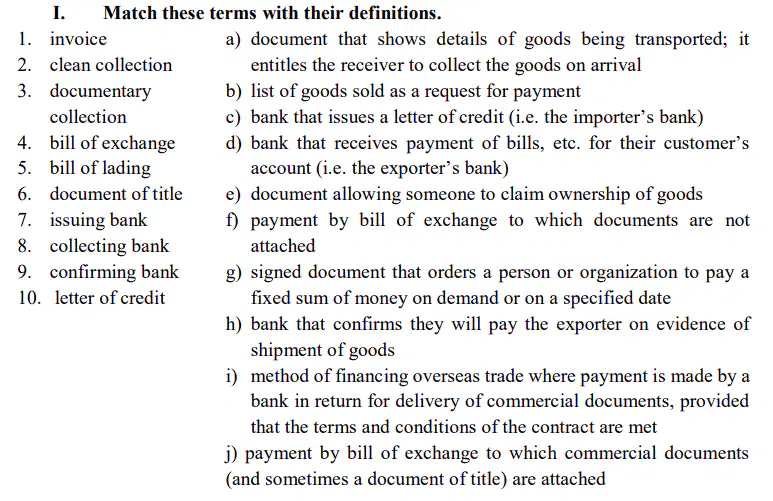
j) payment by bill of exchange to which commercial documents (and sometimes a document of title) are attached
(a)
Open Account
1. The importer pays for the goods after receiving the documents.
True
False
Open Account
2. There is no contract involved
True
False
Open Account
3. The exporter must be able to trust the buyer.
True
False
Documentary Credit
4. If a letter of credit is issued, the importer’s bank agrees to pay for the goods without conditions.
True
False
Documentary Credit
5. If a letter of credit is confirmed, the exporter’s bank takes responsibility for payment.
True
False
Documentary Collection
6. Commercial documents and the document of title are always enclosed with a bill of exchange.
True
False
Documentary Collection
7. Importers may not accept the bill of exchange until the goods arrive.
True
False
Documentary Collection
8. Exporters can keep control of goods by sending bills of lading through the banking system.
True
False
Documentary Collection
9. Exporters reduce risk if documents are released against acceptance of the bill rather than payment
True
False
Advance Payment
10. This means that the importer has to pay before any goods are dispatched
True
False

1. The first step the exporter takes is to ask his bank to ………….. a bill of exchange on the overseas buyer.
(a)

2. The exporter’s bank ………………. the bill of exchange, together with the commercial documents, to the importer’s bank.
(a)

3. At the same time, the exporter…………………. the goods
(a)

4. The exporter must take care to ………………….the correct documents to the bank
(a)

5. When the importer………..…the bill of exchange, the bank will………….the documents of title to the goods. (2 đáp án viết cách nhau = 1 dấu cách)
(a)

6. If the importer…………………..the bill, the exporter may have to find an alternative buyer or ship the goods back again
(a)

7. In some parts of the world, banks may be slow to …………….. payment to the exporter’s bank.
(a)
In the documentary collection, if the importer (a) the bill, the exporter may have to find an alternative buyer or ship the goods back
the first step of the proceduce for documentary collection, the exporter's task is to ask his bank to (a) a bill of exchange on the overseas buyer
(a) is payment by bill of exchange to which commercial documents and sometimes a document of title are attached
a document by which a buyer undertakes to pay a seller through a bank if the seller delivers the goods according to terms of the contract. it can be documentary or irrevocable: (a)
(a) is the most secure mode of payment for the importer
(a) is the most secure mode of payment for exporters
in some parts of the world, banks may be slow to (a) payment to the exporter's banks
exporter/importer financing in which a bank acts as intermediary without accepting financial risks: (a)
export/import financing in which an exporter ships merchandise and latter bills the importer for its value is
(a)
export/import financing in which an importer pays an exporter for merchandise before it is shipped is (a)

