
NEW
Font size
 Worksheets
Plate Tectonic Pretest Review
Total questions: 32
Worksheet time: 26mins
Tectonic plates consist of
continental crust
mesospheric crust
both continental and oceanic crust
oceanic crust
Pangaea was an ancient supercontinent made up of...
America, Greenland, and Europe
Antarctica, India, and America
all of Earth’s continents
South Africa, India, Australia, and South America
The scientist who developed the big idea called "sea-floor spreading"
Alfred Wedgener
Harry Hess
Edward Dutton
Ortelius
Why did no one believe Wegener's thoery that the continents were once together?
He could not explain HOW the continents moved
He didn't have evidence
His data was wrong
He didn't use the right technology to gather data
The movement of the tectonic plates is caused by
the rotation of the Earth
convection currents in the Asthenosphere
the gravity of the iron-nickel core
the Moho discontinuity
Which layer of the Earth consists of tectonic plates?
asthenosphere
mantle
mesosphere
lithosphere
Which of these tectonic plate boundaries is most likely to form a volcano.
a continental plate colliding with a continental plate
an oceanic plate sliding past a continental plate
a continental plate sliding past a continental plate
an oceanic plate colliding into a continental plate
Which two plates collided with each other to form the Himalayan Mountains?
Nazca and Eurasia
Indo-Australian and Eurasian
North America and Antarctic
South American and Indo-Australian
In the region where two continental plates collide, what geological feature MOST often forms?
an ocean
a volcano
a river valley
a mountain chain
Hot fluid or semi-fluid material below or within the earth's crust from which lava and other igneous rock is formed on cooling.
Convection Current
Lithosphere
Core
Magma
Solid, outer layer and is made of both the oceanic and continental crust.
Hydrosphere
Core
Mantle
Crust
Rocky or rigid outer part of Earth consisting of the brittle crust and the top part of the upper mantle
Lithosphere
Oceanic Crust
Continental Crust
Asthenosphere

When two plates collide.
transform boundary
divergent boundary
convergent boundary
seafloor spreading
The two kinds of earth crust are:
Magma and igneous
Rocks and soil
Oceanic and continental
Mountains and volcanoes
What is Pangaea?
The name of a German scientist
Another name for continental drift
The name of the super-continent that existed millions of years ago
The name of ancient fossil


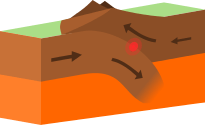
Which tectonic plate is denser?
Oceanic
Continental
Constructive
Collision
Which statement best describes the movement of Earth’s plates?
The plates are constantly moving.
The plates stayed in one place for millions of years but are moving now.
There is no evidence that plates ever moved.
The plates moved for millions of years but have now stopped.

The place where two plates come together is known as a _______
transform boundary.
divergent boundary.
convergent boundary.
rift valley.
Tectonic plates move at an average of a few ____ a year.
millimeters (mm)
centimeters (cm)
meters (m)
kilometers (km)
What is the name of the fault that runs through California?
Juan de Fuca Fault
Gorda Fault
San Andreas Fault
Pacific Fault
When was the theory of plate tectonics developed?
1760s
1790s
1850s
1960s
The Earth's magnetic field sometimes reverses itself
(north turns into south and south turns into north).
True
False
When one lithospheric plate moves down into the asthenosphere under another plate at a convergent boundary, this is called . . .
convection
mantle
strike-slip
subduction

