
 Worksheets
1st Industrial Revolution Review
Total questions: 10
Worksheet time: 5mins
Name
Class
Date
1.
How did enclosures contribute to the development of the Industrial Revolution?
a)
They enabled farmers to rotate crops and produce many different types of specialty vegetables.
b)
Enclosures were used to pen animals for domestication, increasing the number of domesticated species.
c)
Enclosures caused farm output to drop, leading farmers to move to cities.
d)
Enclosures displaced farmers, who formed the labor force for the new factories in cities.
2.
What was one of Britain’s primary contributions to industrialism?
a)
Britain developed new farming practices that led to the second Agricultural Revolution.
b)
British inventors developed new machines for the textile industry that led to the factory system.
c)
The British government freely exported new technology, allowing industrialization to spread.
d)
British entrepreneurs invested in manufacturing and transportation allover Europe.
3.
What was one way that James Watt’s steam technology contributed to the Industrial Revolution?
a)
Steam engines helped increase the efficiency of the putting-out system.
b)
The water frame used steam to improve the speed of spinning thread.
c)
Steam engines improved the shipping of goods and raw materials.
d)
Steam engines allowed boats to move quickly along new canals.
4.
Why were the first factories more efficient than the earlier putting-out system?
a)
They did not require an outside source of power.
b)
They allowed laborers to build a product from start to finish.
c)
They brought workers and machines together in one place.
d)
They could be built in any location.
5.
Industrialization spread because
a)
Britain shared the new technology in order to gain new trading partners.
b)
Other nations wanted to have the same economic opportunities that Britain enjoyed.
c)
Parliament relaxed Britain's monopoly on industrial technology.
d)
Britain had to trade its technology for labor and natural resources.
6.
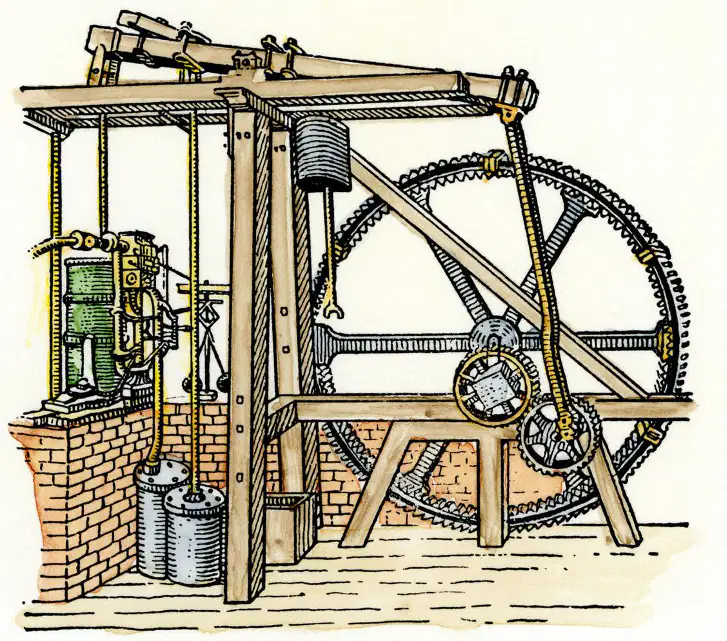
Which British invention, shown here, revolutionized industry and transportation?
a)
A. dynamo
b)
B. steam engine
c)
C. internal combustion engine
7.
Which of the following best describes the new middle class that emerged as a result of industrialization?
a)
It was made up largely of industrial workers and miners.
b)
It was made up largely of wealthy rural landowners.
c)
Many of its members owned and operated the businesses that hired urban workers.
d)
Many of its members lived in overcrowded conditions in industrial cities.
8.
Which statement best describes child labor during the early years of the Industrial Revolution?
a)
Child labor did not exist before the Industrial Revolution.
b)
Mines and textile factories employed large numbers of children.
c)
Laws kept children from working in dangerous mines and factories.
d)
Most child laborers spent part of each day in school.
9.
What was one long-term benefit of the Industrial Revolution?
a)
Factory work allowed women to earn as much money as men.
b)
Over time, poverty was eliminated in industrialized nations.
c)
Governments took greater control over the economy.
d)
In industrialized countries, the overall standard of living improved.
10.
Socialism is based on the belief that
a)
the means of production should be shared by everyone in society.
b)
governments should interfere in business only to prevent harm.
c)
industrialization is an evil that must be stopped.
d)
workers will unite and overthrow the ruling class to form a classless society.
100 %

