
 Worksheets
Circular and Planetary Motion Review
Total questions: 20
Worksheet time: 7mins
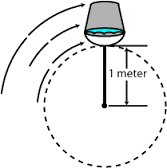

Two students (A and B) are on a merry-go round (depicted). Which student has the greater period of revolution (angular speed)?
A
B
Both are equal
Cannot be determined
Two students (A and B) are on a merry-go round (depicted). Which student has a greater tangential speed?
A
B
Both are equal
Cannot be determined
Two students (A and B) are on a merry-go round (depicted). Which student has a greater centripetal acceleration?
A
B
Both are equal
Cannot be determined
How can you find the distance around a circle?
2πr
d/t
v2
T
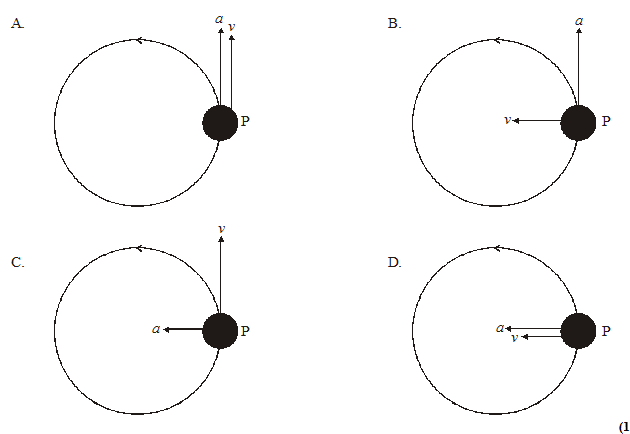
Why does an object experiencing uniform circular motion have an acceleration?
because it ir changing speed
because it is changing direction
because it is moving n a straight line
because it has mass
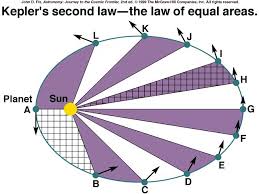

The graph shows Keplers 3rd Law. A new planet is discovered at a distance of 35 AU. What is the orbital period?
250 years
200 years
175 years
16 years
Earth travels fastest in January and slowest in July. What is the most likely explanation for this?
Earth is nearest the Sun in July and farthest away in January.
Earth is nearest the Sun in January and farthest away in July.
Earth is nearest the Sun in April and farthest away in October.
Earth is nearest the Sun in October and farthest away in April.

Why are black holes...black?
There are no stars to produce light.
Light waves die inside.
The gravity pulls stronger/faster than the speed of light, so light cannot escape.
No one paid the electric bill.

Why do objects experience centripetal acceleration even though they can have a constant speed?
Because they are speeding up as they move in a circle
Because they are constantly changing direction and hence, velocity changes, and that net change is directed inward.
Because they are constantly changing both speed and direction
Because when you have 100 people pedaling, you can speed up more easily.
The linear velocity is always _____ to the line of a circle.
outwards
towards the center
tangent
faster

