
NEW
Font size
 Worksheets
Microscopes and Cell Theory Quiz
Total questions: 24
Worksheet time: 12mins
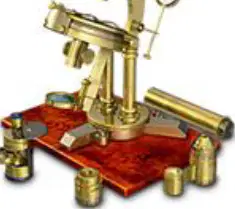
Which of the following microscopes is the oldest according to the image?
British Microscope (circa 1865)
Hand-Held Microscope (circa early 1700s)
Leeuwenhoek Microscope (circa late 1600s)
ZEISS Primo Star Microscope (circa 2010)

Which microscope in the image is from the 20th century?
Leeuwenhoek Microscope (circa late 1600s)
British Microscope (circa 1865)
Winkel-ZEISS Dissecting Microscope (circa 1927)
ZEISS Primo Star Microscope (circa 2010)
What are all living organisms made up of according to the cell theory?
Single cells only
Multiple cells only
One or more cells
Non-cellular structures
What is the basic unit of organization in living organisms?
The atom
The molecule
The organ
The cell
Where do all cells come from?
Non-living matter
Spontaneous generation
Living cells
External environment
What do cells pass on to their daughter cells during cell division?
Nutrients
Energy
Genetic material
Waste products
What does a compound light microscope use to magnify an object?
A single glass lens
A series of glass lenses
Plastic lenses
Digital magnification
What is the range of magnification for the most commonly used eyepieces in a compound light microscope?
5X-30X
10X-15X
20X-50X
100X-150X
How is the total visual magnification of a microscope derived?
By adding the magnification values of the object and the eyepiece
By dividing the magnification values of the object by the eyepiece
By multiplying the magnification values of the object and the eyepiece
By subtracting the magnification values of the eyepiece from the object
If you are using a 10X eyepiece and a 100X objective, what is the total visual magnification achieved?
1000X
110X
3000X
100X
When were electron microscopes invented?
1930's
1940's
1950's
1960's
What is the maximum magnification that some Transmission Electron Microscopes (TEM) can achieve?
100,000X
200,000X
500,000X
1,000,000X
Which type of electron microscope can image living cells?
Transmission Electron Microscope (TEM)
Scanning Electron Microscope (SEM)
Scanning Tunneling Electron Microscope (STEM)
Compound Light Microscope
What does a Scanning Electron Microscope (SEM) allow for that is different from TEM?
It can magnify up to 1,000,000X
It uses lenses to magnify the image
It allows for a three-dimensional image of the cell
It uses light to magnify the image
Which component is not used in electron microscopes?
Magnets
Electron beam
Lenses
Fluorescent screen
What is a common feature of all cells?
All cells have a nucleus
All cells have a flagellum
All cells have a plasma membrane
All cells have a capsule
What is the function of the plasma membrane in cells?
It generates energy for the cell
It helps in protein synthesis
It controls what enters and leaves the cell
It stores the genetic material of the cell
Where do prokaryotic cells occur?
In multicellular organisms
In most unicellular organisms like bacteria
In plants only
In animals only
Which of the following is a characteristic of eukaryotic cells?
They lack a plasma membrane
They are smaller and less complex
They contain a nucleus and other organelles
They do not have specialized structures
What are organelles?
Structures that carry out specific functions within a cell
The outer layer of a cell
Genetic material found in prokaryotic cells
Hair-like structures on the surface of a cell
What is the nucleus in a eukaryotic cell?
The cell wall surrounding the cell
A central organelle containing genetic material
A structure used for cell movement
An organelle that produces energy
Which of the following is an example of a eukaryotic cell?
Escherichia coli
Staphylococcus
Plant cells
Nostoc
What is a characteristic feature of prokaryotic cells?
They contain a true nucleus
They are found in multicellular organisms
They do not contain a nucleus
Their DNA is linear in shape
Which of the following is common to both eukaryotic and prokaryotic cells?
Mitochondria
Cell membrane
True nucleus
Linear DNA

