
 Worksheets
Vietnam and the 1960s Part 1
Total questions: 15
Worksheet time: 8mins
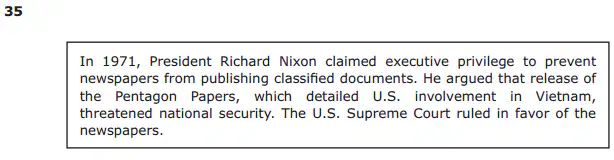
Which of the following provided a legal basis for this Supreme Court decision?
13th Amendment
Brown v. Board of Education
The Civil Rights Act of 1964
1st Amendment
Which box list characteristics of the 1960s?
Prohibition, the lost Generation, Harlem Renaissance, Religious fundamentalism
Widespread unemployment, New Deal programs, The Golden Age of Hollywood, the Dust Bowl
the counterculture,, Civil Rights movement, Vietnam War, Space Race
Televangelists, Neoconservatism, Video games, The fall of the Soviet Union
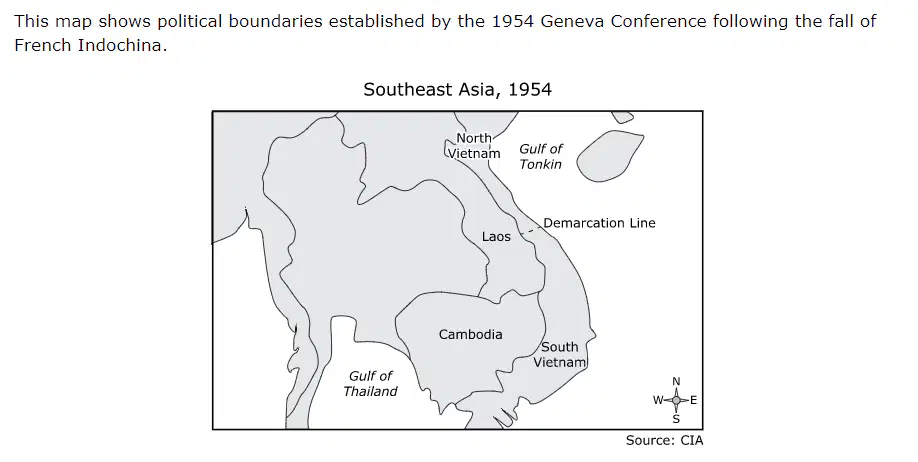
After the 1954 Geneva Conference, which action became a part of US foreign policy?
The gradual buildup of financial and military aid to South Vietnam
Buildup of economic and industrial aid to North Vietnam
The use of diplomatic efforts to reunify Cambodia and South Vietnam
The use of military force to restore French rule in Laos and North Vietnam

Which idea reflected in these remarks formed the basis for US involvement in Vietnam?
Nuclear deterrence
Flexible response
Domino theory
Iron Curtain
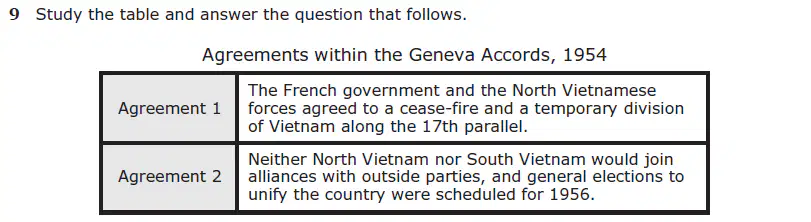
Why was the US concerned about Agreement 2?
Officials believed the election would lead to a civil war and revolution.
Congress members feared foreign policy decisions would lead to criticism at home.
The administration opposed the creation of regional alliances.
Leaders feared communist officials would win the election and take over the country.
What was the overall goal of the US military intervention in Vietnam from 1964-1973?
Eliminating trade barriers between the US and Southeast Asia
Isolating the Soviet Union by improving Chinese relations with the US
Promoting economic growth in the Pacific region
Preventing communism from spreading throughout Southeast Asia

What happened as a direct result of these recommendations?
North Vietnamese leaders appealed for a ceasefire.
UN military involvement Vietnam escalated.
South Vietnamese leaders rejected military assistance.
Soviet ground troops were deployed to Vietnam.
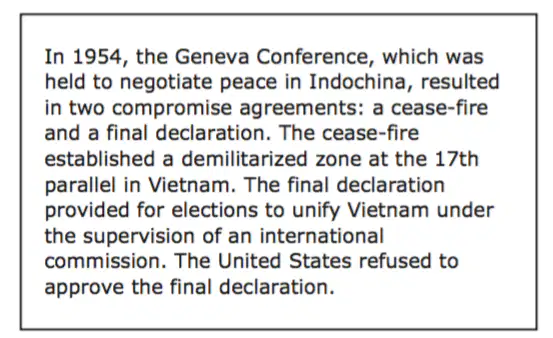
Which policy guided US opposition to this declaration?
containment
Constructive engagement
Deterrence
Peaseful coexistence
The domino theory, which provided the basis for US entry into the Vietnam War, was the belief that intervention was necessary to prevent-
the expansion of communism across Southeast Asia
the inclusion of Taiwan in the Warsaw Pact
the loss of UN military bases in Asia
the rise of Ziggy Stardust and the Spiders from Mars
Which of these best explains why worldwide reactions to US involvement in Vietnam grew increasingly hostile during the late 1960s and early 1970s?
The US was viewed as appeasing a brutal dictator
The US demanded the unconditional surrender of HO Chi Minh.
The US was viewed as an aggressor invading an underdeveloped nation
The US ignored a UN security Council resolution to cease hosttilties.
The primary reason given by US leaders to justify military involvement in Vietnam was that it would-
promote reconstruction after WW2
maintain the policy of détente
fulfill prior United Nations obligations
keep communism from spreading throughout the region
As part of the Nixon administration policy of Vietnamization, the US military-
trained South Vietnamese forces to take over combat responsibilities from US troops
shared military technology with North Vietnam
Imposed martial law in North Vietnam
installed a puppet government in South Vietnam
During the time between the passage of the Gulf of Tonkin Resolution and the start of the Tet offensive, what happened in the Vietnam War?
All US civilians were evacuated from Vietnam
Peace talks between South Vietnam and North Vietnam were conducted in Paris.
The US government deployed more troops to Vietnam
South Vietnam surrendered to North Vietnam.
Which cause united many college students, civil rights activists, and labor union members during the 1960s?
Opposing US participation in the Vietnam War
Expanding presidential use use of executive privilege
Protecting the world against climate change
Using détente policy with China
Why did the government implement a draft during the Vietnam War?
To monitor ethnic groups for espionage activities
To fund the war by authorizing the sale of government bonds
To regulate freedom of expression
To provide the military with additional manpower

