
 Worksheets
Force TEST
Total questions: 34
Worksheet time: 51mins
Name
Class
Date
1.
A group of students is playing tug-of-war. The students on both sides of the rope are pulling with equal force so
that the rope is not moving. This is an example of
a)
Unbalanced forces
b)
Balanced forces
c)
Acceleration
d)
Displacement
2.
A firefighter feels the hose pushing backwards onto him as he uses it to put out a fire. What is the most likely cause of this?
a)
The hose material is very elastic
b)
Since the hose is at rest, it tends to stay at rest
c)
The force exerted on the water equals the mass of the water times its acceleration
d)
The escaping water exerts an equal and opposite force on the hose
3.
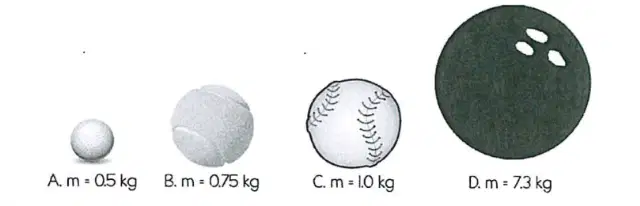
If the same force is applied to each of the balls pictured below, which one will have the LEAST acceleration?
a)
A
b)
B
c)
C
d)
D
4.
Which of the following is measured in Newtons?
a)
Weight
b)
Momentum
c)
Mass
d)
Acceleration
5.
The upward force on an object falling through the air is
a)
Air resistance
b)
Momentum
c)
Inertia
d)
Gravity
6.
The relationship among mass, force, and acceleration is explained by
a)
Law of Conservation of Momentum
b)
Newton's 1st Law of Motion
c)
Newton's 2nd Law of Motion
d)
Newton's 3rd Law of Motion
7.
According to Newton's laws, for any object, the greater the force that's applied to it, the greater its_______ will be.
a)
Acceleration
b)
Inertia
c)
Gravity
d)
Size
8.
The size of the gravitational force between two objects depends on their
a)
Frictional forces
b)
Inertia
c)
Masses and the distance between them
d)
Speed and direction
9.
An astronaut is planning a trip to a newly-discovered planet. According to the Law of Universal Gravitation, the astronaut's weight on the new planet will be greater than his weight on Earth if:
a)
The new planet has less gravity than Earth
b)
The new planet has the same gravity as Earth
c)
The new planet has more gravity than Earth
d)
The gravity of the planet doesn't matter. Weight is the same everywhere in the universe
10.
"To every action there is an equal and opposite reaction" describes which law?
a)
Law of Conservation of Momentum
b)
Newton's 1st Law of Motion
c)
Newton's 2nd Law of Motion
d)
Newton's 3rd Law of Motion
11.
Calculate force on an object that has a mass of 10 kg and an acceleration of 4 m/s²
a)
40 N
b)
8 N
c)
2.5 N
d)
0.4 N
12.
A 500 N force is applied to a 25 m/s² object. The mass of the object is
a)
12,500 m/s
b)
12,500 kg
c)
20 m/s
d)
20 kg
13.
The _____ of an object does not change, but its _____ can, based on its location.
a)
mass, volume
b)
mass, weight
c)
weight, mass
d)
weight, volume
14.
When two forces on the same object are equal and opposite, these forces are called ______ forces.
a)
Net
b)
Balanced
c)
Unbalanced
d)
Frictional
15.
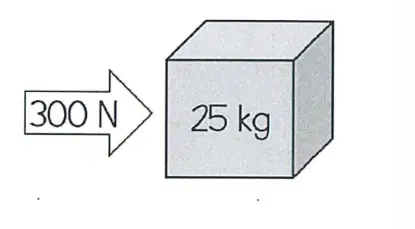
What is the acceleration of the box in the picture?
a)
7,500 m/s²
b)
300 m/s²
c)
25 m/s²
d)
12 m/s²
16.
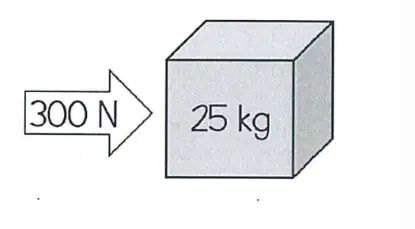
What is the weight of the box in the picture?
a)
25 kg
b)
25 N
c)
245 kg
d)
245 N
17.
As the mass of an object increases, its inertia will
a)
decrease
b)
increase
c)
stay the same
d)
be unable to determine
18.
Which two quantities are measured in the same units?
a)
velocity and acceleration
b)
weight and force
c)
mass and weight
d)
force and mass
19.
A student drops a feather and rock at the same time from Mrs. Taylor's window. If air resistance wasn't a factor, what should she observe?
a)
The rock falls slower than the feather
b)
The rock falls faster than the feather
c)
The rock and feather fall at the same rate
d)
The rock and feather remain suspended and do not fall
20.
A man weighing 800 N is standing on a chair. In order to support the man, what force is the chair exerting?
a)
less than 800 N
b)
greater than 800 N
c)
800 N up
d)
800 N down
21.
An object that is falling freely has a constant what?
a)
speed
b)
velocity
c)
acceleration
d)
nothing is constant
22.
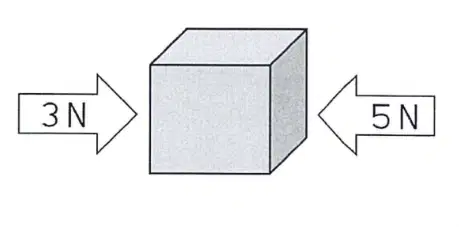
What is the net force on the block?
a)
8 N right
b)
8 N left
c)
2 N left
d)
2 N right
23.
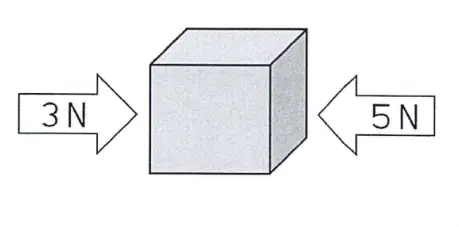
If the block in the picture has an acceleration of 1 m/s², what would be the block's mass?
a)
8 kg
b)
2 kg
c)
0.5 kg
d)
0.135 kg
24.
Which of the following best describes how a swimmer moves through the water?
a)
The swimmer pushes backwards on the water and the water pushes with an equal but opposite force back on the swimmer.
b)
The swimmer pushes off the side of the pool and his inertia keeps him moving through the water.
c)
The swimmer uses friction to push himself through the water.
d)
Air resistance limits the swimmer's speed.
25.
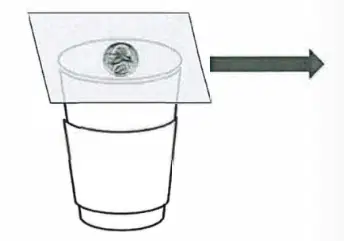
In the picture, if the card were quickly pulled off the cup like the arrow suggests, what property would explain why the coin falls into the cup rather than moving with the card?
a)
friction
b)
force
c)
inertia
d)
air resistance
26.
An object will move at a constant velocity unless an unbalanced force acts upon it
a)
Newton's 1st Law
b)
Force
c)
Gravity
d)
Air resistance
e)
Inertia
27.
Push or pull one body exerts on another.
a)
Force
b)
Gravity
c)
Air resistance
d)
Inertia
e)
Newton's 1st law
28.
A friction-like force that opposed the motion of objects the move through the air.
a)
Air resistance
b)
Force
c)
Gravity
d)
Inertia
e)
Newton's 1st law
29.
The highest velocity a falling object will reach.
a)
Terminal velocity
b)
Force
c)
Gravity
d)
Air resistance
e)
Inertia
30.
Tendency of an object to resist changes in motion.
a)
Inertia
b)
Force
c)
Gravity
d)
Air resistance
e)
Newton's 1st law
31.
The attraction any two objects have on one another.
a)
Gravity
b)
Force
c)
Air resistance
d)
Inertia
e)
Newton's 1st law
32.
The force of gravity on an object.
a)
Weight
b)
Force
c)
Gravity
d)
Air resistance
e)
Inertia
33.
A net force acting on an object causes the object to accelerate in the direction of the net force.
a)
Newton's 2nd Law
b)
Force
c)
Gravity
d)
Air resistance
e)
Inertia
34.
Related to the amount of force needed to change an object's motion.
a)
Momentum
b)
Force
c)
Gravity
d)
Air resistance
e)
Inertia
100 %

