
NEW
Font size
 Worksheets
9189PH3DOMPPT3
Total questions: 51
Worksheet time: 26mins
What are the two operating principles for any chimney or flue system according to the Level 3 Diploma in Plumbing and Domestic Heating?
Remove water vapor and draw in air for combustion.
Remove combustion products to the outside and draw in air for combustion.
Filter particulates and recycle heat back into the system.
Create a vacuum and circulate warm air.
On what principle do the operating principles of a chimney or flue system work?
The principle that cold gases sink, creating a pressure difference called 'down draught' via conduction.
The principle that hot gases rise, creating a pressure difference called 'up draught' via convection.
The principle that gases expand when heated, creating a pressure difference called 'out draught' via radiation.
The principle that gases contract when cooled, creating a pressure difference called 'in draught' via conduction.
What is the basic concept of a chimney or flue system?
To cool down the air inside a room
To create this up draught, either by natural or mechanical means, in order to get rid of the fumes
To filter and clean the air within a building
To circulate warm air throughout a building
Which of the following is a type of flue design?
Forced draught
Natural draught
Electrical draught
Hybrid draught
What is the other flue design mentioned in the text apart from natural draught?
Mechanically sealed
Room sealed
Environmentally sealed
Pressure sealed
What is the simplest design of all flues that relies on heat rising to create the up draught?
Forced draught flue
Balanced flue
Open flue
Power flue
Where is the air for combustion taken from in an appliance with an open flue?
From outside the building
From the combustion chamber
From the room in which the appliance is located
From the secondary flue
How are the products of combustion removed in an appliance with an open flue?
Through a vent in the room
Up the flue by natural draught
Directly outside through a side vent
By being recycled into the combustion chamber
What must be supplied to the room and appliance from outside via a vent in an open flue system?
Natural gas
Electricity
Air for combustion
Water for cooling
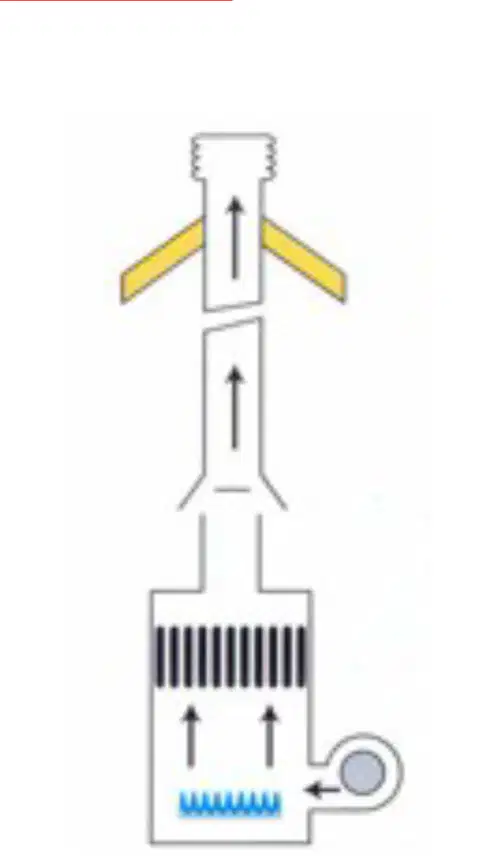
What is the purpose of the fan in an open flue with forced draught as described in the learning material?
To cool down the appliance
To create a positive up draught by blowing the products of combustion up the flue
To filter the products of combustion
To supply fresh air into the appliance
What do room sealed (balanced) flues use to draw air for combustion?
Air from within the room
Air directly from outside
A combination of indoor and outdoor air
No air is drawn for combustion
Why are room sealed (balanced) flued appliances considered safer than open-flued appliances?
They use less energy
They produce more heat
They do not allow combustion air to enter the room
They are easier to install
What are the two types of room sealed (balanced) flues?
Electric and gas-powered
Natural draught and fan assisted (forced)
Indoor and outdoor
Horizontal and vertical
How are the products of combustion evacuated from the building in a room sealed natural draught system?
Through a separate duct from the combustion air duct
Through the combustion air duct
Through natural ventilation without a duct
Through a chimney
How does a room sealed fan assisted flue work compared to a natural draught flue?
It uses natural convection without any mechanical parts.
It is forced by a manufacturer's fan to ensure positive and safe evacuation of products.
It relies solely on wind power to function.
It is larger and requires more space for installation.
What is one advantage of a room sealed fan assisted flue over a natural draught flue?
It can only be positioned in a few specific places.
It requires a larger space for installation.
It can be positioned in many more places than the natural draught flue.
It operates without any electrical components.
What creates a negative pressure within the case of a fan assisted boiler?
The fan positioned on the fresh air inlet
The fan positioned on the combustion product’s outlet from the heat exchanger
The mixture of gas and air to the burner
The use of a modern condensing boiler design
What does the fan positioned on the fresh air inlet of a fan assisted boiler create?
Negative pressure (sucking)
Positive pressure (blowing)
A mixture of water and air to the burner
A negative pressure within the case
Which design do modern condensing boilers use in relation to the fan position?
Fan positioned on the combustion product’s outlet
Fan positioned on the heat exchanger
Fan positioned on the fresh air inlet
Fan positioned on the gas outlet
What is the minimum length that the primary flue must be on open flued appliances?
At least 500 mm
At least 600 mm
At least 700 mm
At least 800 mm
What is the function of the draught diverter?
To increase the efficiency of the burner flame
To prevent the loss of flame stability at the burner
To increase the pull of the secondary flue
To concentrate the flue gases
Secondary flues should be constructed of what type of material?
Single-wall insulated material
Twin-wall insulated material
Non-insulated material
Triple-wall insulated material
What is the job of the terminal in an open flue system?
To increase the up-draught in the flue
To filter the flue gases
To help the flue gases discharge to atmosphere and prevent external elements from entering
To regulate the temperature of the flue gases
How does the design and installation of chimney and flue systems affect their function?
They do not affect the function at all.
They only affect the aesthetic appeal of the system.
They affect the function of air intake and the safe dispersion of the products of combustion.
They only affect the cost of the system.
What is the maximum angle that should be kept when bends are required in chimneys and flues?
30°
45°
60°
90°
What does the effective height of a chimney or flue take into account?
The color of the chimney
The material of the chimney
The frictional resistance encountered en route
The temperature of the gases
For a flue to work efficiently, how quickly does the temperature need to rise and remain?
Slowly and fluctuate often
Quickly and remain constant
Quickly and then drop rapidly
Slowly and remain low
What can happen when the flue is cool?
The flue gases move quickly and prevent condensation
The flue gases move efficiently upwards
The flue gases move slowly and can create condensation
The flue gases heat up fully in 5–10 minutes
How long can it take for the chimney/flue to heat up fully when the flue is heated?
1–2 minutes
3–4 minutes
5–10 minutes
15–20 minutes
What is the required velocity of flue gases for safe evacuation from the building?
3m/s
6m/s
9m/s
12m/s
Terminals need to have an opening that is how many times the cross-sectional area of the flue itself?
Equal to the cross-sectional area of the flue
Twice the cross-sectional area of the flue
Three times the cross-sectional area of the flue
Four times the cross-sectional area of the flue
Where should a terminal be located in relation to a pressure zone?
Inside a pressure zone
Directly above a pressure zone
Outside a pressure zone
Along the border of a pressure zone
What is the minimum flue height termination for a pitched roof with a flue that has less than 70 kW net input without a nearby structure?
At ridge, or 600 mm above or at least 1.5 m measured horizontally to the roof line
600 mm above the roof line
250 mm above the roof line
1000 mm above the roof line
What is the minimum flue height termination for a flat roof with a flue that has less than 70 kW net input and is within 1.5 m of a nearby structure?
600 mm above the roof line
250 mm above the roof line
1000 mm above the roof line
At ridge, or 600 mm above or at least 1.5 m measured horizontally to the roof line
Which of the following is NOT a type of rigid chimney?
Brick and masonry
Pre-cast blocks
Metallic flues
Flexible liners
What type of chimneys are designed for fireplaces or appliances according to the Level 3 Diploma in Plumbing and Domestic Heating?
Flexible chimneys
Rigid-brick and masonry chimneys
Metal chimneys
Plastic chimneys
What was the size of chimneys installed prior to 1966?
175mm round
200mm²
9" x 9" or 225mm x 225mm
150mm x 150mm
After 1966, what materials were chimneys made of?
Wood, metal, and plastic
Clay, pumice, and concrete
Steel and aluminum
Brick and mortar
Why were larger chimneys considered too big for gas appliances after 1966?
They would cause the velocity of the flue gases to increase too much
They were not aesthetically pleasing
They would cause the velocity of the flue gases to slow down too much
They were too expensive to produce
What is one identified problem with pre-cast flue blocks?
They are not durable.
They have poor 'pull'.
They are not made from concrete.
They can be installed with all gas appliances.
Pre-cast flue blocks are made from which material?
Plastic
Concrete
Metal
Wood
Can all gas appliances be installed on pre-cast flue block systems?
Yes, all gas appliances can be installed.
No, not all gas appliances can be installed.
Only electric appliances can be installed.
The text does not specify.
What should always be checked before installing a flue system?
The house design plans.
The local weather conditions.
The manufacturer's instructions.
The color of the flue blocks.
What is the primary material used to make high-grade single wall flue systems?
Aluminum
Copper
Stainless steel
Plastic
What is the purpose of a twin wall in flue systems?
To enhance the visual appeal of the chimney
To create a barrier against condensation and heat
To reduce the cost of chimney construction
To increase the airflow within the chimney
Where can twin wall flue systems be used?
Externally only
Internally only
Both internally and externally
Neither internally nor externally
What are flexible metallic liners made from?
Copper
Aluminum
Stainless steel
Plastic
Why must flexible metallic liners never be exposed?
To prevent energy loss
To avoid corrosion
To maintain aesthetic appeal
Because they must be connected directly to the appliance
What is the main document referred to for the installation and construction of chimneys and flues in the Level 3 Diploma in Plumbing and Domestic Heating?
British Standards
Approved Document J
Building Regulations 2010
Installation Manual for Domestic Heating
Is the Approved Document J from the Building Regulations mandatory or optional for the application and construction of chimneys and flues?
Optional
Recommended
Mandatory
Suggested
Should Approved Document J be used alone or with another set of standards for the application and construction of chimneys and flues?
Alone
With British Standards
With International Codes
With Manufacturer's Guidelines

