
Font size
 Worksheets
AP Physics 1 Unit 8 - Simple Harmonic Motion
Total questions: 26
Worksheet time: 31mins

Refer to the graph below of the displacement x versus time t for a particle in simple harmonic motion. Which of the following graphs shows the kinetic energy K of the particle as a function of time t for one cycle of motion?


A block on a horizontal frictionless plane is attached to a spring, as shown below. The block oscillates along the x-axis with simple harmonic motion of amplitude A.
Which of the following statements about the block is correct?
At x = 0, its velocity is zero.
At x = 0, its acceleration is at a maximum.
At x = A, its Force is at a maximum
At x = A, its velocity is at a maximum.
At x = A, its acceleration is zero.
A block on a horizontal frictionless plane is attached to a spring, as shown below. The block oscillates along the x-axis with simple harmonic motion of amplitude A.
Which of the following statements about energy is correct? Select two answers.
The potential energy of the spring is at a minimum at x = 0.
The potential energy of the spring is at a minimum at x = A.
The kinetic energy of the block is at a minimum at x = 0.
The kinetic energy of the block is at a minimum at x = A.
The kinetic energy of the block is always equal to the potential energy of the spring.

A pendulum with a period of 1 s on Earth, where the acceleration due to gravity is g, is taken to another planet, where its period is 2 s. The acceleration due to gravity on the other planet is most nearly
g/4
g/2
g
2g
4g

An ideal massless spring is fixed to the wall at one end, as shown above. A block of mass M attached to the other end of the spring oscillates with amplitude A on a frictionless, horizontal surface. The maximum speed of the block is vm. The force constant of the spring is
Mg/A
Mgvm/2A
M(vm)2/2A
M(vm)2/A2
M(vm)2/2A2
What is the relationship between frequency and period?
f = t/n
f = 1/T
f = 2 T
f = T/2


What is the amplitude of the wave shown in the image?
30 cm
20 cm
15 cm
10 cm

The graph shows the reducing amplitude of a body in Simple Harmonic Motion (SHM).
This reduction in amplitude is known as ...
dumping
damping
dampening
doodling

What is the period of the wave shown in the image?
10 sec
20 sec
30 sec
40 sec

Which of the pendulums would have the shortest period?
1
2
3
4
5
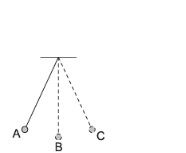
A pendulum oscillates as shown. At which of the following position(s) is the kinetic energy equal to the total energy?
A
B
C
Not enough information given.
An object of mass 𝑚 is attached to a horizontal spring, stretched to a displacement 𝐴 from equilibrium and released, undergoing harmonic oscillations on a frictionless surface with period 𝑇 . The experiment is then repeated with a mass of 4𝑚. What’s the new period of oscillation?
2T
T
4T
T√2
A block attached to the lower end of a vertical spring oscillates up and down. If the spring obeys Hooke’s law, the period of oscillation depends on which of the following?
I. Mass of the block
II. Amplitude of the oscillation
III. Force constant of the spring
I only
II only
I and II
I and III

A block of mass 0.5kg on a horizontal surface is attached to a horizontal spring of negligible mass and spring constant 50N/m. The other end of the spring is attached to a wall, and there is negligible friction between the block and the horizontal surface. When the spring is unstretched, the block is located at x=0m. The block is then pulled to x=0.3m
and released from rest so that the block-spring system oscillates between x=−0.3m and x=0.3m. What is the magnitude of the acceleration of the block and the direction of the net force exerted on the block when it is located at x=0.3m?


A student attaches a block to a vertical spring so that the block-spring system will oscillate if the block-spring system is released from rest at a vertical position that is not the system’s equilibrium position. The system oscillates near Earth’s surface. The system is then taken to the Moon’s surface, where the gravitational field strength is nearly 1/6 that of the gravitational field strength near Earth's surface. Which of the following claims is correct about the period of oscillation for the system?
The system has a longer period on Earth than on the Moon.
The system has a shorter period on Earth than on the Moon.
The system has the same period on Earth as the Moon.
The period of oscillation cannot be determined without knowledge of the spring constant, the mass of the block, and the exact gravitational field strength near Earth’s surface and the Moon’s surface.

A block with a mass M is attached to a spring with a spring constant k. The block undergoes SHM. Where is the block located when its velocity is a maximum in magnitude?
x = 0
x = +/-A
X = +A/2
X = -A/2
A block with a mass M is attached to a spring with a spring constant k. The block undergoes SHM. Where is the block located when its potential energy is a maximum?
x = 0
x = +/-A
X = +A/2
X = -A/2

Two oscillating systems: spring-mass and simple pendulum undergo SHM with an identical period T. If the mass in each system is doubled which of the following is true about the new period?
Spring: T Pendulum: T/√ 2
Spring: T/√ 2 Pendulum: T
Spring: √ 2*T Pendulum: T
Spring: T Pendulum: √ 2*T

A particle undergoes SHM represented by the graph. Which of the following is true about the amplitude and period of oscillations?
A = 1m, T = 0.8s
A = 1m, T = 0.1s
A = 1m, T = 0.4s
A = 2m, T = 0.4s

A block of mass M is attached to a horizontal spring k. The block undergoes SHM with amplitude of A. Which of the following graphs represents the elastic potential energy as a function of position x?


A block of mass M is attached to a horizontal spring k. The block undergoes SHM with
amplitude of A. Which of the following graphs represents the kinetic energy as a function
of position x?


