
 Worksheets
Natural Selection Quiz Review
Total questions: 25
Worksheet time: 50mins
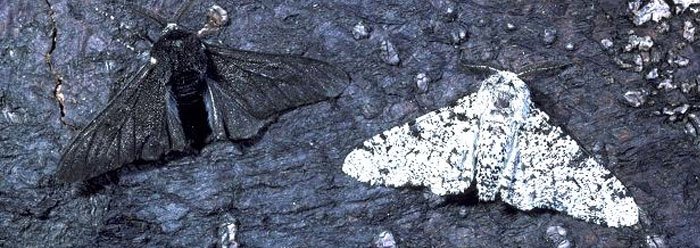
The trees these moths used to live on were white, but have been covered in soot(pollution) from coal factories. Which moth will be more successful in this environment?
Dark moth
Light moth
Both will be equally successful
Neither will be successful


Northern foxes can have different fur colors.
The foxes hunt squirrels for food. Foxes that have fur the same color as their environment are better at getting closer to squirrels and catching them.
The diagram below shows a population of foxes that live in one area. At time 1, the population had the same number of brown and white foxes. At time 2, after many generations, there were many more brown foxes and fewer white foxes in the population.
How did the environment change between time 1 and time 2? How did the population change?
You cannot tell how the environment changed. With each generation, more foxes passed on the gene for brown fur to their offspring.
The environment became brown. Brown foxes are more likely to survive, so the white foxes changed to have brown fur.
The environment became brown. Brown foxes are more likely to survive, so both kinds of foxes passed on the gene for brown fur to their offspring.
The environment became brown. With each generation, more brown foxes survived long enough to pass on the gene for brown fur to their offspring.

1. Blue jays are birds that live in the forest. They can have beaks of different thicknesses.
Blue jays use their beaks to get to the seeds they eat. Blue jays with thinner beaks can easily reach and eat the seeds inside pinecones. Blue jays with thicker beaks can easily open and eat seeds with hard shells.
The diagrams below show three possible blue jay populations.
1. If their environment changes to have only seeds in pinecones, which of the following blue jay populations will most likely survive?
Populations 1 and 2 will most likely survive.
Populations 2 and 3 will most likely survive.
Only Population 2 will survive because it is the only population with variation.
All the populations will survive because the blue jays will change the thickness of their beaks if they need to.
The more genetic variation a population has,
the more likely it is for some individuals to
evolve
migrate
survive
mutate
Why is competition important for natural selection?
It shows which variations are more successful, allowing the organisms with those variations to survive.
It causes organisms, regardless of which traits they have, to die out, reducing the population size.
It causes organisms to get stronger due to having to outcompete other species.
Competition is not important for natural selection.
Which of the following best describes how natural selection results in insects that are pesticide resistant?
When a pesticide is sprayed on a crop, a few insects survive. These insects happen to have a random mutation that makes them resistant to the pesticide. These insects survive and reproduce, eventually resulting in pesticide-resistant population.
When a pesticide is sprayed on a crop, the insects respond by mutating their DNA, making them resistant to the pesticide. Therefore, a pesticide resistant population evolves.
When a pesticide is sprayed on a crop, it causes mutations in the insect DNA. Some of these mutations make the insects pesticide-resistant. These insects now form a pesticide-resistant population.
When a pesticide is sprayed on a crop, it kills the insects, which allows a new species to migrate into the habitat. Some of these species are pesticide resistant, thus a new population of pesticide resistant insects appears.
Adaptations can be:
camouflage
ability to survive cold weather
hunting skills
all of the above

Which type of selection is shown in the scenario?


This makes an organism more suited to its environment
species
lifespan
adaptation
mutation

Example: How does the lizard benefit from being blended into its sandy habitat?
It makes the lizard harder to see.
It makes the lizard harder to hear.
It makes the lizard harder to touch.
It makes the lizard harder to smell.

The Florida panther is a large cat related to lions. Panthers eat deer, rodents, and farmers' livestock. People Hunted panthers and destroyed their habitat. Since the panthers were not able to adapt quickly, which of these things most likely happened to the panthers?
Panthers population become more diverse
Panther population increased as a response to humans.
Natural predators killed and ate all the panthers in Tennessee.
Panthers mostly likely became extinct in Tennessee.
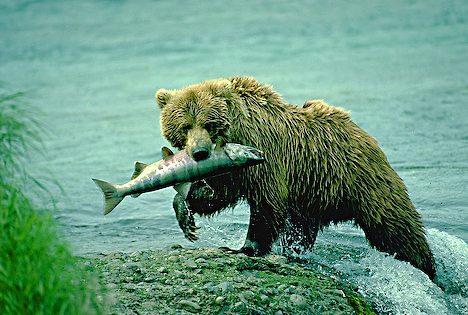
A grizzly bear survives because he is well-adapted to his environment. When he reproduces he passes on those traits to his offspring. this process is called
Natural Selection
Selective Breeding
Random mutations
Variations in a species

The bird on the right is better adapted to get the worm. It will probably survive and reproduce. This is known as_____.
Atomic distribution
Natural Selection
Population

