
Font size
 Worksheets
The Great Air Race Lesson 2 Quiz Review Game
Total questions: 16
Worksheet time: 9mins
the boundary formed when two air masses meet, creating some type of weather or precipitation.
Density
Front
Atmospheric Pressure
Air Mass
Isobar
the amount of particles in a given amount of matter and how closely packed together they are
Density
Front
Atmospheric Pressure
Air Mass
Isobar
the weight of the gases that make up the Earth’s atmosphere
Density
Front
Atmospheric Pressure
Air Mass
Isobar
a line on a weather map to show points that have the same air pressure
Density
Front
Atmospheric Pressure
Air Mass
Isobar
a large horizontal volume of air in the atmosphere that is mostly even in temperature and moisture
Density
Front
Atmospheric Pressure
Air Mass
Isobar
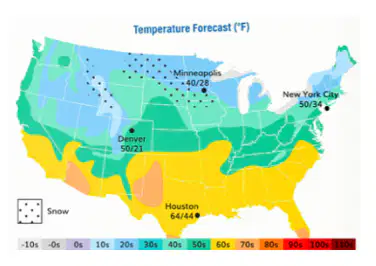
Use data from the weather map to predict how the weather in certain areas would affect outdoor activities. The numbers by the cities indicate the highest and lowest temperatures in the area. Which city's weather would most likely affect outdoor activities?
New York City
Houston
Denver
Minneapolis
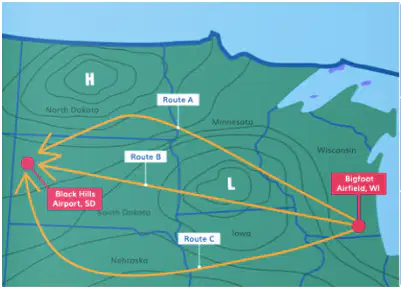
Use the map to predict the best route from Bigfoot Airfield, WI, to Black Hills Airport, SD.
Route A
Route B
Route C
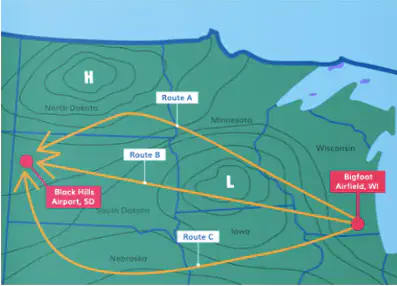
What type of winds would be expected on Route A?
Strong Headwinds
Light Crosswinds
Strong Crosswinds
Light Headwinds
What type of winds would be expected on Route B?
Strong Headwinds
Light Crosswinds
Strong Crosswinds
Light Headwinds
What type of winds would be expected on Route C?
Strong Headwinds
Light Crosswinds
Strong Crosswinds
Light Headwinds
Select the air masses that fit the observation: 'Relative humidity can't get high enough for precipitation to occur. Dew point is too low.'
Warm and Dry
Cold and Dry
Warm and Wet
Very Cold and Dry
Cold and Wet
Select the air masses that fit the observation:
"Precipitation only forms at low atmospheric pressure. Precipitation occurs when relative humidity reaches 100%. This happens when the air temperature drops to reach the dew point. Rain is formed when the temperature is above freezing. Snow is formed when the temperature is below freezing."
Warm and Dry
Cold and Dry
Warm and Wet
Very Cold and Dry
Cold and Wet
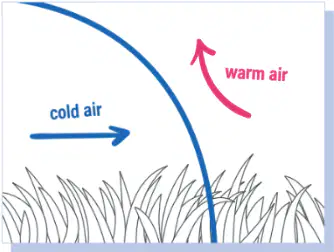
A meteorologist observed the interaction of the following air masses on a day with high levels of moisture in the air. When the air masses shown in the picture interact, which front is most likely to occur?
Warm Front
Occluded Front
Stationary Front
Cold Front
A meteorologist observed the interaction of the following air masses on a day with high levels of moisture in the air. Which weather conditions are most likely to occur? Select all that apply.
Snow
High Winds
Rain
Dry Heat
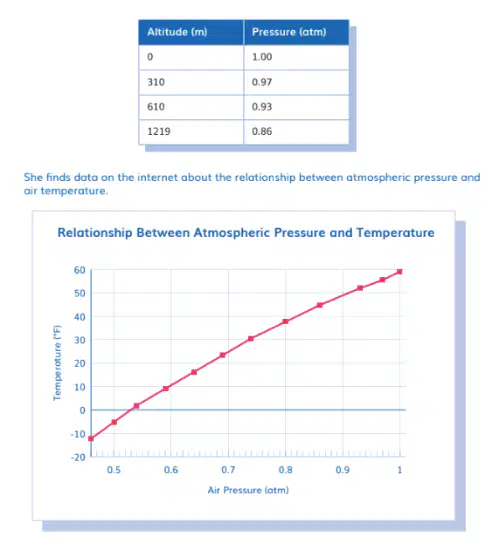
Keira is planning a hiking trip in Vermont. On her last hike, she collected data on the relationship between altitude and atmospheric pressure. Describe the relationship between air altitude and air temperature.
As altitude increases, air temperature decreases.
As altitude increases, air temperature increases.
As altitude increases, air temperature stays the same.

Keira is trying to decide which of the following mountains she should climb. She wants to have a comfortable picnic at the top of whichever mountain she climbs. Based on the data, which mountain peak is likely to be the warmest?
Mount Grant
Elmore Mountain
Gile Mountain
Mount Ellen

