
 Worksheets
Biodiversity & Ecology
Total questions: 25
Worksheet time: 13mins
Name
Class
Date
1.
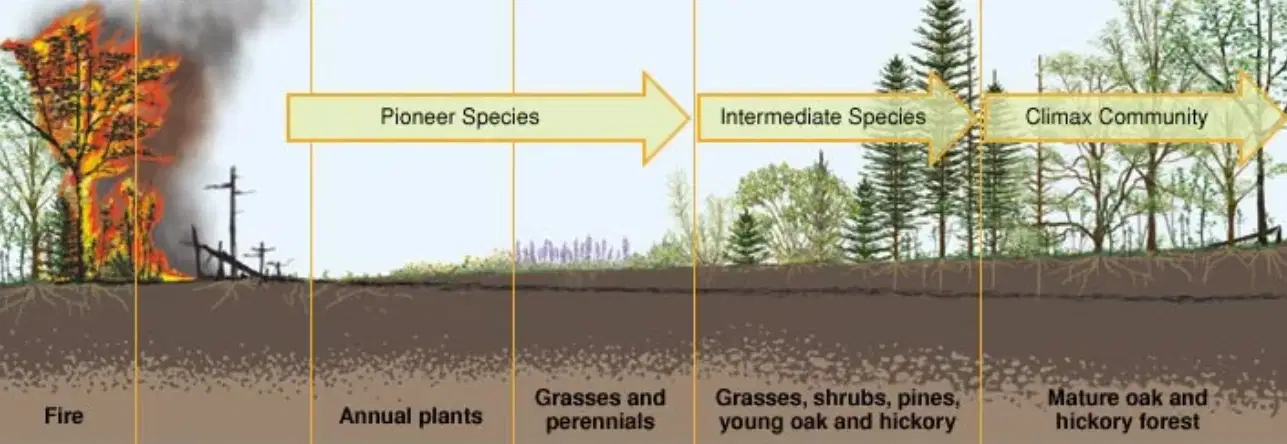
This picture shows:
a)
primary succession
b)
secondary succession
2.
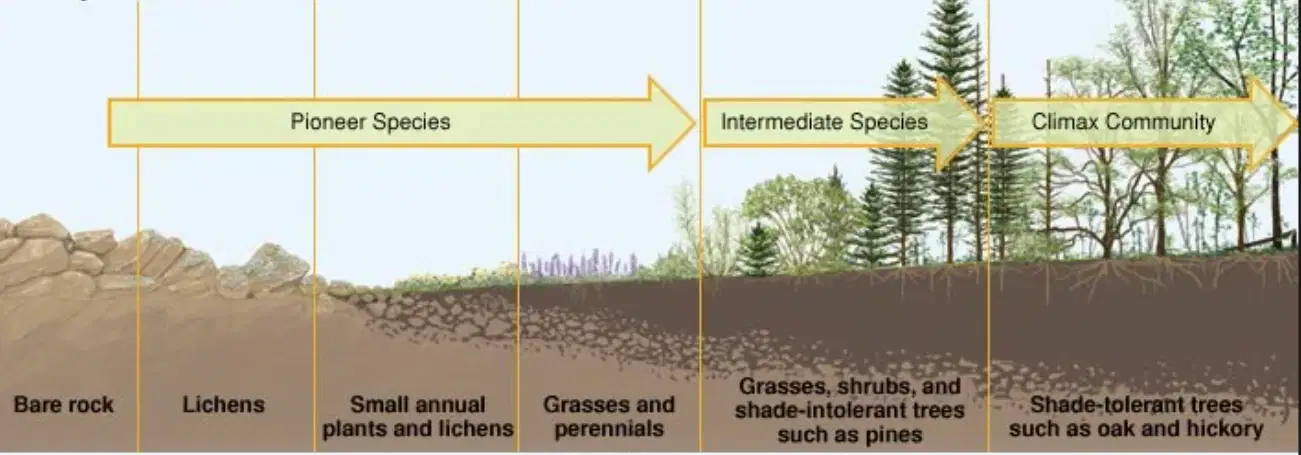
This picture shows:
a)
primary succession
b)
secondary succession
3.
Order the following changes in succession of an ecosystem from beginning to end.
A Thin soil accumulates and seedlings emerge from the soil.
B Lichen and moss grow on the rock surfaces and start dissolving rocks.
C A landslide builds up a new land surface at the base of a mountain.
D. A mature community of meadow plant and animal populations becomes established.
a)
A,B,C,D
b)
C, B,A,D
c)
B,A,D,C
d)
D,C,B,A
e)
4.
Jason lives near a state park and he likes hiking through the grassy trails that lead to a nearby lake. He appreciates nature and the surrounding components making up the ecosystem. Water, fuel, food and raw materials are examples of what.
a)
natural resources
b)
cultural resources
c)
regulating services
d)
cycling of matter and enegy
5.
Sometimes when a bee pollinates a flower, this action is beneficial to humans. Bees are the main pollinators of many plants that humans eat, such as blueberries, potatoes, apples, celery and strawberries. What are the benefits that humans receive from the ecosystem called?
a)
ecological restoration
b)
sustainability
c)
ecosystem services
d)
ecology
6.
Wolves were reintroduced to Yellowstone National Park in 1995. This keystone species restored the park's ecosystem. What is the ecological value of a keystone species?
a)
They influence the surival of many other species in an ecosystem.
b)
They prevent the ecosystem from changing and growing.
c)
They protect land and water resources within the ecosystem.
d)
They decrease the number of unwanted species in an ecosystem.
7.
Two students observe the changes to the island community during and after a storm. Lisa classifies the changes as primary succession, whereas Kadie classifies them as secondary succession. Which argument is supported by the evidence?
a)
Lisa is correct because lichen and moss were the first organisms to return to the island.
b)
Kadie is correct because the lichen and moss were disturbed, but remained on the island.
c)
Both students are correct because the changes were caused by a natural even rather than by human activity.
d)
Neither student is correct because the changes were caused by human activity rather than by a natural event.
8.
In Hawaii new land forms when larva erupts from Kilauea volcano and hardens. the new land is without any living things. The first organisms to populate the surface of that new land are known as __________ species. With time, a series of changes called ________ succession occur, through which the new land becomes colonized by a variety of organisms.
a)
primary, pioneer
b)
secondary, pioneer
c)
pioneer, primary
d)
pioneer, secondary
9.
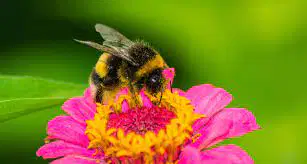
In a garden ecosystem, a bee has a relationship with a flowering plant. The relationship is an example of mutualism. How are the bee and the plant affected in the relationship?
a)
The bee and the plant both benefit.
b)
The bee and the plant are both harmed.
c)
The bee is harmed and the plant benefits.
d)
The bee benefits and the plant is harmed.
10.

Spanish moss grows on the branches of Oak trees. The moss benefits from being up high. The tree is neither helped or harmed. What type of relationship is this?
a)
parasitism
b)
mutualism
c)
competition
d)
commensalism
11.

Many people hang mistletoe over doorways during winter holidays. Mistletoe is a plant that feed on the branches of Oak trees. In doing so, it takes away from the nourishment of of the tree. What type of relationship exists between the mistletoe and Oak tree?
a)
predation
b)
parasitism
c)
mutualism
d)
competition
12.

A plant called the bullhorn acacia has swollen thorns with hollow spaces inside. A certain species
of ant lays eggs inside these thorns. The ants feed from the nectar of the acacia without harming it.
The ants protect the acacia from insects that want to eat its leaves or bark. What type of relationship
exists between the plant and the ants?
a)
commensalism
b)
mutualism
c)
parasitism
d)
prey
13.
Which natural ecosystems change through secondary succession. Which of the following describes and ecosystem in which a secondary succession will most likely occur?
a)
a coastline newly formed from erupted lava
b)
an island where rain showers occur most afternoons
c)
a forest partly burned by wildfire caused by a lightning strike
d)
a hillside where all the soil and organisms were removed from mining
14.
Lichens in a forest ecosystem are actually fungi and algae living together. The fungi benefit from food produced by the algae. The algae benefit from nutrients and water absorbed by the fungi. Which of the following relationships in different ecosystems is most similar to the interaction of the fungi and algae?
a)
mutualism between fungi and ants
b)
parasitism between fungi and humans
c)
commensalism between birds and trees
d)
competition between algae and aquatic plants
15.
The niche is a/an
a)
community of animals.
b)
an organisms role in its environment.
c)
kind of habitat.
d)
part of a food web.
e)
16.
The niche of a producer is to
a)
eat other consumers.
b)
provide food for carnivores.
c)
make carbon dioxide and oxygen.
d)
provide food for themselves and other organisms.
17.

If a mosquito feeds on a bird that is infected with the West Nile Virus and then feeds on a human being who then contracts the virus, what role is the mosquito playing in the infection of the person?
a)
pathogen
b)
host
c)
predator
d)
parasite
18.
The study of how organisms interact with their environment like a bee pollinating a flower is called _______.
a)
biodiversity
b)
ecology
c)
predation
d)
invasive species
19.

The Bradford Pear tree was brought to South Carolina in the 1990's and began to cross pollinate with other trees and take over our important and useful hardwood forests. Businesses no longer sell these trees here in the US. What is this an example of?
a)
invasive species
b)
pioneer species
c)
endangered species
d)
extinct species
20.
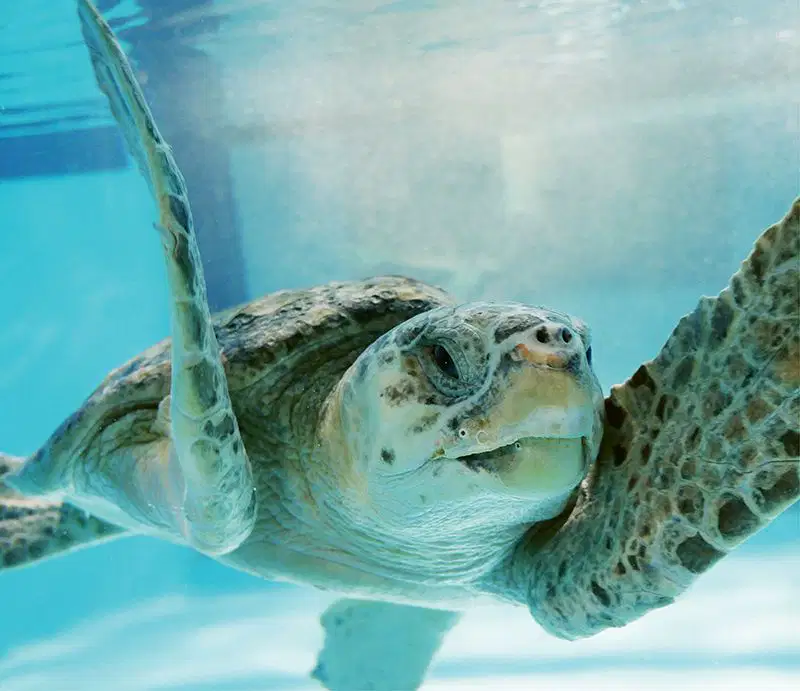
A species that is endanger of becoming extinct like the Loggerhead turtle in SC is called a/an ___________ species.
a)
climax
b)
endangered
c)
extinct
d)
invasive
21.
A ______ species is one that has disappeared from existence like the Woolly Mammoth.
a)
climax
b)
endangered
c)
extinct
d)
invasive
22.
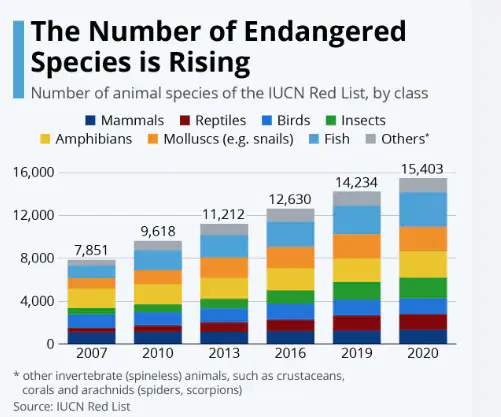
According to the graph, which type of species number is becoming more endangered year to year?
a)
amphibians
b)
birds
c)
fish
d)
mammals
23.
____________ is the process of using less of a resource so that it can last longer.
a)
Conservation
b)
Ecological restoration
c)
Regulation
d)
Sustainability
24.

This is an example of ___________________.
a)
climax community
b)
invasive species
c)
endangered species
d)
pioneer species
e)
25.
____________ is the ability of an ecosystem to maintain biodiversity and production indefinitely.
a)
Conservation
b)
Regulation
c)
Sustainability
d)
Ecological restoration
100 %

