wayground logo

Free Printable Worksheets

Font size

S
M
L
XL
Worksheets

6.4 Rock cycle, plate tectonics lesson 1-7

Total questions: 27

Worksheet time: 50mins

Name
Class
Date
1.
Weathering directly helps form which rock(s)?
a)
igneous
b)
metamorphic
c)
sedimentary
d)
all of these
2.

Water carrying sediment down a hill is an example of...

a)

weathering

b)

erosion

c)

deposition

3.
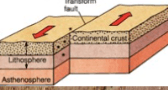
Crust is neither created or destroyed at _____ boundaries.
a)
convergent
b)
divergent
c)
transform
d)
all of the above
4.
Mountains form at _____.
a)
convergent boundaries
b)
divergent boundaries
c)
transform boundaries
d)
atmospheric boundaries
5.

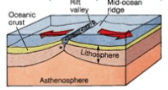
At a mid ocean ridge, like the Mid Atlantic Ridge, _____ .

a)
the plates are spreading apart
b)
the plates are moving together
c)
the plates are sliding past each other
d)
the plates are not moving
6.
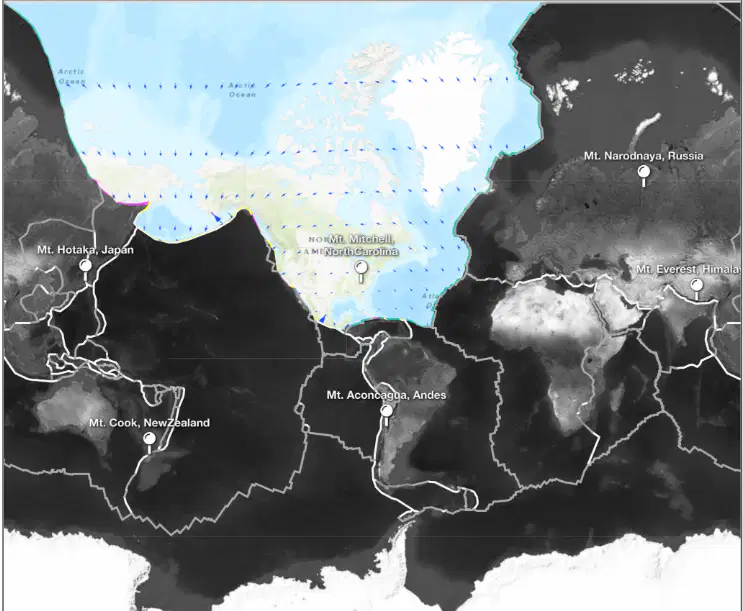
At which plate boundary would you expect to find mountains?
a)
African and Arabian Plates
b)
Eurasian and Indo-Australian Plates
c)
North American and Caribbean Plates
d)
Pacific and Nazca Plates
7.
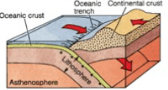
The continental crust is _____.
a)
more dense than the oceanic crust so the continental subducts under the oceanic crust
b)
more dense than the oceanic crust so the oceanic subducts under the continental crust.
c)
 less dense than the oceanic crust so the continental subducts under the oceanic crust.
d)
less dense than the oceanic crust so the oceanic subducts under the continental crust.
8.

Match the following

a)
1.

divergent

b)
2.

convergent

c)
3.

transform

9.
During sea floor spreading, molten material rises up from the mantle...
a)
along the continents
b)
at the mid ocean ridges
c)
deep ocean trenches
d)
at north and south poles
10.

Most tectonic plates have both oceanic and continental crust. How are they different?

a)

Oceanic is thinner and less dense than continental.

b)

Continental is thinner than more dense than oceanic.

c)

Continental is thicker and less dense than oceanic.

d)

Oceanic is thicker and more dense than continental.

11.
Question Image

Match the following

a)

A

1.

sediment

b)

B

2.

igneous rock

c)

C

3.

magma

d)

D

4.

metamorphic rock

e)

E

5.

sedimentary rock

12.

The United States is slowy moving _____

a)

to the north towards Canada

b)

to the northeast towards Europe

c)

to the southeast towards South America

d)

to the west southwest towards Asia

13.

In lesson 4, we look at the United States and created a model of its fault lines. The North American Plate, home to our  United States goes from ___ to ___.

a)

California to Kentucky

b)

California to New York

c)

Colorado to New York

d)

California to the Mid Atlantic Ridge

14.

The North American Plate moves  _____ per year.

a)

2 miles

b)

2 centimeters

c)

2 meters

d)

2 kilometers

15.

Plates move because _____.

a)

convection currents in the mantle

b)

radiation directly from the sun

c)

conduction from mountains warming as the sit on the crust that absorbed energy from the sun

d)

all of these

16.

Which are heat sources that help a metamorphic rock form? Select all that apply.

a)

heat from the mantle

b)

being near pockets of rising magma in the crust

c)

friction of plate movement

d)

the sun

17.

Fossils are only found in _____

a)

sedimentary rock

b)

metamorphic rock

c)

igneous rock

d)

all of these can have fossils

18.

What is created when you have continental crust converging with continental crust?

a)

Mountains

b)

Rift Valleys

c)

Trenches

d)

all of these

19.

What can occur when you have continental crust converging with ocean crust?

a)

volcanic arc

b)

trench

c)

earthquake

d)

subduction zone

e)

all of these

20.

What happens in the area where tectonic plates move away from each other (divergent)?

a)

a deep tunnel to the center of earth is formed

b)

crust grinds against each other

c)

new crust is created

d)

all of these

21.

Hot fluid or material below or INSIDE the earth's crust that can form igneous rock if cooled is called _____.

a)

Convection Current

b)

Lithosphere

c)

Lava

d)

Magma

22.
Which of the following causes Earth's tectonic plates to move?
a)
Energy from the Sun
b)
Magnetic Pole Reversal
c)
Convection currents in the mantle
d)
Faults in Mountain Ranges
23.

Volcanoes can create new land when they release ____ across the surface of earth.

a)
lava
b)
water
c)
faults
d)

magma

24.
What is a destructive force?
a)
A natural process that destroys land
b)
A natural process that creates land
c)
A natural process where areas that are normally dry is covered in water
25.
A constructive force is defined as
a)
a natural occurrence that can build up or break down
b)
an earthquake or a volcano
c)
a natural force that builds up and creates new land
d)
a destructive force that has been controlled
26.
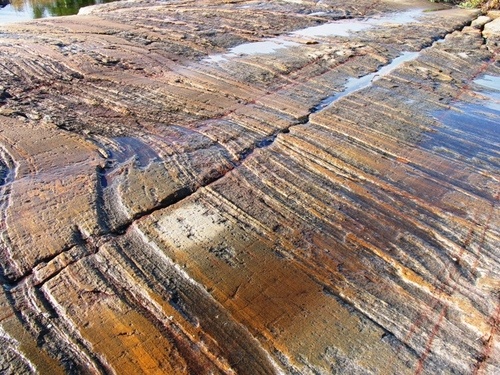
This is a picture of glacier scars found in Africa.  What are these evidence for?
a)
Africa has always been near the equator
b)
Africa was once in an area of the Earth that had a very cold climate
c)
The continents have not moved
d)
sea floor spreading
27.

Match the rock type to how it forms

a)

metamorphic rock

1.

Heat and pressure

b)

igneous

2.

melting then cooling

c)

sedimentary

3.

pressure applied to layers