
Font size
 Worksheets
[habs] 12.1 Program Development Lifecycle Quiz
Total questions: 27
Worksheet time: 14mins
What are the five stages of the program development lifecycle?
Planning, Design, Coding, Testing, Maintenance
Analysis, Design, Coding, Testing, Deployment
Analysis, Design, Coding, Testing, Maintenance
Analysis, Planning, Implementation, Evaluation, Maintenance
What is the purpose of the 'Analysis' stage in the program development lifecycle?
To write the code for the program
To test the program to make sure it works under all conditions
To investigate and specify what a program is required to do
To ensure the program continues to work during use
Which development model is described as a linear sequential program development cycle?
Iterative model
Waterfall model
Rapid application development (RAD)
Agile model
What is the key characteristic of the Iterative model of program development?
Each stage is completed before the next is begun.
A simple subset of the requirements is developed and enhanced repeatedly.
The program is developed in parallel with early user involvement in testing.
The program is developed without a predefined structure.
What distinguishes Rapid application development (RAD) from other program development models?
It has a strict sequence of stages that must be followed.
It focuses on fast development and delivery of high-quality systems at low cost.
Different parts of the requirements are developed in parallel with prototyping.
It emphasizes on maintenance and error fixing after deployment.
What is the purpose of a program development lifecycle?
To ensure that a program is only used by the developer
To make a program less understandable for other developers
To develop a successful program that is well ordered and clearly documented
To prevent a program from requiring any alterations after development
Why might a program that has been developed require alterations?
Because it is no longer needed by the user
To deal with new circumstances or errors that have been found
To make the program more complicated
To reduce the number of users who can understand the program
How long does the program development lifecycle last?
Until the program is sold to another company
Until the program is used by at least one other developer
Until the program is no longer used
Only during the initial development phase
What is the first stage in the program development lifecycle?
Design
Analysis
Coding
Testing
What is created during the design stage of the program development lifecycle?
A suitable programming language
A feasibility study
Program specification
The final program
Which stage of the program development lifecycle is completed right before the 'Coding' stage?
Analysis
Design
Testing
Maintenance
What is the purpose of the analysis stage in the program development lifecycle?
To write the program using a programming language
To test the program
To define the problem and requirements specification
To maintain the program
Which of the following is NOT a document produced during the design stage?
Structure charts
State-transition diagrams
Pseudocode
Feasibility study
What is the purpose of maintaining a program throughout its life?
To ensure it continues to work effectively
To reduce the program's cost
To redesign the program completely
To limit the program's functionality
What does program maintenance involve?
Only adapting the program to meet new requirements
Correcting any errors that come to light and improving functionality
Ignoring any errors that arise during use
Never changing the program after it is developed
Which of the following is NOT a principle of the waterfall model?
Each stage has specific deliverables
Stages do not overlap and are completed one at a time
Working program is produced late in the lifecycle
Linear, as each stage is completed before the next is begun
What is a benefit of the waterfall model?
Suitable for long, complex projects
Difficult to change the requirements at a later stage
Works well for smaller programs where requirements are known and understood
Not suitable for programs where the requirements could be subject to change
What is a drawback of the waterfall model?
Each stage has specific deliverables
Easy to manage, understand and use
Not suitable for long, complex projects
Well documented as full documentation is completed at every stage
According to the waterfall model, when is customer involvement primarily expected?
Throughout the entire process
Only at the maintenance stage
Only involved at the start and end of the process
At the end of each stage
What is a principle of the iterative model in program development?
The system is developed only once and not altered.
Incremental development as the program development lifecycle is repeated.
Customer involvement is not necessary.
Working programs are not produced at any iteration.
Which of the following is a benefit of the iterative model?
It is more difficult to test and debug smaller programs.
It is not flexible and difficult to alter requirements.
Some working programs developed quickly at an early stage in the lifecycle.
Customers are not involved at each iteration.
What is a drawback of the iterative model?
It is suitable for short simple projects.
It does not require good planning overall and for every stage.
The whole system needs to be defined at start, so it can be broken down into pieces to be developed at each iteration.
Customers involved at each iteration can cause surprises when the final system is delivered.
What is the primary benefit of using the Rapid Application Development (RAD) model?
It requires extensive planning.
It reduces overall development time.
It is suitable for short simple projects.
It does not require customer involvement.
Which principle is emphasized in the RAD model?
Minimal planning.
No reuse of previously written code.
Low customer involvement.
Sequential development phases.
What is a drawback of the RAD model?
It is very flexible as requirements evolve from feedback.
It provides reduced overall development time.
It needs strong teams of skilled developers.
It allows for rapid customer feedback.
Why is the RAD model not suitable for short simple projects?
Because it requires minimal planning.
Because it needs strong teams of skilled developers.
Because it is not flexible.
Because it is only suitable for complicated projects that need to be developed in a short timeframe.
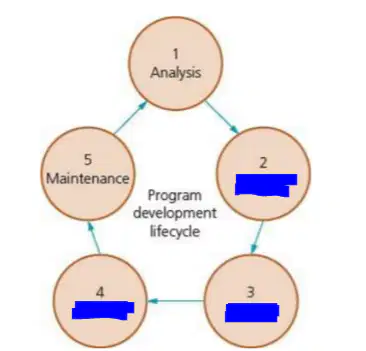
The operation at point 3 is (a) ?

