
NEW
Font size
 Worksheets
Y10 - Reflex arc
Total questions: 13
Worksheet time: 7mins
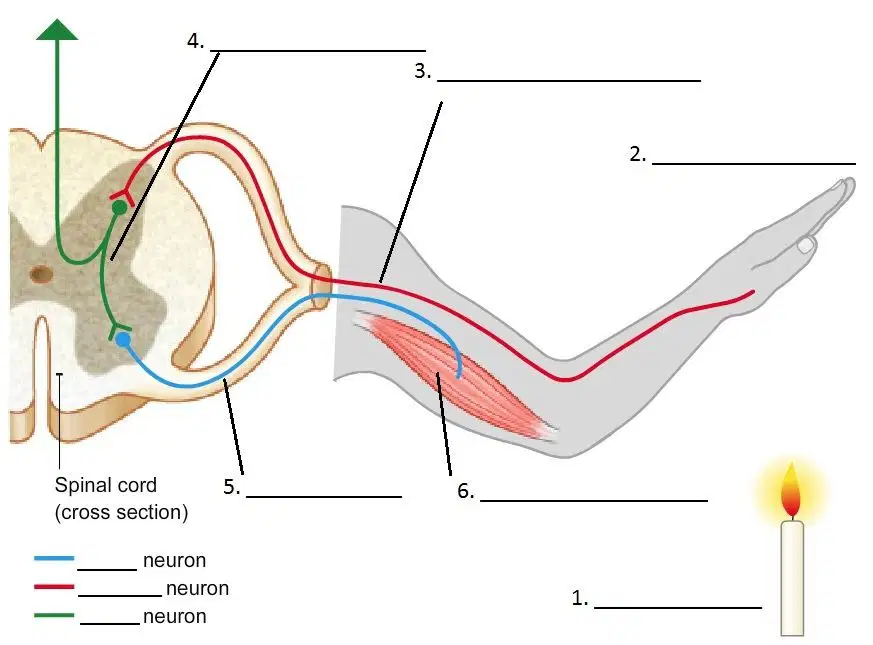
What is number 4?
Relay neurone
Motor neurone
Sensory neurone
Spine
What is number 3?
Relay neurone
Motor neurone
Sensory neurone
Spine
What is number 2?
Candle
Receptor
Fire
Stimulus
What moves across the synapse?
Electrical impulse and a chemical messenger
Electrical impulse
Chemical messenger
Why does the pupil get smaller?
We have to think about this and our brain then creates the change
It is a reflex response and stops damage to the retina
To allow as much light into the eye are possible.
To see better
What is number 1?
Candle
Receptor
Fire
Stimulus
What is included in the central nervous system (CNS)?
Brain and all neurones in the body
Spinal cord and all neurones in the body
Brain and spinal cord
The nerve cells
What is number 6?
Arm
Quad
Muscle
Hand
What is the generalised order during a nervous response?
Response → receptor → coordinator → effector → stimulus
Stimulus → receptor → coordinator → effector → response
Stimulus → effector → coordinator → receptor → response
Receptor → stimulus → coordinator → effector → response
What is number 5?
Sensory neurone
Relay neurone
Motor neurone
Nerve cell
What is the role of neurotransmitters in the nervous system?
To transmit electrical impulses within neurons
To regulate hormone production
To transmit signals between neurons
To protect neurons from damage
The gap between two neurons where neurotransmitters are released is called the:
Electrical signal
Nerve cell
Neurone gap
Synapse
Name the three different types of neurone
Sensory, relay and motor neurones
Sensory, generalised and motor neurones
Sensory, relay and effector neurones
Sensory, relay and response neurones

