
 Worksheets
Africa Independence Movement
Total questions: 25
Worksheet time: 42mins
What was the purpose of the Berlin Conference?
Teach Africans how to govern themselves independently.
Discuss the best trade routes from Africa to Germany.
Grant independence to African colonies.
Partition African territory among European nations.
Why did European countries set up colonies in Africa?
They wanted to build the economies of African nations.
They wanted to solve ethnic and tribal disputes.
They wanted to gain wealth from trade and natural resources.
They wanted to help organize African schools.
Which European country gained the most land in Africa during the Age of Imperialism?
France
Great Britain
Germany
Spain
Who was NOT invited to the Berlin Conference?
Leaders from Africa
Leaders from Great Britain
Leaders from Germany
Leaders from France
What was a result of the "Scramble for Africa"?
African tribes became entangled in cultural conflicts with one another.
Unhappy Africans rebelled against European colonial governments.
European nations took control of nearly all of Africa.
All of the above.
A system of acquiring colonies to provide raw materials for a stronger country is called:
Nationalism
Imperialism
Patriotism
Socialism
How did Europeans determine new boundaries in Africa?
They used existing borders that were already set up in Africa.
They had many African leaders help draw the borders.
They completely ignored existing borders and drew new ones that were convenient for them.
They drew borders with Africa's different ethnic groups in mind, making sure they were separated.
Boundaries established by European governments that placed competing ethnic groups within the same country in Africa led to what?
the spreading of Islam
economic prosperity
ethnic tensions, conflict, and civil wars
widespread starvation and famine

How did the Europeans “partition” Africa?
At the Berlin Conference in 1884 the European countries divided Africa for natural resources.
At the Paris Conference in 1886 the European countries divided Africa for natural resources.
European countries just showed up with their military and took over.
Europe never took anything from Africa.
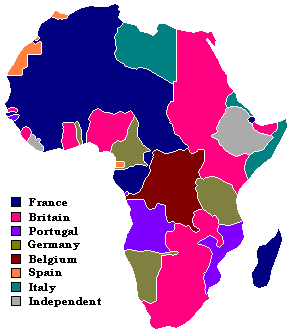
Which conclusion is accurate based on the map above?
the partitioning of Africa into colonies creates uneven and artificial political boundaries
European countries divided Africa because there were no civilizations there in 1914
modern African countries probably enjoy these boundaries because they all follow rivers
there were so many European countries that had colonies in Africa, so there was little conflict
The invasion, occupation, colonization, and annexation of Africa territory by European powers during the New Imperialism period between 1881 & 1914
Apartheid
Colonization
Scramble for Africa
Imperialism
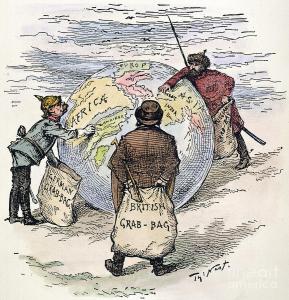
What is Imperialism?
when one nation is able to control other, usually smaller or weaker, nations
loyalty and devotion to a nation especially as expressed in a glorifying of one nation above all others
shared or governmental ownership and administration of the means of production and distribution of goods
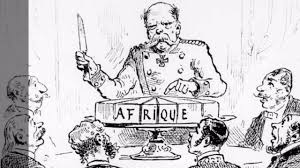
Which of the following describes the purpose of the Berlin Conference?
Stop European conflict by assigning African regions and the resources in each region
Stop European conflict by equally distributing Africa's resources
Stop European conflict by allowing African's to participate
Stop European conflict by allowing African's and Europeans to obtain equal land
a philosophy that emphasized a common bond shared by people of African descent and advocated unity among African people
civil war
artificial political boundaries
European Partitioning of Africa
Pan-African movement
1. To unite people of African descent (still in Africa and around the world), reminding them that they have a common culture and history, so they should work to the same goals.
2. To end European Colonization in Africa (get all African nations their own political freedom.)

What country did South Africa, Kenya, and Nigeria gain its independence from?
Great Britain
France
Germany
Portugal
Became independent of British rule in 1960, through peaceful measures.
Kenya
South Africa
Nigeria
Ethiopia
Nationalist who helped to lead Kenya to Independence and became their first Black President
Nelson Mandela
F.W. de Klerk
Jomo Kenyatta
Count Major Sellers


TRUE or FALSE: Pan-Africanism was a nationalism movement led by scholars all over the world to promote independence of African nations from Europe
True
False
Which best describes Kenya’s independence movement?
Violent
Peaceful
Rapid
Calculated

