
 Worksheets
Chapter 12 Review
Total questions: 30
Worksheet time: 30mins
Name
Class
Date
1.
a camp that grows into a town almost overnight
a)
boom town
b)
transcontinental
c)
prairie
d)
homesteader
e)
reservation
2.
a person who received land under the Homestead Act of 1862
a)
homesteader
b)
transcontinental
c)
prairie
d)
reservation
e)
tradition
3.
a person who searches for gold, silver, or other valuable
a)
prospector
b)
transcontinental
c)
prairie
d)
homesteader
e)
reservation
4.
public land set aside by the government for the use of a particular group of people
a)
reservation
b)
transcontinental
c)
prairie
d)
homesteader
e)
tradition
5.
the handing down of information, beliefs, and customs from one generation to another
a)
tradition
b)
transcontinental
c)
prairie
d)
homesteader
e)
reservation
6.
across a continent
a)
transcontinental
b)
prairie
c)
homesteader
d)
reservation
e)
tradition
7.
a large area of level or slightly rolling land
a)
prairie
b)
transcontinental
c)
homesteader
d)
reservation
e)
tradition
8.
Where did the Central Pacific Railroad Company start building the railroad?
a)
a) Omaha, Nebraska
b)
b) Sacramento, California
c)
c) New York City, New York
d)
d) Chicago, Illinois
9.
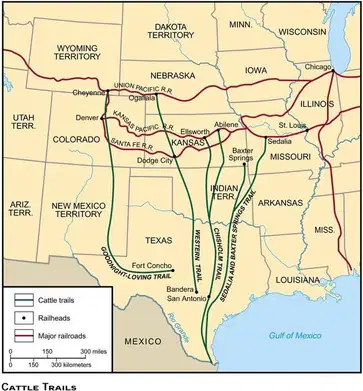
Which cattle trail starts in Texas and ends in Nebraska?
a)
Western Trail
b)
Goodnight-Loving Trail
10.
Who were the majority of workers on the Union Pacific Railroad?
a)
a) Chinese immigrants
b)
b) Irish immigrants
c)
c) Mexican Americans
d)
d) Native Americans
11.
What was the purpose of the Homestead Act of 1862?
a)
a) To encourage settlement and farming in the Great Plains
b)
b) To establish railroad companies
c)
c) To provide free land for Native Americans
d)
d) To promote industrialization in urban areas
12.
What did homesteaders have to do to receive land under the Homestead Act?
a)
a) Pay a large sum of money
b)
b) Build a home within six years
c)
c) Grow crops for three years
d)
d) Live on the land for five years and build a home within six months
13.
Why did the United States government encourage settlement in the Great Plains?
a)
a) Because the land was unsuitable for farming
b)
b) To promote urbanization
c)
c) To increase population in the East Coast
d)
d) Because the soil was good for farming and raising animals
14.
How did the completion of the transcontinental railroad impact travel to the West?
a)
a) It made travel slower and more difficult
b)
b) It had no impact on travel
c)
c) It made travel faster and easier
d)
d) It increased travel costs
15.
What impact did settlers and railroads have on Native Americans as they moved west?
a)
a) They helped Native Americans preserve their traditions
b)
b) They forced Native Americans onto unfamiliar lands
c)
c) They provided Native Americans with new opportunities
d)
d) They encouraged Native Americans to move closer to cities
16.
What did the U.S. government set aside for Native Americans on the Great Plains before the Civil War?
a)
a) Farms
b)
b) Reservations
c)
c) Schools
d)
d) Mining rights
17.
What led to the Battle of Little Bighorn?
a)
a) A dispute over farming land
b)
b) The discovery of gold on Lakota reservation land
c)
c) A conflict over hunting rights
d)
d) A disagreement over tribal leadership
18.
Who were the leaders of the Lakota during the Battle of Little Bighorn?
a)
a) George Custer and Crazy Horse
b)
b) Sitting Bull and Chief Joseph
c)
c) Crazy Horse and Sitting Bull
d)
d) Chief Joseph and George Custer
19.
What was the outcome of the Battle of Little Bighorn for the U.S. Army?
a)
a) The U.S. Army suffered heavy losses
b)
b) The U.S. Army emerged victorious
c)
c) The U.S. Army captured Sitting Bull
d)
d) The U.S. Army negotiated a peace treaty
20.
Why did Chief Joseph surrender to the U.S. soldiers?
a)
a) He was promised better land elsewhere
b)
b) He was tired of fighting and wanted peace
c)
c) He was betrayed by his own tribe
d)
d) He believed the U.S. soldiers were invincible
21.
What was the purpose of the Dawes Act of 1887?
a)
a) To grant Native Americans more rights
b)
b) To encourage Native Americans to become farmers
c)
c) To preserve Native American traditions
d)
d) To prevent Native Americans from becoming U.S. citizens
22.
Why did the Dawes Act ultimately fail to achieve its goals?
a)
a) Native Americans refused to become farmers
b)
b) Native Americans were not interested in education
c)
c) Native Americans wanted to keep their traditions
d)
d) Native Americans sold their land before the 25-year period
23.
What was the Ghost Dance, as taught by Wovoka, intended to accomplish?
a)
a) To prepare for war against the U.S. government
b)
b) To bring joy and peace to the Plains people
c)
c) To summon spirits of deceased ancestors
d)
d) To protest against the loss of Native American land
24.
True or False: By the end of the 1880s, the cowhand's way of life had disappeared.
a)
True
b)
False
25.
What was the primary role of cowhands during cattle drives?
a)
a) Tending to sick cattle
b)
b) Guiding cattle to rail towns
c)
c) Selling cattle to ranchers
d)
d) Managing farm equipment
26.
How did boom towns first deal with law enforcement?
a)
a) They hired professional law officers
b)
b) They formed vigilante committees
c)
c) They relied on the military
d)
d) They established self-governing councils
27.
What was the fate of many boom towns and mines by the end of the 1800s?
a)
a) They became centers of industry
b)
b) They were abandoned
c)
c) They were integrated into large mining companies
d)
d) They became agricultural hubs
28.
What was the primary purpose of the Grange organization formed by settlers in the West?
a)
a) To promote mining ventures
b)
b) To provide legal services to homesteaders
c)
c) To support and advocate for farmers' interests
d)
d) To establish educational programs for children
29.
Where did raising cattle become a major industry in the late 1800s?
a)
a) Texas
b)
b) New York
c)
c) Mahopac
d)
d) Utah
30.
True or False: Mining was often difficult and deadly work
a)
True
b)
False
100 %

