
 Worksheets
Honors Physics - Chapter 14/15 Review - Harmonic Motion/Waves
Total questions: 25
Worksheet time: 18mins
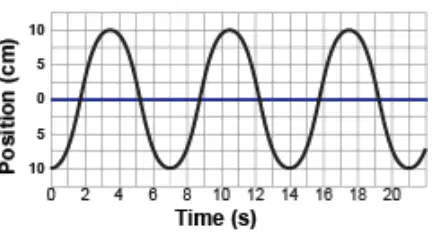
What is the period of the oscillation in the graph? (in seconds)
(a)
Which of the following is NOT an example of harmonic motion?
pistons in a running car engine
waves in a pond spreading outward from a stone that was dropped
vibrating guitar string
swinging pendulum
ball rolling down a hill
The highest and lowest points of a mass oscillating on a spring are 22 cm apart. What is the amplitude of the movement? (in cm)
(a)

A pendulum is oscillating and the graph of its motion is shown. What is the frequency of the oscillation? (in Hz)
(a)
A simple harmonic oscillator has a frequency of 2.5 Hz and an amplitude of 2.4 cm. What is the period of the oscillations? (in seconds)
(a)
A mass-and-spring oscillator is damped due to friction. Which quantity does the damping cause to change the most as time passes? (Assume the oscillator is underdamped.)
restoring force
inertia
amplitude
frequency
period
A simple pendulum that oscillates at 10° has a period of 3.2 seconds. What is the approximate length of the pendulum?
7.0 m
2.5 m
247.6 m
1.8 m
A pendulum with a 1.0 m string has a natural frequency of 0.50 Hz, while a pendulum with a 9.0 m string has a natural frequency of 0.17 Hz. Which statement best describes the relationship between pendulum length and pendulum period?
Period is independent of length.
An increase in length corresponds to an increase in period.
The relationship depends on the specific lengths we are investigating.
An increase in length corresponds to a decrease in period.
The relationship depends on the specific frequencies we are investigating.
A pendulum is oscillating with a natural frequency f = 3 Hz. If the length of the pendulum increases by a factor of 4 what happens to the frequency?
increases by a factor of 2
does not change
increases by a factor of 4
decreases by a factor of 2
decreases by a factor of 4
A pendulum is oscillating with a natural frequency f = 3 Hz. If the mass on the pendulum doubles what happens to the frequency?
does not change
increases by a factor of 2
increases by a factor of 4
decreases by a factor of √2
decreases by a factor of 2
A 2 kg mass on a spring oscillates at 3 Hz with a maximum displacement of 17 cm. Determine the maximum velocity of the mass.
6.8 m/s
3.2 m/s
14 m/s
6.1 m/s
5.9 m/s
A mass oscillates on a spring hanging from the ceiling that has a spring constant, k, of 200 N/m and a natural frequency of 2.5 Hz. If the speed of the mass is 3.8 m/s as it moves through its equilibrium position, what is the total energy of the system when totally compressed?
8.91 J
5.85 J
3.79 J
2.92 J
A mass oscillates on a spring hanging from the ceiling that has a spring constant, k, of 200 N/m and a natural frequency of 2.5 Hz. If the speed of the mass is 3.8 m/s as it moves through its equilibrium position, what is the maximum displacement of the spring (in cm)?
24 cm
82 cm
141 cm
58 cm
An electromagnetic wave traveling at 3.0 × 10⁸ m/s has a 0.65 m wavelength. What is the frequency of this wave?
3.0 × 10⁸ Hz
5.0 × 10⁸ Hz
2.5 × 10⁸ Hz
4.6 × 10⁸ Hz
If a wave has a frequency of 160 Hz and a wavelength of 6.00 m, then what is the speed of this wave? (in m/s)
(a)
An ocean buoy moves up-and-down once every 6.0 seconds due to passing water waves. What is the wavelength of the waves if their speed is 5.0 m/s? (in m)
(a)
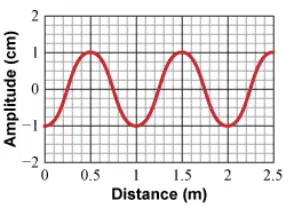
What is the wavelength of the wave in the graph? (in m)
(a)
A person who shouts while hiking in a canyon is likely to hear an echo. What wave behavior explains this phenomenon?
reflection
attenuation
diffraction
refraction
resonance
Which of the following wave characteristics always remains unchanged whenever a wave refracts?
wavelength
polarization
direction
frequency
speed
Two waves of the same frequency interfere with each other. The first wave has amplitude A1 = 58 cm and wavelength λ1 = 2 m. The second wave has amplitude A2 = 42 cm and wavelength λ2 = 2 m. What is the amplitude of the sum of the two waves if the waves are exactly in phase? (in cm)
(a)
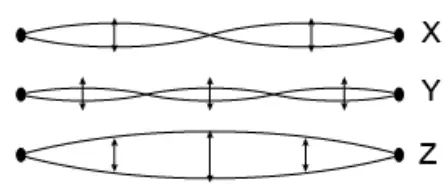
What is the frequency of pattern Z in the diagram showing three standing waves that occur on the same string. The frequency of pattern X is 108 Hz and the frequency of pattern Y is 162 Hz. (in Hz)
(a)
Two sound waves combine to create a louder sound than either of them individually. What is this a good example of?
constructive interference
destructive interference
damping
supersonic behavior
wave-boundary interaction
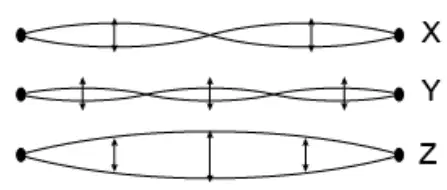
What is the wavelength of pattern Y in the diagram showing three standing waves that occur on the same string? The wavelength of pattern X is 1.1 m and the wavelength of pattern Z is 2.2 m.
0.46 m
0.37 m
4.4 m
0.73 m
6.6 m
Two waves of the same frequency and wavelength interfere with each other. The first wave has amplitude A1 = 52 cm and wavelength λ1 = 2.0 m. The second wave has amplitude A2 = 38 cm and wavelength λ2 = 2.0 m. What is the amplitude of the sum of the two waves if the waves are 180° out of phase? (in cm)
(a)
You and a friend create a standing wave with a rope, then you both hold your hands still while the standing wave continues oscillating. In total, there are 3 nodes in this wave. How many anti-nodes are there?
(a)

