Worksheets
Year 7 Homework Quiz - Tectonics
Total questions: 20
Worksheet time: 25mins
Tectonic plates consist of
continental crust
mesospheric crust
both continental and oceanic crust
oceanic crust
Pangaea was an ancient supercontinent made up of...
America, Greenland, and Europe
Antarctica, India, and America
all of Earth’s continents
South Africa, India, Australia, and South America


What is the correct order (starting from the surface) of Earth’s layers?
crust, outer core, inner core, mantle
mantle, outer core, inner core, crust
crust, mantle, outer core, inner core
outer core, inner core, crust, mantle

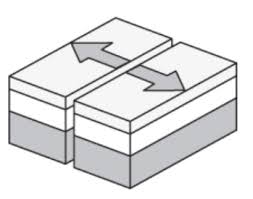
What is a plate boundary where both plates move away from each other?
Constructive (divergent)
plate
Destructive (convergent)
Conservative (transform)
Any trace of an ancient organism that has been preserved in rock is called a
landform
continent
fossil
landmass
What is a plate boundary where two plates slip past each other moving in opposite directions?
Conservative (transform)
Destructive (convergent)
Constructive (divergent)
Most geologists think that the movement of Earth's plates is caused by
conduction
earthquakes
convection currents in the mantle
Earth's magnetic field

The process by which the ocean floor sinks beneath a deep-ocean trench and back into the mantle is known as _______
convection.
continental drift.
subduction.
conduction.
Scientists think that convection currents flow in Earth’s
continents.
mantle.
lithosphere.
inner core.

A scale used for measuring the magnitude of an earthquake is known as the ______________
Ritter Scale
Seismic Scale
Richter Scale
Wegner Scale
What are formed at collision zones / boundaries?
Fold Mountains
Oceans Trenches
Tsunamis
What type of boundary occurs when two tectonic plates separate?
divergent
convergent
transform