
 Worksheets
Lumbar-Pelvic Assessment and Hamstring Strains
Total questions: 1
Worksheet time: 17mins
According to the summary, what is recommended in conjunction with lumbar-pelvic strengthening exercises to help resolve chronic hamstring strain?
Joint proprioceptive mechanisms
Increased rest periods
Dietary changes
Medication therapy
What mantra is frequently mentioned by Dr. Ida Rolf, as noted in the introduction?
Where the pain is, it ain't
Structure dictates function
Global assessment of structure is paramount
Localized evaluation is necessary for acute injury
Which type of injuries are described as the most prevalent in sports involving rapid acceleration and sprinting?
Ankle sprains
Hamstring injuries
Shoulder dislocations
Wrist fractures
What does research suggest about lumbar-pelvic alignment in relation to chronic hamstring strain?
It has no significant effect
It may play a significant role
It is only relevant in acute cases
It is less important than muscle strengthening
Who developed a multifaceted approach to musculoskeletal pain in the 1970s?
Vladimir Janda
Stuart McGill
Greenman
Hennessy and Watson
What does lumbar hyperlordosis often correlate with?
Posterior tilt of the pelvis
Anterior pelvic tilt
Sacroiliac joint dysfunction
Normal sacroiliac movements
According to the text, what can training error or overstretching in athletes lead to?
Decreased muscle tension
Normal sacroiliac movements
Exaggerated normal sacroiliac movements
Reduced hamstring strain
What is the result of a tight rectus femoris muscle according to the text?
Anterior tilt on the contralateral side
Posterior and inferior rotation on the same side
Posterior tilt on the contralateral side
Anterior and superior rotation on the same side
What did Janda's treatment protocol include?
What can a beneficial compensatory mechanism for people with pelvic instability lead to over time?
Decreased muscle tension
Normal sacroiliac movements
Exaggerated normal sacroiliac movements
Reduced hamstring strain
What is a primary function of the pelvis according to the text?
To reduce hamstring strain
To transfer the loads generated during standing, walking, sitting, and other functional tasks
To provide compression of the leg
To assist with muscle contraction
Which of the following is NOT mentioned as a cause of sacroiliac joint (SIJ) dysfunction?
Hamstring spasm
Weakness or unreactivity of gluteus maximus
Poor closure of the SIJ during load transfer
A tightened anterior hip capsule
According to the text, what does the study by Vleeming et al. suggest about the sacrotuberous ligament?
It is the primary cause of SIJ dysfunction
It is not connected to the iliotibial tract
Gluteus maximus attaches to the sacrotuberous ligament in all cases
In 50% of cases unilateral or bilateral fusion of the sacrotuberous ligament with the tendon of the long head of biceps femoris was evident
What does the term "arthrokinetic failure" refer to?
The inability to recognise the importance of neuromuscular re-education and strengthening of muscle groups
The failure of joint mobilisation techniques
The successful fusion of the sacrotuberous ligament with the tendon of the long head of biceps femoris
The contraction of the myofascia
Which muscle is described as a prime mover in hip extension and contributes to increased gluteus maximus strength when it is inhibited?
Iliopsoas
Gluteus medius
Gluteus minimus
Iliotibial tract
According to Janda (1978), what should be mobilised first before mobilising the joint, if there is a restrictive barrier?
The muscles that are being inhibited
The joint itself
The muscles that are tight and weak
The muscles that are strong and mobile
What is the simple clinical rule of thumb proposed by Sky et al., (2007) for strengthening what's weak?
Strengthen what's tight and mobilise what's stiff
Strengthen what's strong and mobilise what's flexible
Strengthen what's weak and mobilise what's stiff
Strengthen what's mobile and mobilise what's inhibited
What did Bullock-Saxton et al., (1993) find to be effective for stimulating the proprioceptive mechanism during walking?
Wearing regular shoes
Walking barefoot
Wearing 'balance shoes'
Wearing high-heeled shoes
Which muscles are particularly important in spinal stability due to their connections with the thoracolumbar fascia and their role in enhancing intra-abdominal pressure, according to Norris (1995)?
The gluteus maximus and tensor fasciae latae
The pectoralis major and latissimus dorsi
The multifidus and transversus abdominis
The rectus abdominis and obliques
What does the force transmission efficiency of the lumbodorsal fascia depend on, as suggested by Gracovetsky (2008)?
The strength of the abdominal muscles only
The interaction between the abdominals and the thoracolumbar fascia in extension
The flexibility of the lumbar spine
The balance between the upper and lower body muscles
What is the primary focus during stability training, according to the text?
The amount of weight lifted
The client's attention to the exercise
The duration of the exercise session
The type of exercise equipment used
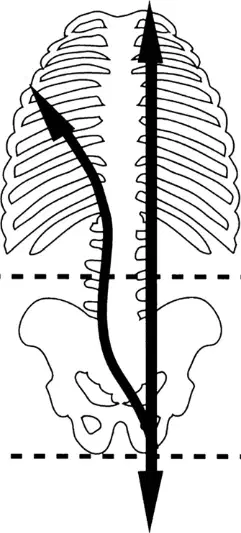
Figure 3 shows the deep longitudinal system: erector spinae, deep laminae of the thoracodorsal fascia, sacrotuberous ligament and biceps femoris. Where on the figure is the sacrotuberous ligament located?
At the top of the figure, connecting to the spine
In the middle of the figure, depicted as a horizontal structure
At the bottom of the figure, connecting the pelvis to the femur
Not depicted in the figure
According to the summary, what is NOT one of the components that contribute to lengthening myofascial components that contribute to excessive lumbar lordosis, anterior pelvic tilt, and joint subluxity?
Mobilizing the SIJ and/or the anterior hip pelvic oblique
Inhibiting receptors and facilitating gluteus maximus to stimulate joint proprioceptor activity
Facilitating exercises for the lumbar-pelvic stabiliser muscles
Increasing the tensile stress on the gluteus maximus and/or hip abductors
What is the focus of the research mentioned in the summary regarding hamstring strain rehabilitation and addressing scar tissue formation?
Increasing the tensile stress on the biceps femoris origin
Addressing the muscle imbalance and facilitating exercises for the lumbar-pelvic stabiliser
Stretching the lumbar-pelvic stabiliser muscles
Facilitating exercises for the hamstring flexibility
Which publication is referenced for the concept of "Stability, Sport and Performance Movement: Great Technique Without Injury"?
Janda, V., 1978. Muscles, central nervous motor regulation and back problems. In: Korr, I. (Ed.), The Neurobiological Mechanisms in Manipulative Therapy. Plenum Press, New York.
Elijthongton, J., 2008. Stability, Sport and Performance Movement: Great Technique Without Injury. North Atlantic Books, California.
Liebenson, C., 2005. Rehabilitation of the Spine: A Practitioner's Manual, second ed. Lippincott Williams & Wilkins, Philadelphia.
Vleeming, A., et al., 1989a. The sacroiliac joint: clinical approach to its dynamic role in stability and function. In: Vleeming, A., et al. (Eds.), Movement, Stability and Low Back Pain. Churchill Livingstone, Edinburgh.

