
 Worksheets
Steering Systems LVL 2
Total questions: 52
Worksheet time: 3hrs 38mins
Technician A says that paying attention to tires and wheels can also assist in identifying problems in the steering system. Technician B says that paying attention to tires and wheels can also assist in identifying problems in the suspension system. Who is correct?
Tech A
Tech B
Both Techs
Neither Tech
The ___________________ keeps constant electrical contact with the air bag as the steering wheel is turned from lock to lock.
A) rotary spring
B) coil spring
C) leaf spring
D) clock spring
Tech A says that you can use any fluid in a power steering pump, as they are all the same. Tech B says that you must use the correct type and brand of fluid by manufacturer. Who is correct?
A) Tech A
B) Tech B
C) Both Techs A and B
D) Neither Tech A nor B
Which statement best describes camber?
The forward or backwards tilt of the road wheel from the vertical line when looked at from the vehicle side.
The lean inwards or outwards of the top of the wheel from the vehicle centre.
The alignment of the rear axle when compared with the front axle
Which image best shows toe?


Why is KPI?
Kingpin inclination
Kingpin incline
Kastor placed insert
King position insert
The correct definition of KPI is?
The distance travelled when a vehicle turns.
The angle formed between a vertical line and the inward tilt of the macpherson strut or hub assembly.
The term given when a pair of wheels are closer together at he front than the back.
What is slip angle?
The angle between a rolling wheels actual direction of travel and the direction towards it is pointing.
A measurement taken to confirm the rear axel is parallel to the front axle.
The angle formed between a vertical line and the inward tilt of the macpherson strut or hub assembly.
Tyre wear on the outer edge may indicate?
Excessive positive castor.
Excessive positive camber.
Excessive negative camber
What does a Steering angle sensor measure?
Steering wheel position.
Steering wheel position angle and rate of turn.
Steering full lock and straight ahead position.
What happens when a steering angle sensor fails?
The driver will notice the steering get heavy.
The Traction control light will illuminate and the steering may become lighter.
The steering will revert to normal non power assisted steering.
Possible causes of loose steering are:
Loose front wheel bearings
Worn ball joints
Worn tie-rod ends
All the above
Possible causes of heavy steering are:
Power steering inoperative
Tight steering box adjustment
Flat tires
All the above
Possible causes of steering shimmy are:
Unbalanced wheels
Loose linkage connections
Incorrect wheel alignment
All the above
After replacing a steering or suspension component, it is vital that the steering alignment is checked and adjusted to meet manufacturer's requirements.
False
True

The Ackerman Principle refers to steering geometry, it was designed to avoid the need for tyres to slip sideways when following the path around a curve.
False
True

The higher the caster, the less stability a vehicle will have at higher speeds. Higher caster equals more responsive handling.
True
False
A driver complains of steering wheel 'shimmy' that gets worse as the vehicle's speed increases. This most likely indicates:
the tyre pressures are too high
the front wheels need balancing
the wheel alignment needs adjusting
the shock absorbers need replacing
In relation to steering, 'oversteer' is produced during cornering when the:
rear wheels of a car are carrying much less load than the front wheels
slip angles of the rear tyres are larger than the slip angles of the front tyres
slip angles of the rear tyres are smaller than the slip angles of the front tyres
slip angles of the front tyres are the same as the slip angles of the rear tyres
In relation to steering geometry, the purpose of the 'castor angle' is to:
provide centre point steering layout
provide toe-out on turns when cornering
allow for the deflection of the wheels
provide self centering of the steering

When the toe is at the correct angle, there’s less friction on the tires as they roll. When they are facing away from each other (toe-out) or toward each other (toe-in), they’re essentially scrubbing on the road ever so slightly with every passing mile.
False
True
In relation to checking and adjusting the front wheel alignment which of the following is NOT true?
Adjustments must be made equally to both track rods
You should remove any very heavy loads from the boot
You should check the tyre pressures are correct
Buckled wheels will not affect the wheel alignment
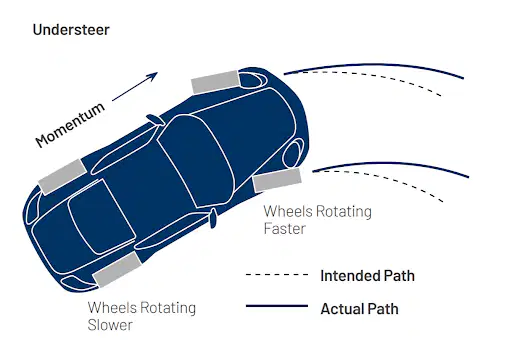
In relation to vehicle behaviour during cornering ‘understeer’ is when the:
slip angles of the front tyres are larger than the slip angles of the rear tyres
slip angles of the rear tyres are smaller than the slip angles of the front tyres
slip angles of the front tyres are the same as the slip angles of the rear tyres
rear wheels of a vehicle are carrying much less load than the front wheels
In a hydraulic Power Assisted Steering system (PAS), what are the fluid pipes from the power steering pump connected to?
The power steering rack's control valve.
The steering wheel.
The steering column.
The hydraulic actuator.
The steering column has a sliding shaft that will slide into itself in the event of an accident, and the column housing mounting points are designed to allow the column to slip downward as the driver makes contact with the steering wheel.
Select one:
True
False
The Alignment angle that is affected by replacing Tie Rods is
Camber
Caster
Toe
Pivot
A test used to check for play in the linkage or rack and pinion is a _____
Dry park test
Road side test
A bounce test
removal of tie rods and check for play
A(n) ______________________________ rack-and-pinion power steering system senses vehicle speed and steering load to provide adequate road feel for the driver.
Proportional
Variable
Computerized
Standard
Which of the following is not a function of the steering system?
Minimize body roll when cornering rapidly.
Provide directional control for vehicle.
Transmit "road feel" to the driver.
Maintain correct level of effort needed to turn front wheels
When front wheel is inclined inward at uppermost, this is known as:
Negative Camber
Positive Camber
Negative Caster
Positive Caster
Positive caster is when?
The swivel axis meets road in front of vertical
The swivel axis meets road behind the vertical
The wheels stick out at top
The wheels lean in at the top
If a vehicle has positive toe. This means:
The car has Toe in & RWD
The car has Toe out & RWD
The car has Toe in FWD
The car has Toe out & FWD
Which angle is viewed from front of Car?
Tracking
Caster
Camber
Thrust
Which angle is checked viewing car from side?
Tracking
Caster
Camber
Thrust
Tires, wheels, and axle housings make up the major portion of a vehicle’s unsprung weight.
True
False
Which of these components directs fluid to the rack piston based on driver input?
Steering gear
Flow control valve
Pressure relief valve
Rotary valve
Which sensor is the main input sensor for the PSCM?
Torque sensor
Steering wheel angle
Rack to gear position
Steering wheel rotation
What controls EPAS operation?
PCM
PSCM
BCM
SCCM
Tech A says that the clock spring (spiral cable) assists the turning of the steering wheel on vehicles with EPS. Tech B says that the clock spring is used to transmit an electrical signal to the driver's side airbag. Who is correct?
Tech A
Tech B
Both A and B
Neither A nor B
The _________ keeps the shock forces from being transmitted through the steering linkage and back to the steering wheel.
Steering shock
Steering angle sensor
Steering boot
Steering damper
5 . What is Track Width?
A. The widest part of a tire's tread
B. The distance between the centers of the front and rear hubs
C. The distance between the ends of the front wheel spindles
D. The distance between the centers of the fronts of the tires
6 . The benefit of using different length control arms in SLA systems is what?
A. It eliminates tire scrub
B. It works better with Rack & Pinion Steering
C. It insures that the turning radius are the same for both wheel
D. It makes it possible to use power steering

