
 Worksheets
Earth and Space
Total questions: 25
Worksheet time: 15mins
Select the pair of bodies which are most alike in composition and size.
Earth and Venus
meteor and comet
Earth and Neptune
asteroid and comet
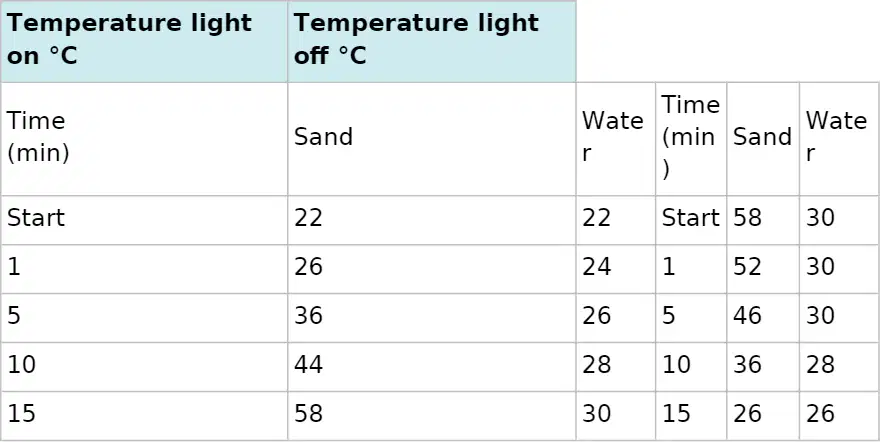
Based on the data provided in the "Change in Temperature" table, analyze the differences in temperature changes for sand and water when the light is on and off.
Based on this data, we would expect (a) to have the greatest changes in temperatures during a 24-hour period.
Why are coastal areas cooler during the day than inland areas?
It rains during the day in coastal areas.
A cool breeze blows from the sea during the day.
Coastal areas experience storms every other day.
The sea absorbs the heat of the air over coastal areas.
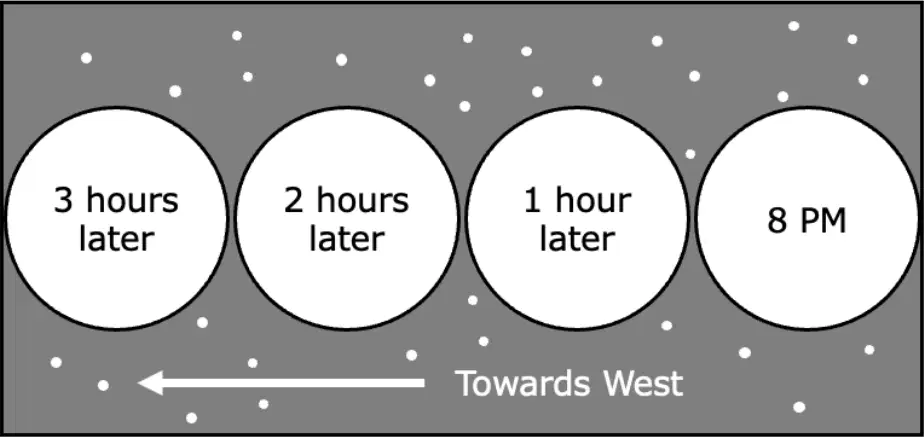
One night Katrina was studying the position of the stars and the Moon in the sky. She made a sketch of the position of the Moon in the sky, as shown in the figure. What is the reason for this movement of the Moon in the sky?
The rotation of Earth about its axis
Earth's orbital motion around the Sun
The Moon's orbital motion around Earth
The rotation of the Moon about its axis
Unlike Earth, the planet Mars cannot support life. To give the planet Mars the ability to support life like on Earth, we would have to find a way to change the planet's _______.
atmosphere
size
surface
temperature
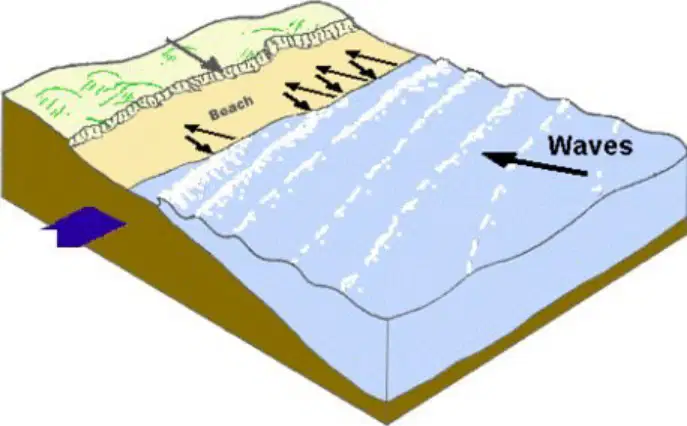
Look at the drawing of a beach. How do the waves change the beach?
They divide the beach in half.
They build sand hills on the beach.
They deposit and wash away the sand.
They increase the plants at the shoreline.
What climate is characterized by constant high temperatures at sea level with an average temperature of 18°C or higher, and is found near the equator?
arid
tropical
Compared to ALL of the other planets in our solar system, how would you describe Jupiter?
the biggest planet
about the same size as Earth
the planet closest to the Earth
the planet farthest from the Sun
In order for water to collect in Earth's atmosphere and form clouds, it must first undergo what process?
precipitation
condensation
dew
evaporation
Clouds are made up of water droplets. When water droplets become too heavy, gravity causes the droplets to fall from the clouds. What is the name for water droplets that fall from clouds?
condensation
convection
evaporation
precipitation

This question is associated with a table that lists the Name of Star, Distance from Earth, Color, Size, and Temperature. The provided information is for The Sun.
because the sun is yellow and the brightest
the sun is the closest star to earth and seems the brightest to us
The Milky Way galaxy contains between 200 and 400 billion stars. The table tells us about three of these stars. Based on the data, what statement is true?
Medium dwarf stars are larger and brighter than red dwarf stars.
Proxima Centauri is hotter and brighter than the other two stars.
Because the Sun is yellow, it is the brightest of the three stars.
The Sun is the closest star to Earth and seems the brightest to us.
Think about all the damage that hurricanes can cause. Which of these actions would prevent the most hurricane wind damage to a home?
digging a trench around the entire home
clearing gutters of leaves and other debris
placing bags of sand in front of all the doors
removing any trees that could fall on the roof
Which statement BEST describes the relationships between the Sun, Moon, and Earth?
Which statement BEST explains the Sun's role in creating condensation during the water cycle?
The Sun heats the air near Earth's surface. Water vapor condenses when it reaches the cooler air rising.
The Sun heats up Earth's water, causing it to sink lower into the ground. Gravity pulls water downward as its temperature increases.
Most evaporation occurs at night, because the temperature drops when the Sun goes down. Water mixes with air as the temperature decreases.
Water changes to water vapor when the Sun's light reflects off of water surfaces on Earth. The reflected light mixes with the vapor created.
The direction wind blows is one of the many factors that determine weather. Choose THREE correct statements related to wind direction.
Wind traveling from a warm place, like the equator, carries warm air.
Wind traveling from cold places, like the North Pole, carries warm air.
Wind traveling over water carries dry air to land, creating clouds and fog.
wind is created when air moves from areas of high pressure to low pressure
wind traveling from cold places like the north pole carries warm air
Humans use both renewable and nonrenewable resources for energy. Choose TWO examples of nonrenewable resources used for energy.
natural gas
coal for electricity
windmills
solar panels
Identify THREE of the statements that are true about the inner planets of our solar system.
None of the inner planets have moons.
Saturn is not considered one of the inner planets.
The inner planets are made mostly of rocky material.
The two planets closest to Earth are also inner planets.
The five planets closest to the Sun make up the inner planets.
Precipitation, transpiration, evaporation, freezing, melting, and condensation are all part of the water cycle. Most of the global evaporation of water into Earth's atmosphere occurs where?
at the equator
over the oceans
over bodies of freshwater
at the North and South poles
Jacorian collected a variety of interesting rocks on his hike, and he would like to use a chart he found online to determine the kinds of rocks he found. Which list contains attributes that would BEST help Jacorian classify his bag of rocks?
scent, sharpness, cracking, luster
color, texture, luster, and hardness
melting point, hardness, flammability
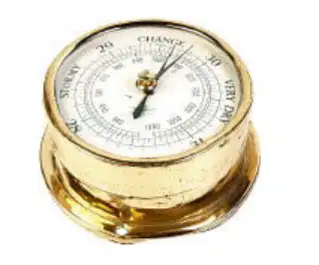
Barometers have long been used to predict the weather. Jay and Jeff were responsible for recording the class weather data each day in March. One day, they noticed that there was a rapid change in the barometric pressure. The barometric pressure dropped down very, very quickly. What type of weather could Jay and Jeff expect soon?
fog
rain
clearing
drop in temperature
Which layer of the Earth is composed mostly of solid rock and includes both the crust and the upper part of the mantle?
Inner Core
Outer Core
Lithosphere
Asthenosphere
What process describes the movement of water from the Earth's surface to the atmosphere and back again, including evaporation, condensation, and precipitation?
Carbon Cycle
Water Cycle
Nitrogen Cycle
Rock Cycle
Which of the following is a renewable energy source derived from organic materials such as plants and animal waste?
Solar energy
Wind energy
Biomass energy
Geothermal energy

