
 Worksheets
Physics Semester 2 Midterm Study Guide
Total questions: 35
Worksheet time: 44mins
Click and drag the LABELS to its appropriate place in the drawing
Charging by Friction
RECEIVED electrons
GAVE AWAY electrons
Categorize each object as Conductor, Insulator, Semiconductors, or None


What are these balloons doing?
Attract
Repel
Nothing

Rubbing your hair with a balloon and causing it to stand up is an example of...
Friction
Induction
Conduction
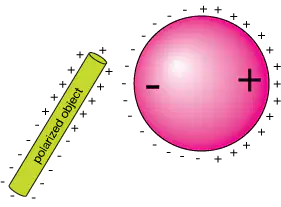
Electric charge is neither created nor destroyed, but can be transferred back and forth between objects.
true
false
Two students are trying to decide whether or not Object A is charged. They perform the following two tests:
Test 1: They bring Object A near a positively charged tape and observe repulsion.
Test 2: They bring Object A near a negatively charged tape and observe attraction.
These two tests lead to the conclusion that Object A is _____.
charged negatively
charged positively
electrically neutral
charged, but with an unknown type of charge
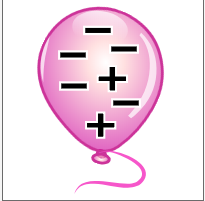
This model of the balloon shows ______ positive charges than negative charges. So this balloon is _____ charged.
fewer/positively
more/positively
fewer/negatively
more/negatively
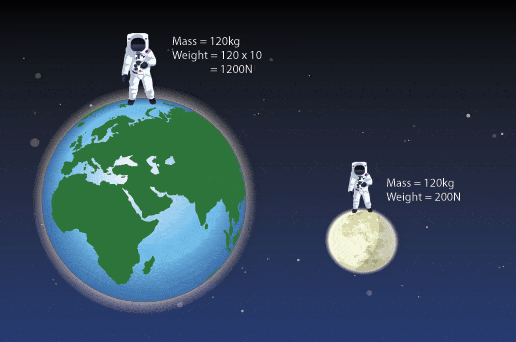
Which of the following will NOT change in different gravitational fields?

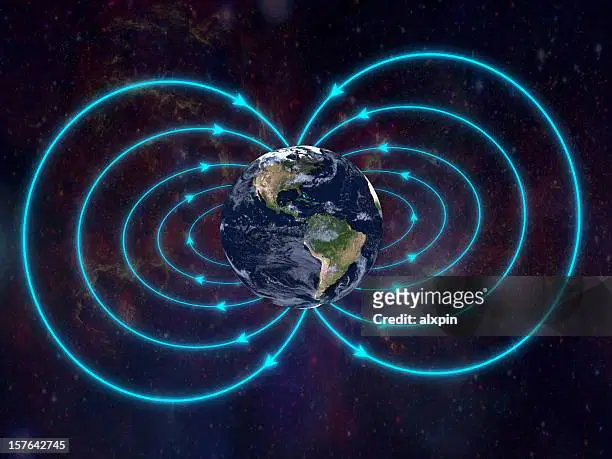
Electric field lines go OUT of (a) charge, and INTO (b) charge.

Which diagram correctly shows the electric field around a POSITIVE charge?
A
B

Which diagram correctly shows the ATTRACTION between 2 OPPOSITE charges?
A
B
Both
Neither
Which diagram correctly shows the REPULSION between between 2 IDENTICAL/LIKE charges?
A
B
Both
Neither
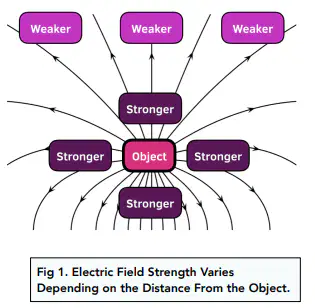
The Electric Field gets STRONGER when the distance is (a) , and WEAKER when the distance is (b) .
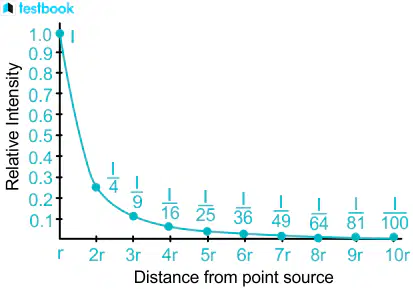
What happens to the force between two charged objects when you DOUBLE (2x) the distance between them?
2X
1/2X
4X
1/4X
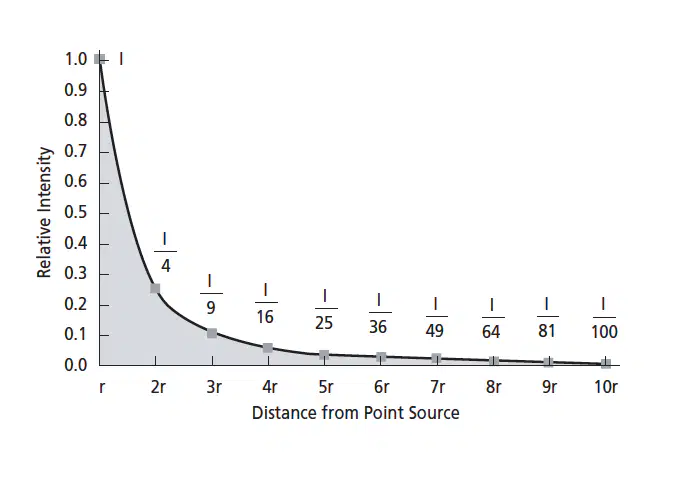
As distance between two objects INCREASE the pull of gravity will __________.
Increases
Decreases
Stays the same
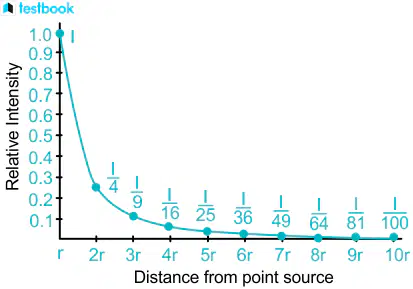
What would be the difference in your weight if you were 5x farther from the center of the earth than you are now?
1/5
1/10
1/25
1/100
Drag and drop the inverse square fractions to their correct place at different distances from the source
1
1/4
1/9

According to Inverse Square Law, the strength of the gravitational/electricity fields will get (a) when distance is increased. For example, if the distance is doubled or increased by 2x, the field will get weaker by (b) . If the distance is increased by 3x, then the field will get weaker by (c) .

As the distance from the source increases, will the field strength ever reaches 0 (zero)? Hint: the x axis is an asymptote)
Yes! There will be a distance where gravity or electricity will be 0
No! The field will get weaker and weaker but will never disappear.
Which is the missing isotope that will balance the following nuclear equation?
94Be + 11H → _____ + 42He
105B
105Ne
63Li
63C
Balance the following equation:
146C --> 0-1e + ________
145B
146C
147N
42He
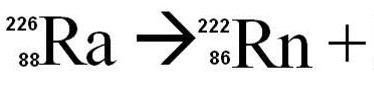

alpha

beta

gamma

Label these parts of a wave
Crest
Trough
Amplitude
Wavelength
Label which side of the Light Wave Spectrum have low or high ENERGY
Low Energy/Not dangerous
High Energy/Dangerous!
Label which side of the Light Wave Spectrum have NON-INONIZING and IONIZING energy
NON-IONIZING/not dangerous
IONIZING/Dangerous!
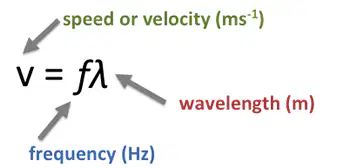
Wave speed depends on which variable(s)?
wavelength only
frequency only
amplitude
frequency and wavelength

A sound wave travels at a speed of 352 m/s. What is its wavelength (m) if it has a frequency of 880 Hz?
(a)
A guitar string vibrates at a frequency of 100 Hz. What is the wavelength (m) of the sound wave if the speed of sound is 150 m/s?
(a)
What is the frequency (Hz) of a wave traveling at 300 m/s with a 4 m wavelength?
(a)
A wave has wavelength of 10.0 m and a speed of 340 m/s. What is the frequency (Hz) of the wave?
(a)
A wave has frequency of 5 Hz and a speed of 25 m/s. What is the wavelength (m) of the wave?
(a)
A wave has frequency of 50 Hz and a wavelength of 10 m. What is the speed (m/s) of the wave?
(a)

