Wayground logo

Free Printable Worksheets

Font size

S
M
L
XL
Worksheets

Plate Tectonics

Total questions: 50

Worksheet time: 35mins

Name
Class
Date
1.

​ (a)   was proposed by ​ (b)   and suggested that the ​ (c)   are in constant motion.

Choose from the below words
Continental drift
Alfred Wegener
continents
Harry Hess
Seafloor Spreading
oceans
2.

The earth's plates, rigid slabs of rock, "float" on the ___ .

a)

asthenosphere

b)

lithosphere

c)

mantle

d)

granitic rock

3.

The earth's outer shell is divided into slabs of rock called ______ .

a)

continental plates

b)

crustal plates

c)

trench plates

d)

tectonic plates

4.

Place each label in the correct category.

Categorize the following

older

granite

less dense

younger

basalt

constantly recycles

thinner

denser
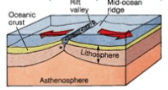
Continental Crust
Oceanic Crust
5.

Match the following

a)
1.

divergent

b)
2.

convergent

c)
3.

transform

6.

Match the following

a)
1.

new crust is created

b)
2.

oceanic crust is destroyed

c)
3.

neither constructive or destructive

7.

At which plate boundary is new crust formed?

a)

divergent

b)

convergent

c)

continental

d)

transform

8.

What type of crusts are involved when one plate subducts beneath another?

a)

continental and continental

b)

oceanic and continental

c)

oceanic and divergent

d)

continental and convergent

9.

What types of landforms are formed at convergent boundaries?

PICK TWO

a)

volcanoes

b)

new crust

c)

Trenches

d)

rift valley

10.

What is the WHOLE AREA called where the oceanic crust goes beneath the continental crust?

a)

subtraction zone

b)

section zone

c)

secondary zone

d)

subduction zone

11.

At which boundary is crust neither consumed or created?

a)

divergent

b)

convergent

c)

transform

d)

oceanic

12.

Drag the labels to the correct the locations on the diagram.

13.

The majority of the world's earthquakes and volcanoes occur along the _ .

(a)  

14.

Select ALL the reasons for plate movement.

a)

Polar Reversal

b)

Convection Currents

c)

Ridge Push

d)

Slab Pull

15.
The hot, plastic-like layer of Earth, made of magma. 
a)
Inner Core
b)
Mantle
c)
Crust
d)
Outer Core
16.
The hot, liquid layer of Earth, made of iron and nickel.
a)
Inner Core
b)
Mantle
c)
Crust
d)
Outer Core
17.
The dense, solid center of Earth, made of iron and nickel.
a)
Inner Core
b)
Mantle
c)
Crust
d)
Outer Core
18.
The boundary between two plates that collide with one another.
a)
Divergent Plate Boundary
b)
Convergent Plate Boundary
c)
Transform Plate Boundary
d)
Subversive Plate Boundary
19.
The boundary between two plates that pull apart from one another.
a)
Divergent Plate Boundary
b)
Convergent Plate Boundary
c)
Transform Plate Boundary
d)
Subversive Plate Boundary
20.
The boundary between two plates that slide past one another. 
a)
Divergent Plate Boundary
b)
Convergent Plate Boundary
c)
Transform Plate Boundary
d)
Subversive Plate Boundary
21.
When two plates collide and one plate slips below the other and down into the mantle. 
a)
Subduction
b)
Erosion
c)
Deposition
d)
Convection
22.
What happens in a liquid or gas when the warmer parts rise and the cooler parts sink.
a)
Subduction
b)
Erosion
c)
Deposition
d)
Convection
23.

The place inside the earth where an earthquake begins.

a)
Fault
b)
Epicenter
c)
Seismic Waves
d)
Focus
24.
The way in which energy during an earthquake travels through the earth.
a)
Fault
b)
Epicenter
c)
Seismic Waves
d)
Focus
25.
The cooler, outer rocky shell of Earth.
a)
Inner Core
b)
Mantle
c)
Crust
d)
Outer Core
26.
Mountains that are formed by the folding up of rock layers due to the collision of two plates
a)
Folded Mountains
b)
Dome Mountains
c)
Fault-Block Mountains
d)
Volcanic Mountains
27.

A mid-ocean RIDGE is located at the boundary of two tectonic plates. Which diagram correctly models the relative plate motion on each side of a mid ocean ridge?

a)
b)
c)
d)
28.

The San Andreas fault is a transform fault. The map below shows a student's approximation of where the fault line crosses through the United States. Students were asked to make maps predicting which way land would most likely move over thousands of years.

a)
b)
c)
d)
29.

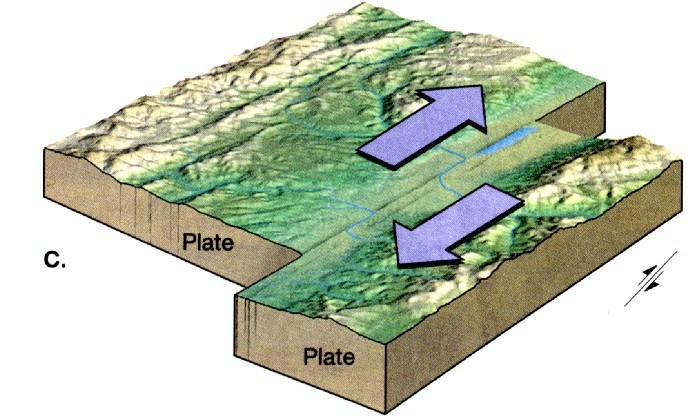
The image shows a plate boundary. Arrows have been added to indicate the movement of the plates.What plate boundary feature is also shown?

a)

A ridge formed by an inactive convergent boundary

b)

A valley forming at an active divergent boundary

c)

A fault forming at an active transform boundary

d)

A volcano formed by an active transform boundary

30.

This landform can occur at a divergent plate boundary.

a)

ocean trench

b)

mid-ocean ridge

c)

tall mountains

d)

transform fault

31.

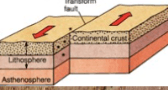
The model below shows two continental plates. What type of plate boundary is this

a)

Transform boundary

b)

Divergent boundary

c)

Subduction boundary

d)

Convergent boundary

32.

Which student correctly identified the geologic process that formed the Himalayan mountains?

a)

1

b)

2

c)

3

d)

4

33.
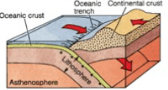
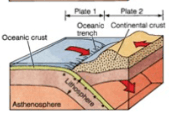
What type of plate boundary is this?
a)
Transform
b)
Convergent
c)
Divergent
d)
Plate
34.

What landform would most likely form at this plate boundary? Choose 2 correct answers.

a)

mountains

b)

volcanoes

c)

trenches

d)

mid-ocean ridges

35.
The area around the Pacific Ocean where lots of earthquakes and volcanoes happen is called the ____________.
a)
Ring of Earth
b)
Ring of Fire
c)
Ring of Stone
d)
Ring of Diamond
36.
Scientists hypothesize that a super continent existed 200 million years ago.  This continent is called
a)
America
b)
Super Earth
c)
Pangea
d)
Eurasia
37.
The image illustrates what type of boundary?
a)
Divergent
b)
Convergent
c)
Transform
d)
Emergent
38.
As you approach the center of the earth what happens to the temperature, pressure , and density.
a)
They all increase
b)
They all decrease
c)
They remain the same
d)
They disappear
39.
Which layer is molten nickel and iron?
a)
Crust
b)
Mantle
c)
Outer core
d)
Inner core
40.
Which layer is the thinnest?
a)
Crust
b)
Mantle
c)
Outer core
d)
Inner core
41.
Which layer is contains the convection currents?
a)
Asthenosphere
b)
Lithosphere
c)
Mesosphere
42.
Which layer includes the crust and the upper mantle?
a)
Asthenosphere
b)
Lithosphere
c)
Mesosphere
43.
What is the correct order from the center of the earth to the surface of the earth?
a)
Crust, Mantle, Inner core , Outer core
b)
Crust, Mantle, Outer core , Inner core
c)
Inner core, Outer core, mantle, crust
d)
Outer core , Inner core, Mantle, Crust
44.
Volcanoes found away from plate boundaries, such as Hawaii, are known as 
a)
hot spots
b)
calderas
c)
trenches
d)
mid-ocean ridges
45.
Scientists rejected the Theory of Continental Drift at first because
a)
they couldn't understand his theory
b)
Pangaea happened so long ago
c)
Alfred Wegener was a meteorologist
d)
convection currents were unknown
46.
What takes place because of sea-floor spreading?
a)
Crust is recycled.
b)
Crust is created.
c)
The ocean is evaporated.
d)
The sea floor remains unchanged.
47.
A normal fault occurs because of 
a)
tension
b)
compression
c)
shearing
48.
A reverse fault occurs because of 
a)
tension
b)
compression
c)
shearing
49.
A strike-slip fault occurs because of 
a)
tension
b)
compression
c)
shearing
50.
The focus of an earthquake is 
a)
above the epicenter
b)
the epicenter
c)
below the epicenter
d)
next to the epicenter