
 Worksheets
IA1 Questions
Total questions: 92
Worksheet time: 46mins
Which sphere of the Earth is primarily composed of water and includes oceans, rivers, and lakes?
Litho
Atmo
Hydro
Bio
Which sphere of the Earth includes the various layers of gases that surround the planet?
Litho
Atmo
Hydro
Bio
Which sphere of the Earth is made up of all the living organisms?
Litho
Atmo
Hydro
Bio
Which sphere of the Earth consists of the solid crust and the uppermost mantle?
Litho
Atmo
Hydro
Bio
What skills are students expected to apply to communicate their understanding of land cover change and climate change according to the unit objectives?
Cartographic, graphic, written, and mathematical skills
Programming, coding, and software development skills
Artistic, creative, and design skills
Legal, administrative, and compliance skills
Which tools are permitted during the examination according to the conditions listed?
Non-programmable calculators
Rulers with markings
Programmable calculators
Rulers without any markings
What is land cover and how is it distributed?
The physical and biological material found on the surface of the land, distributed evenly across the globe
The physical and biological material found on the surface of the land, distributed based on climate zones
The artificial structures built by humans, distributed mainly in urban areas
The water bodies that cover the Earth, distributed based on human activities
What processes connect the Earth’s physical systems and affect land cover?
Biological processes such as photosynthesis and respiration
Geological processes like erosion and sedimentation
Human processes including urbanization and deforestation
All of the above
What are the different types of land cover?
Vegetation biomes, biogeographic areas, anthropogenic biomes
Urban, rural, and wilderness areas
Forests, deserts, and oceans
Residential, commercial, and industrial zones
How do population growth, an increase in affluence, and technology impact land cover?
They have no significant impact on land cover
They lead to a decrease in land cover diversity
They contribute to changes in land cover through increased demand for resources and space
They improve the quality of land cover by promoting conservation efforts
How do human activities like settlements, croplands, rangelands, and forestry transform land cover surfaces?
By maintaining the natural state of the land cover
By increasing the biodiversity of the land cover
By altering the natural land cover to meet human needs
By reducing the economic value of the land
How do human induced transformations impact upon the Earth’s systems?
They have no impact on the Earth's systems
They improve the stability of the Earth's systems
They disrupt the balance and functioning of the Earth's systems
They increase the Earth's capacity to support life
What are global climatic systems?
Systems that regulate the distribution of ice cream flavors around the world
Systems that control the worldwide distribution of technology
Systems that determine the economic policies of countries
Systems that influence the weather patterns and climate around the world
What is climate change and how does it impact land cover types?
Climate change is a stable pattern in weather conditions, having no impact on land cover types
Climate change refers to long-term alterations in temperature and weather patterns, which can lead to changes in land cover types
Climate change is a term for political policies on the environment, indirectly affecting land cover types
Climate change is a new technology for improving land cover types
What are the implications of climate change on people and the environment and how might people best respond to them?
Climate change has minimal implications, and no response is necessary
Climate change benefits the environment, and people should promote it
Climate change poses challenges to people and the environment, and people should adapt and mitigate its effects
Climate change only affects remote areas, and people should focus on urban development

Identify three natural features visible in the image provided.
River, forest, mountain
Canal, park, skyscraper
Ocean, desert, highway
Beach, river, forest

Identify three human-made features visible in the image provided.
Houses, roads, canals
Trees, mountains, clouds
Rivers, lakes, oceans
Forests, beaches, wildlife

Explain one potential negative environmental consequence of the human features shown in the image.
Increased wildlife habitats due to urban development
Improved air quality due to industrialization
Reduced water pollution with the construction of canals
Habitat fragmentation and loss due to urban expansion
Biomes are defined as:
The world's smallest ecological zones
The world's major communities, classified according to the predominant vegetation and characterized by adaptations of organisms to that particular environment
The classification of the world's water bodies
The different layers of the Earth's atmosphere
What is the basis for classifying climatic zones on our planet?
The types of animals found in each zone
The cultural practices of human societies in each zone
The temperature and precipitation over the seasons
The mineral composition of the soil in each zone
What is the current global population ?
Nearly 6 billion
Almost 8 billion
Over 9 billion
About 7 billion
By how much is the global population increasing yearly?
60 million
70 million
80 million
90 million
What is the daily increase in the global population?
120,000 each day
100,000 each day
80,000 each day
150,000 each day
What has the population growth led to an increased need for?
Food, water, and shelter only
Technological goods and energy only
Infrastructure only
Food, water, shelter, basic resources, industrial and technological goods, energy, and infrastructure
What has escalated in terms of exploitation of Earth's resources?
The level and intensity of exploitation
The number of resources available
The rate of renewable resource generation
The efficiency of resource usage
Why must a balance be found in resource usage?
To increase the exploitation of resources
To ensure a sustainable supply
To reduce the cost of resources
To promote industrialization
What additional issue needs to be dealt with due to overexploitation of resources?
Economic growth
Climate change
Technological advancement
Urban development
Which of the following is NOT a recent consequence of climate change?
More severe and destructive weather events
Longer and hotter periods
Decreased frequency of catastrophic wildfires
Inundation of coastal wetlands and low-lying islands
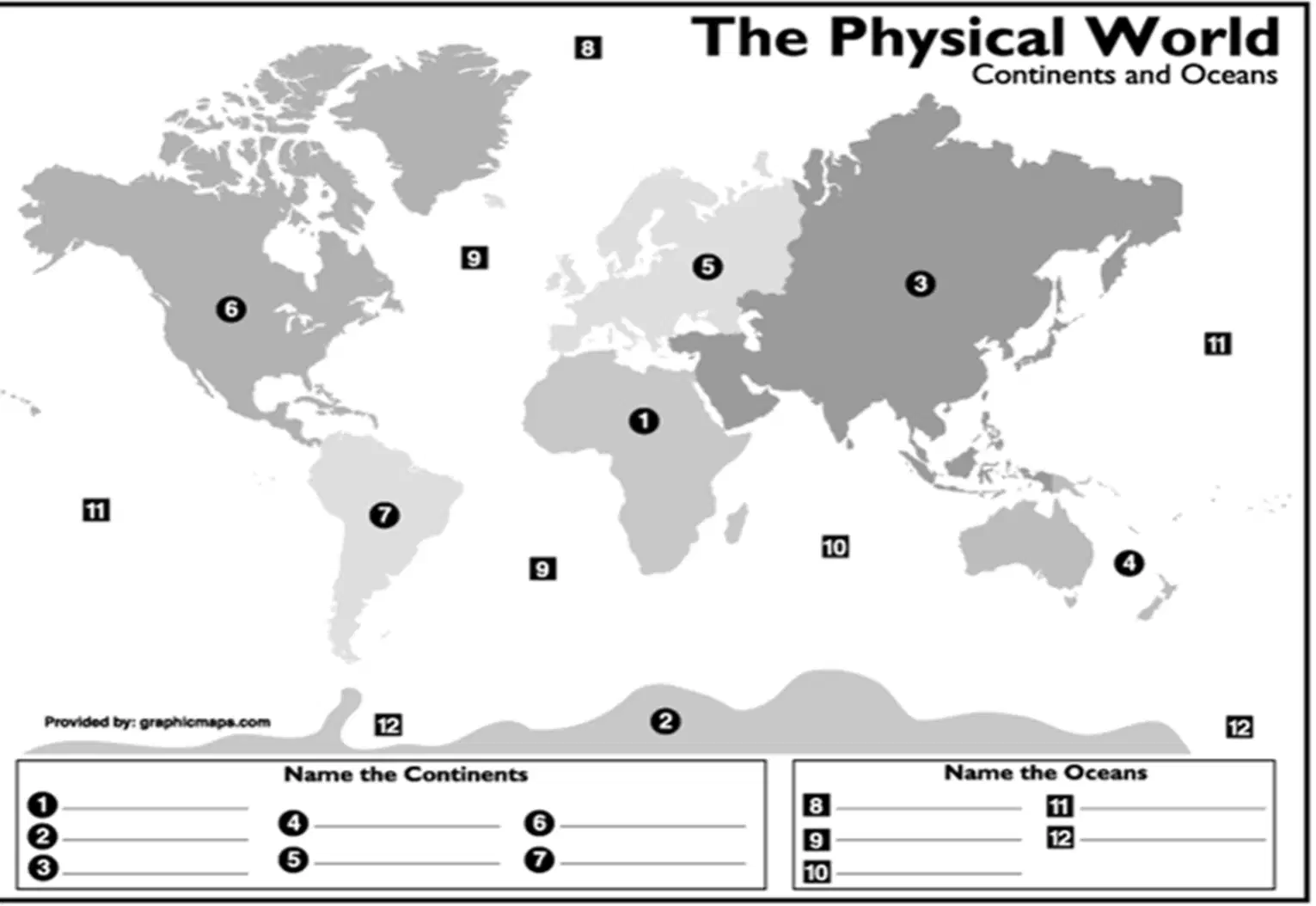
Which number corresponds to the continent of Africa on the map?
3
5
7
9

Which number corresponds to the Pacific Ocean on the map?
8
10
11
12

Which number corresponds to the continent of South America on the map?
1
6
7
9

Which number corresponds to the Atlantic Ocean on the map?
2
8
9
12
What does land cover refer to?
The process by which land is used for urban development
The type of natural resources found within the land
Literally what is covering the land (e.g., vegetation, human infrastructure or development, agriculture or bare earth)
The legal ownership of land
Approximately what percentage of the Earth's surface is covered by land?
50%
30%
70%
10%
How many large landmasses, or continents, are there on Earth?
5
6
7
8
Which continent has the largest land area and population?
Europe
Asia
Africa
North America
Which continent is the second largest in terms of land area?
South America
Antarctica
Africa
Australia

Which color represents 'Tundra' biomes on the map?
Purple
Green
Red
Orange

Which biome is most prevalent around the equator according to the map?
Taiga
Tundra
Tropical rainforest
Steppe
Where are 'Ice sheet and polar desert' biomes mainly located according to the map?
At the equator
In the central parts of continents
Near the Arctic and Antarctic circles
Along the coastlines

Which biome is characterized by both high average annual precipitation and high average annual temperature according to Figure 1?
Boreal forest
Desert
Grassland
Tropical rainforest

Based on Figure 1, which biome has the lowest average annual temperature?
Temperate deciduous forest
Tundra
Temperate rainforest
Grassland

According to Figure 1, which biome is likely to have the least amount of average annual precipitation?
Desert
Tropical rainforest
Boreal forest
Temperate rainforest
What does the term 'land use' refer to?
The legal ownership of land
The natural features present on the land
The way people utilize an area for economic, social, or cultural purposes
The process of changing the natural land cover to urban areas

What term is used to describe biomes that have been influenced by human activity according to the map?
Natural biomes
Anthropogenic biomes
Uninhabited biomes
Indigenous biomes
What is an example of a common term for "Cropland, rainfed" according to the ESA classification?
Wetland, mangroves and forests that grow in water
Farming areas that rely on rainfall for water supply
Snowfields, glaciers and ice caps
Rangelands used for extensive animal grazing
Which ESA classification would be associated with "Wetland, mangroves and forests that grow in water"?
Cropland, irrigated
Urban areas
Tree cover, flooded
Saline water
True or False: Approximately 35 per cent of land is covered by some form of tree or forest cover.
True
False
True or False: Urban and artificial areas account for approximately 2 per cent of land cover.
True
False
If global air temperatures continue to increase, which land cover is most at risk of decreasing?
Forestry
Grassland
Barren land
Inland water bodies
What is the estimated volume of water contained in the Earth's oceans?
1.35 million km³
1.35 billion km³
135 million km³
13.5 billion km³
How much of the Earth's surface is covered by oceans?
50%
60%
70%
80%
Which of the following is not one of the four major oceans?
Pacific Ocean
Atlantic Ocean
Indian Ocean
Baltic Sea
Where is the Southern Ocean located in relation to latitude?
North of 60 degree latitude
South of 60 degree latitude
At the equator
South of the equator but not defined by latitude
Why do oceans absorb a significant amount of the sun's heat?
Because of the small area of the world's oceans
Because of the vast area of the world's oceans
Because the oceans are shallow
Because the oceans are made of fresh water
Compared to ocean water, how does continental land react to heat?
Land heats up and cools down more quickly than ocean water
Land retains warmth longer than ocean water
Land and ocean water heat up and cool down at the same rate
Land cannot retain heat
How do oceans transfer heat to the atmosphere?
Through evaporation only
By powerful convectional currents
By radiation only
Through conduction only
What is the role of oceans in the exchange of heat and moisture between physical systems?
They play a minor role in the exchange
They have no role in the exchange
They play a key role in the exchange
They only exchange moisture but not heat
Are all oceans connected?
No, each ocean is an isolated system
Yes, but only two oceans are connected
Yes, all oceans are connected and water circulates around the entire planet
No, only oceans in the same hemisphere are connected
What human activities have made oceans vulnerable?
Fishing, shipping, coastal land clearing, marine construction, and pollution
Tourism and recreation
Oceanic exploration
Underwater mining
How has the intensity and speed of human change affected marine ecosystems?
It has allowed more time for marine ecosystems to adjust
It has had no significant impact on marine ecosystems
It has given marine ecosystems little time to adjust
It has improved the resilience of marine ecosystems
What risk do the oceans face due to the overload from human-induced changes?
Improved biodiversity
Eventual collapse
Increased fish populations
More stable ecosystems
Which layer of the Earth's atmosphere is closest to the surface?
Stratosphere
Troposphere
Mesosphere
Exosphere
What is the primary cause of seasonal changes on Earth?
The Earth's rotation on its axis
The Earth's orbit around the Sun
The tilt of the Earth's axis relative to its orbit
The distance between the Earth and the Sun
How does deforestation directly affect the carbon cycle?
By increasing the amount of carbon dioxide in the atmosphere
By decreasing the Earth's temperature
By increasing oxygen production
By reducing soil erosion
What role do oceans play in regulating the Earth's climate?
They have no significant impact on climate regulation
They primarily contribute to global warming
They absorb carbon dioxide and regulate temperature
They only affect coastal climates
What is the primary cause of the greenhouse effect leading to global warming?
Deforestation
Industrial pollution
Carbon dioxide emissions from burning fossil fuels
Ozone depletion
What percentage of the Earth's water is freshwater?
About 97%
About 3%
About 23%
About 50%
Which of the following is a primary cause of deforestation?
Natural forest fires
Expansion of urban areas
Agricultural expansion
Increased precipitation
How much has the world warmed in the last 100 years?
3 degree
4degrees
1 degree
2 degrees
How does urbanization affect local ecosystems?
It increases local biodiversity by introducing new species
It has no significant impact on local ecosystems
It leads to habitat destruction and fragmentation, often reducing biodiversity
It enhances ecosystem services, improving the local environment
How much have sea levels risen over the past 100 years?
10-20cm
20-30cm
30-40cm
40-50cm
How much Arctic Sea Ice thinned since 1965?
85%
65%
75%
55%
What are the two main causes of rising sea levels?
Warmer temperatures and carbon in the atmosphere
Additional carbon and methane
Thermal expansion & additional water from melting glaciers and ice caps
Disruptions to the hydrological cycle & carbon cycles
What % of species are at risk of extinction in the next 100 years?
50%
25%
40%
10%
How many people lost their lives in a heat wave in 2003?
1000
10000
5000
50000
How many KG of CO2 is absorbed by one tree a year?
10kg
20kg
30kg
40kg
.The process of carbon being removed from the atmosphere and stored as either a solid or a liquid is....
Carbon sequestration
Carbon dioxide
Carbonic acid
Carbon dating
What % of GHG emissions are caused by deforestation?
5%
25%
15%
35%
What do we call the washing of nutrients out of soil?
Bleaching
Reaching
Erosion
Leaching
What do we call the capture of water by plants?
Interception
Deception
Globalisation
Transpiration
What % of deforestation is caused by cattle ranching?
33%
43%
53%
63%
What is the process of cutting down tress and burning the debris left?
Slash & Light
Slash & burn
Cut & burn
Cut & light
What % of the worlds terrestrial plants and animal species live in TRF's?
30%
40%
50%
60%
What does PEEL chain mean?
Point Explain Evidence Leave
Point Enter Evidence Link
Point Explain Evidence Link
Plan Evidence Explain Leave
When should PACO be used?
When the word describe is in the question
When the word distribution is in the question
When the word pattern is in the question
When there is a graph
Q & Q means use both...
Numbers and words in your answer when describing stimulus
Numbers and evidence when describing stimulus
Words and SPAG in when describing stimulus
SPAG and numbers when responding to stimulus
How many bits of evidence should we aim to use when given a stimulus?'
One
Two
Three
Four
How many of the stimulus should we try to use in Section B?
Some
Most
All
Four
How long can I spend on each question?
Depends - have to work it out
Guess
1 minute per mark
1 minute per word
LATAAKS means you do what with scatter graphs?
LOBF, accuracy, title, axis labelled, anomaly, key, scaling
Don't know
Look after tiny animals
ignore them
I MUST do what with datawrapper choropleth maps?
Make a map
Use steps in the key
Take my time
Add a scale

